Gold Has Come Down. Apparently, Your Watch Hasn’t Heard.
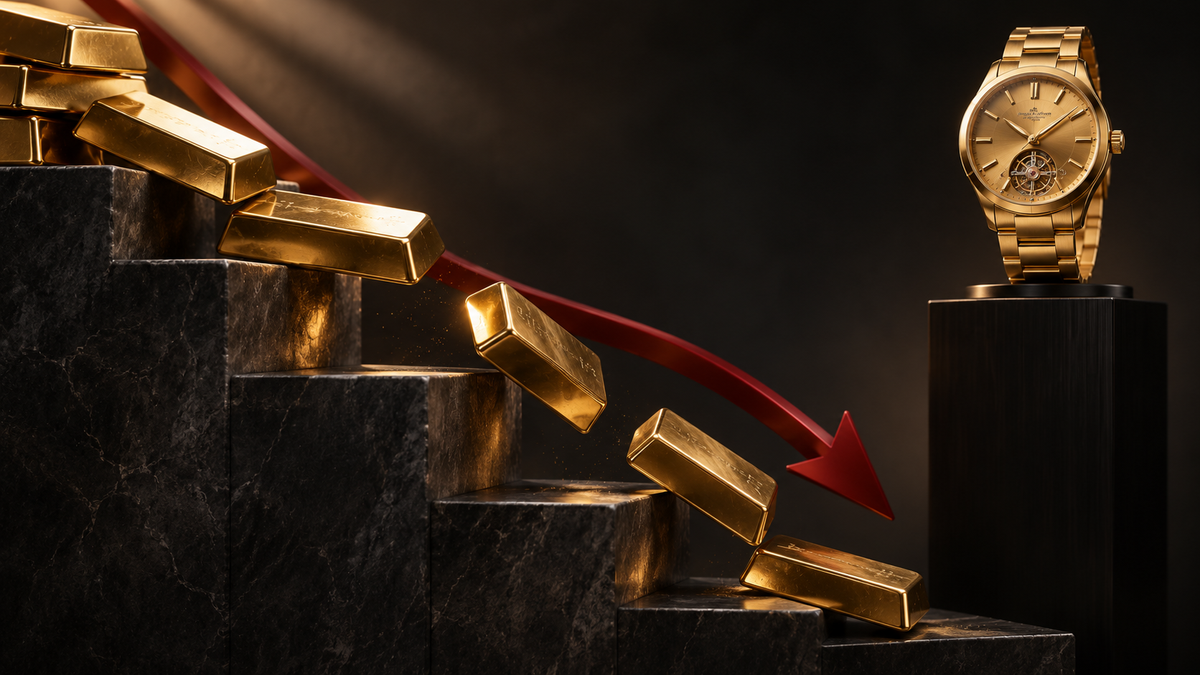
Watchmakers spent the past 18 months raising prices as precious metals became more expensive. Now that gold has retreated, collectors might reasonably ask when the same arithmetic will start working in their favor.
The watch industry has become remarkably good at explaining why your next watch must cost more. Gold is expensive. The Swiss franc is strong. Tariffs are disruptive. Skilled labor costs money. Manufacturing takes time. Somewhere in Switzerland, another spreadsheet has reluctantly concluded that the customer will need to contribute several thousand dollars more.
Fair enough. Costs rise. Businesses respond.
But costs also fall.
With gold trading around $3,859 an ounce on November 16, an awkward question has arrived at the boutique: where is the corresponding price adjustment? Live quotations varied during the session, but the retreat was real. Reuters reported gold touching its lowest level since October 2025. Against the roughly $4,093 spot quotation Reuters reported on November 14 last year, $3,859 represents a decline of approximately $234, or 5.7%. GoldPrice.com
That does not mean a gold watch should automatically become 5.7% cheaper. Nobody buying a Patek Philippe perpetual calendar believes the invoice is simply the melt value plus a modest charge for attaching the hands.
It does, however, justify asking why gold’s contribution to watch pricing seems so much easier to identify on the way up.
When bullion rises, it becomes an explanation. When bullion falls, we are invited to appreciate the complexity of luxury manufacturing.
Collectors can appreciate complexity. Many voluntarily purchase perpetual calendars. What they might appreciate even more is a consistent explanation.
The price increases are documented. So are some explicit statements linking them to precious-metal costs. But an important distinction belongs at the beginning: Rolex, Patek Philippe and Vacheron Constantin have not all publicly offered identical explanations, and outside reporting about the reasons for a price increase should not be presented as a quotation from the manufacturer.
There is also a significant exception to the suggestion that these companies never lower prices. Patek Philippe did cut U.S. prices earlier this year.
Those qualifications make the question more interesting. They do not make it disappear.
Consider what happened during the past 18 months.
According to WatchCharts’ July 2025 analysis, Rolex increased U.S. prices by an average of approximately 3% in May, following an earlier January adjustment. Patek Philippe raised prices in May by an average of 6.8%, with gold models increasing approximately 8%, compared with about 5% for steel and platinum. Audemars Piguet’s May increase averaged 6.6%, with gold models rising approximately 10%. Its rose-gold Royal Oak Offshore reference 26420RO went from $62,100 to $68,500. WatchCharts UK
These were meaningful differences. The gold watches were frequently being asked to carry more of the increase.
Vacheron Constantin raised U.S. prices approximately 6.5% in mid-June 2025. Its steel Overseas 4520V rose from $25,000 to $26,800, or 7.2%. WatchCharts found no clear separation between its gold and steel adjustments. That makes Vacheron an example of broader price escalation, rather than clean evidence of a surcharge specifically tied to gold. WatchCharts UK
The distinction matters. If steel and gold watches rise together, the explanation is plainly larger than the bullion market.
By January 2026, Rolex had increased U.S. prices again. WatchPro’s tracking put the average adjustment at approximately 7%, with steel references increasing around 5.6% and gold models nearly 9%. By that point, its tracked gold watches were approximately 20% more expensive than at the end of 2024. Those are U.S. figures; adjustments differed by market. usa.watchpro.com
Then came another round.
Reuters reported on June 12 that Rolex had increased gold-watch prices globally by an average of 5% that month. Cartier had raised gold-watch prices by as much as 10% in May, according to WatchCharts’ Mark Xu, whom Reuters interviewed. A white-gold Rolex Daytona was reported at $59,100 in the United States, up 14% during 2026 and 33% since 2024. Rolex declined to comment for that report. investing.com
The bill had become considerably more substantial. The public explanation from Rolex itself remained considerably less expansive.
Elsewhere, WatchPro’s June 2026 tracking supplied more examples. Cartier’s gold-and-diamond Tank Américaine Small Model increased from $35,900 to $38,400, approximately 7%. IWC’s gold Ingenieur 40 on a gold bracelet rose 8.4% to $55,600, while its gold Portugieser Chronograph on a leather strap increased 7.3% to $23,500. The publication also recorded restraint elsewhere, including unchanged prices for certain models. This was never a perfectly uniform industry march. usa.watchpro.com
Still, the pattern is clear enough: precious-metal watches absorbed substantial increases, often larger than those applied to other materials.
And while some manufacturers left others to explain the relationship, Richemont put it on the record.
In its November 2025 results announcement, the owner of Cartier, Vacheron Constantin, IWC, A. Lange & Söhne and other luxury houses explicitly connected its pricing actions with gold, currencies and duties. Chairman Johann Rupert wrote: “In order to reflect this high-cost environment, we introduced balanced and targeted price increases.” Media
On the accompanying November 14, 2025 earnings call, chief executive Nicolas Bos discussed increases in May and September, particularly at Cartier, saying they were intended “to try to reflect some of the increase in the price of gold, notably.” He also discussed exchange-rate adjustments. Those remarks concerned Cartier and the group’s pricing approach; they should not be represented as Vacheron specifically explaining its own increase. FY26 Interim results presentation Transcript
In May 2026, Richemont’s annual results again linked higher gold costs and unfavorable currency movements with “measured price increases” at its Jewellery Maisons, the division that includes Cartier. Media
Balanced. Targeted. Measured.
The vocabulary is reassuring. The customer still pays the entire number at the bottom.
None of this proves that gold was a fabricated expense. It was a real expense, and it remains expensive by historical standards. Indeed, there is an important complication for anyone hoping to argue that the last 18 months of increases should simply be unwound: gold was trading around $3,200 in mid-May 2025. At roughly $3,859 today, it remains about 20% above that level. A decline over the past year does not erase the increase over the full period under examination. reuters.com
The sharper argument concerns the retreat from 2026’s much higher prices, and what happens as that retreat works through manufacturers’ costs.
Conveniently, Richemont addressed precisely that issue just three days ago.
During its November 13, 2026 earnings call, chief financial officer Burkhart Grund explained that the company experiences a “lagging effect both on the upside and the downside” from raw-material price movements. Gold costs reflected in its first-half accounts were still approximately 40% higher than in the comparable prior-year period, he said. The decline from the recent peak had not yet reached the income statement. richemont.com
That is a substantive answer. It deserves to be included.
A watch delivered today does not necessarily contain gold purchased today. Material passes through purchasing, production and inventory before the finished watch is sold. Depending on a company’s purchasing arrangements and accounting, the cost reaching its financial results can differ substantially from the spot price flashing on a screen.
Nor does falling bullion reduce the salaries of watchmakers, the cost of developing a movement or the rent on a boutique. Currency changes can offset savings. Other costs can keep rising.
But Grund’s explanation also creates the next question.
If the effect works in both directions, what happens when the downward movement finally arrives?
Does the customer receive some benefit? Does the manufacturer hold prices steady for longer? Does it reverse part of a previous increase on gold references? Or does the lower cost simply improve the margin while the higher retail price becomes permanent?
An accounting lag can explain a delay. It does not, by itself, explain why savings should never be shared.
Richemont’s latest results illustrate why the answer needs care. For the six months ended September 30, 2026, its reported gross margin increased to 66.5%. But that included positive tariff-related one-time items. Excluding those items, gross margin was 64.6%, down from 65.3% a year earlier. The group said higher production costs, notably gold, were largely offset by price increases and a more favorable sales mix. These are group results, not a disclosure of what Richemont earns on an individual Vacheron or Cartier watch. Media
It would therefore be careless to declare that falling gold has already delivered a windfall on every watch in the cabinet.
It would be equally incurious to stop asking what happens next.
There is also a practical question of scale. How much should a decline in gold affect the price of a gold watch?
Take a purely illustrative example: a watch whose case and bracelet together contain 150 grams of 18-karat gold alloy. That is an assumed quantity, not a measured specification for a particular Rolex, Patek or Vacheron. At 75% purity, the alloy contains 112.5 grams of fine gold, equivalent to approximately 3.62 troy ounces.
A $234 decline per ounce reduces the theoretical value of that fine-gold content by approximately $846.
That is a material saving. It is also considerably less than 5.7% of a $60,000 retail price.
The calculation helps establish a sensible standard. Collectors should not expect a finished watch to track bullion percentage for percentage. The movement, finishing, assembly, distribution, warranty and brand premium do not disappear when gold has a bad week.
But the same logic applies in reverse. A percentage increase in bullion cannot automatically justify the same percentage increase across the entire retail price of a watch, either.
Anyone invoking the commodity market should be willing to discuss the actual commodity exposure.
Otherwise, gold becomes an unusually versatile ingredient: substantial enough to explain the increase, yet too small a component to justify reconsidering it.
Then there is Patek Philippe, which complicates the industry’s apparent devotion to upward motion.
On February 1, 2026, Patek cut U.S. retail prices by approximately 8.6%, following the easing of Swiss import tariffs. WatchPro reported that the white-gold Cubitus reference 7128/1G-001 fell from $92,469 to $84,522 before sales tax. The Aquanaut Chronograph 5968A-001 dropped from $67,574 to $61,766. At the same time, UK prices increased 4%. usa.watchpro.com
That was a tariff and international-pricing adjustment, rather than a rebate for cheaper gold. But it establishes something useful: a prestigious Swiss watchmaker can lower an official price.
The movement continues running. The boutique remains standing. The company’s heritage survives.
Patek deserves credit for making the adjustment. Its example also makes it harder to argue that lowering a luxury watch’s price is institutionally impossible.
Richemont has acknowledged the same principle. Asked about price reductions in November 2025, Bos said: “It does happen that we decrease prices.” He explained that some exceptional watches and high-jewelry pieces receive upward and downward local-currency adjustments. That is different from promising broad reductions on standard production references, but it confirms that the mechanism exists. FY26 Interim results presentation Transcript
The obstacle, then, is partly commercial.
My reading is that manufacturers have compelling reasons to prefer keeping the higher price. If customers continue buying, a reduction gives away revenue the market has already demonstrated it will support. Cutting an official price can also complicate inventory held by retailers, irritate recent buyers and create expectations that waiting will produce another reduction.
Those are plausible incentives, rather than disclosed explanations from every brand discussed here.
They also suggest why the gold argument deserves scrutiny. A company may raise prices partly because its costs have increased and partly because it believes customers will accept more. Once the market accepts the higher number, the original cost pressure can fade without removing the commercial opportunity.
That is pricing power. There is nothing mysterious about it.
But pricing power is a different explanation from reluctantly passing along the cost of precious metals.
The industry would help itself by being clearer about the distinction.
On the November 13 call, Rupert emphasized international price consistency, the relationship between price and value, and the importance of residual values. He also said: “We just don’t want to be greedy.” richemont.com
That is a worthy ambition. Customers might reasonably ask how it will be expressed if gold remains lower.
A freeze could be part of the answer. Manufacturers do not necessarily need to announce a dramatic reduction to give buyers some benefit from easing costs. Holding prices steady while absorbing other inflation would be meaningful. So would selectively reversing increases on references most exposed to gold.
What would be less persuasive is another gold-related increase followed, when gold retreats, by an indefinite explanation that watches are complicated.
The question for Rolex is how much of its successive precious-metal increases reflected purchasing costs, and how much reflected what buyers would bear.
The question for Patek is whether the willingness to recalibrate U.S. prices when tariffs eased might ever extend to sustained relief in other costs.
The question for Vacheron and its parent is how the promised downward flow of material costs will influence future pricing, particularly after broadly applied increases that were never confined to gold watches.
None of those questions requires a manufacturer to publish every detail of its margins. They do require more than a general appeal to craftsmanship.
Collectors already understand craftsmanship. They are paying for it.
What they are entitled to question is the consistency of the financial explanation attached to it.
Gold has fallen. The full benefit may take time to reach the factories’ accounts. Some earlier increases may still be justified by costs that remain elevated. Patek has already demonstrated that reductions can happen.
All of that belongs in an honest assessment.
So does the uncomfortable possibility that the higher price will stay simply because the industry believes it can.
If that is the answer, manufacturers should have the confidence to say so. Luxury has always charged for desirability, scarcity and the name on the dial.
It becomes harder to take the explanation seriously when gold is invited into the conversation only when it can help raise the bill.
–Michael Wolf