Issue #288 | Buying Time - November 11, 2026
A $203 million auction weekend, independent watchmaking’s creative roots, and the many ways a watch earns its price.
BuyingTime in 47 Seconds
Watches of Switzerland reports 15% revenue growth, led by its American business, while Geneva’s major auction houses generate a combined $203 million. Both suggest that collectors are spending, although the auction results reveal a market that continues to distinguish carefully between exceptional objects and everything around them.
Today’s watches offer plenty of reasons to look beyond the biggest numbers. Vacheron Constantin refines the Fiftysix, Krayon turns falling magnolia petals into a mechanical expression of daylight, and MB&F gives its suspended balance wheel an enamel menagerie. At more accessible prices, Orient shrinks the Bambino, Praesidus revives the military ana-digi, and Angelier brings vintage dress-watch proportions to Kickstarter.
Our features connect Jaeger-LeCoultre’s American history with the pioneers of independent watchmaking, a space-tested Konstantin Chaykin chronograph, and the enduring appeal of simple time-only watches. We also compare a $6,300 Omega with a $270 Timex, examine Lange’s platinum-bracelet Datograph Perpetual, and preview a new symposium devoted to precision timekeeping.
Yesterday’s Vacheron Constantin Traditionnelle Complete Calendar Openface sold at a winning bid of US$41,000. Today’s auction features an unworn 2026 Ulysse Nardin Freak ONE Guilloché, one of 99 pieces, with bidding scheduled to end at 1:50 p.m. EST.
Time Graphing Today’s Watch Universe
What Makes a Watch Worth It?
The watch business has supplied us with two rather emphatic numbers today: 15% revenue growth at Watches of Switzerland and $203 million in sales across Geneva’s major auction houses. After months of conversations about cautious consumers, selective collectors, and the distance between asking prices and actual bids, those figures deserve attention.
They also deserve interpretation. A retail group’s growth and a trophy auction’s record total measure different things. Neither can tell an individual collector whether the next watch is worth buying.
The Watches of Switzerland results show the importance of American demand, with U.S. sales rising 22% at constant currency. They also demonstrate how acquisitions influence reported growth. The business is expanding, but management still expects the second half to bring a slower pace. Even a strong trading update contains a reminder to read past the headline.
The Geneva auction weekend requires similar care. Exceptional watches, important provenance, and determined bidders can produce a spectacular aggregate result. That does not mean every watch by a successful maker suddenly deserves a higher price. The three takeaways from the fall seasondescribe precisely that tension: extraordinary results alongside questions about market depth, resale demand, and uneven performance within major brands.
Collectors have always lived with those distinctions. We sometimes forget them when the room gets excited.
Today’s issue offers a useful opportunity to consider the different kinds of value that can sit inside a watch. There is the value of an invention, the value of an extraordinary surface, the value of a useful instrument, and the quieter value of an object that simply fits your life.
Start with invention. Today’s feature on the pioneers of independent watchmaking reminds us that today’s enthusiasm for independent makers rests on decades of individual conviction. These watchmakers developed mechanisms, preserved skills, restored important objects, and built businesses around ideas that were often far removed from the commercial mainstream.
We can admire the auction prices now attached to some of their names. The more rewarding exercise is understanding what they contributed before those prices arrived.
That history also helps explain why the latest independent releases can be so engaging. The Krayon Anywhere Magnolia uses petals to communicate the changing boundaries of daylight. Its decoration participates in the complication. A magnolia tree outside a workshop becomes the starting point for a watch that connects its owner to a particular place on Earth.
The MB&F LM101 editions by Gabriel Colliard make a different argument. Here, an already theatrical mechanism becomes the setting for miniature animal scenes in cloisonné enamel. The appeal asks for close inspection: the relationship between the suspended balance, the arrangement of the composition, and the patient work of forming and firing the dial.
Neither watch needs to justify itself through a checklist of practical advantages. Its achievement lies in making something difficult, distinctive, and emotionally persuasive.
Practical achievement has its own place, of course. The Konstantin Chaykin SC02C approaches watchmaking through the demands of spacewalks. Glare, pressure, legibility, and elapsed-time measurement become design problems with consequences. The resulting chronograph reminds us that an instrument’s appearance can emerge from the work it is expected to perform.
Then comes the question that makes luxury-watch conversations wonderfully uncomfortable: how much of that practical capability do we actually need?
Our Omega Seamaster and Timex Deepwater comparison puts the issue directly on the table. The Timex delivers a sapphire crystal, substantial water resistance, and dependable quartz timekeeping for $270. The Omega offers mechanical sophistication, more elaborate finishing, and a different ownership experience at $6,300.
A collector can understand the price difference and still prefer either watch. What matters is knowing which qualities you are paying for—and which ones you will enjoy after the purchase has stopped feeling new.
That is where proportions and familiarity become surprisingly important. The smaller Orient Bambino addresses an everyday concern that no exotic material can solve: whether a watch feels right on the wrist. The time-only selection makes a related point. Remove enough functions and the remaining decisions become more visible. Hands, markers, case shape, and dial spacing have to carry the experience.
History offers another kind of value, and the Jaeger-LeCoultre Collectibles capsule provides an especially good example. American cases, English calendar discs, unusual shapes, and early sporting designs show a manufacturer responding to real markets and changing circumstances. Heritage becomes more interesting when we can see the commercial decisions, technical constraints, and local preferences inside it.
The same curiosity should follow us into an auction. Yesterday’s Vacheron sold at $41,000. Today’s limited-edition Freak brings a very different watchmaking philosophy to the block. Both invite a collector to decide what the object offers and what that offering is worth in the present market.
That judgment belongs to the buyer. A retail price supplies context. A production limit describes availability. An auction result records an agreement reached on a particular day.
The pleasure of collecting comes from developing the understanding to make those numbers useful. Follow the mechanism, study the craft, try the proportions, and learn the history. Eventually, the question becomes personal enough to answer: What will make this watch worth owning?
-Michael Wolf
News

Watches of Switzerland Raises Its Forecast as Sales Climb 15%
Watches of Switzerland Group reported revenue of £974 million for the six months to November 1, up 15% year over year. The performance prompted an increase in its FY27 revenue-growth forecast to 7–10%, alongside an expected improvement of 60–80 basis points in adjusted EBIT margin. The group forecasts EBIT of £87–89 million, while net debt declined to £24 million.
America remained the largest market, with revenue rising 22% at constant currency to £501 million. The U.S. business benefited from a full six months of trading at Deutsch & Deutsch, acquired in January. UK revenue increased 9% to £473 million, giving the group growth on both sides of the Atlantic.
Management says trading momentum remains good, although it expects more moderate revenue growth and margin expansion in the second half. One fewer trading week and the annualization of the acquisition will influence those comparisons. The results provide an encouraging signal for luxury-watch retail, with the strongest interpretation coming from the combination of sales growth, improved profitability expectations, and reduced debt.
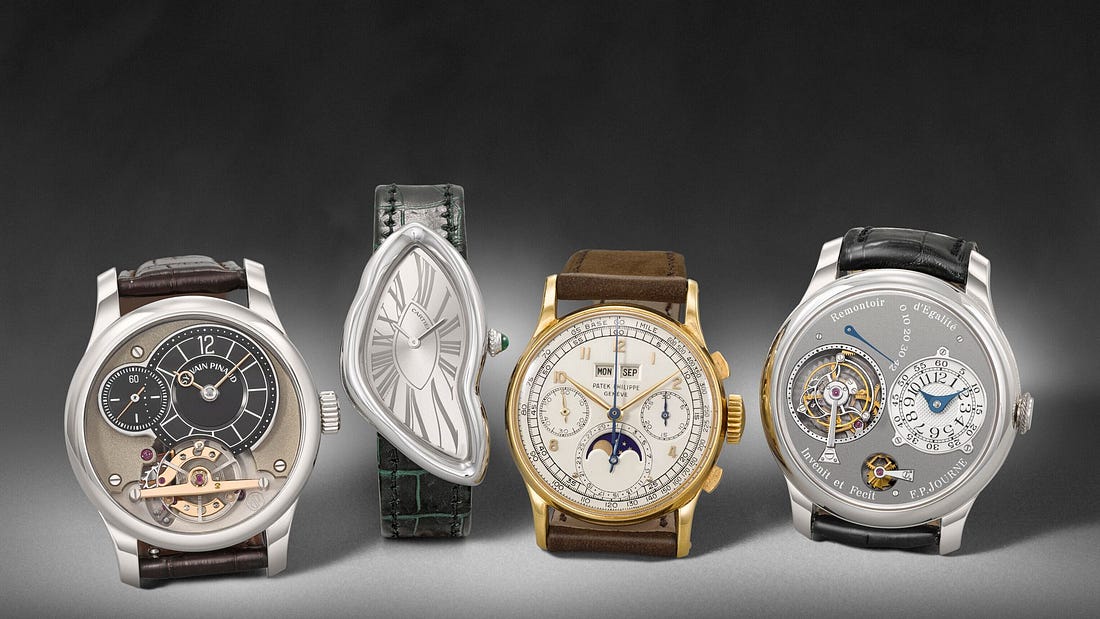
Geneva’s Watch Auction Weekend Generates US$203 Million
Geneva’s November sales at Phillips, Christie’s, and Sotheby’s produced a combined US$203 million, with Phillips contributing US$112.3 million, Christie’s US$58.7 million, and Sotheby’s more than US$32 million. F.P. Journe was a major force at Phillips and Christie’s, while important Patek Philippe watches continued to attract substantial bids, including approximately US$2.8 million for a Sky Moon Tourbillon.
Rarity, originality, and provenance helped distinguish leading lots. George Daniels, Philippe Dufour, and Rolex featured among the notable results, while a Cartier mystery clock established a record for a Cartier timepiece. Yet comparable prices for top watches appeared broadly steady, suggesting that the record aggregate total should be read alongside the composition and quality of the offerings.
The audience is changing, too. Christie’s reported that Millennials and Gen Z accounted for 40% of registrants, while 19% of bidders were new to the house. Those figures suggest that the market’s future depends on both established collectors and a new generation learning where to place its attention—and its money.
Features
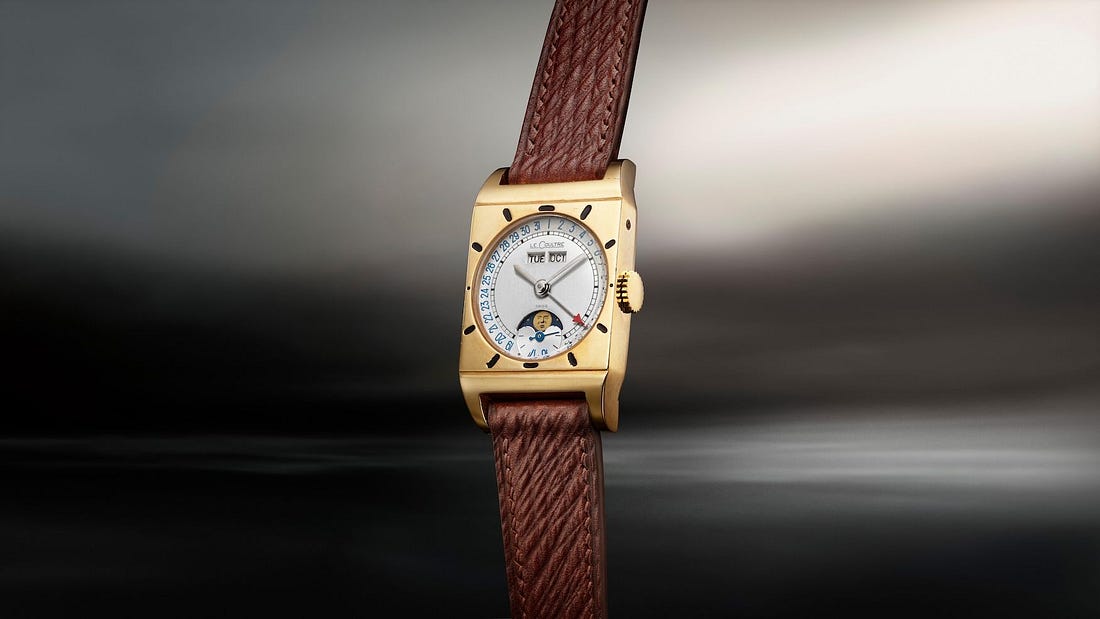
Jaeger-LeCoultre’s Collectibles Collection Explores Its American Story
Jaeger-LeCoultre’s eighth Collectibles capsule examines the manufacture’s relationship with the American market through watches spanning the 1930s to the early 1980s. The selection shows how tariffs, domestic case production, local preferences, and enthusiasm for new technology influenced the watches American customers encountered.
Among the highlights are a chocolate-brown Reverso, a 1947 triple calendar with English calendar discs, a rare rectangular calendar watch in 18k gold, and a Futurematic with an unusually forward-looking design. The selection also includes the Beetle Case, Deep Sea Alarm Barracuda and Shark models, an American-made 1970s Memovox, and a watch concealed inside a $10 gold coin.
Together, the pieces present a more varied history than a succession of familiar icons. They document adaptation, experimentation, and the sometimes surprising forms that emerge when a Swiss manufacturer serves a particular market. The collection is on view at Jaeger-LeCoultre’s Madison Avenue boutique through November 20, with watches available to clients worldwide while unsold.
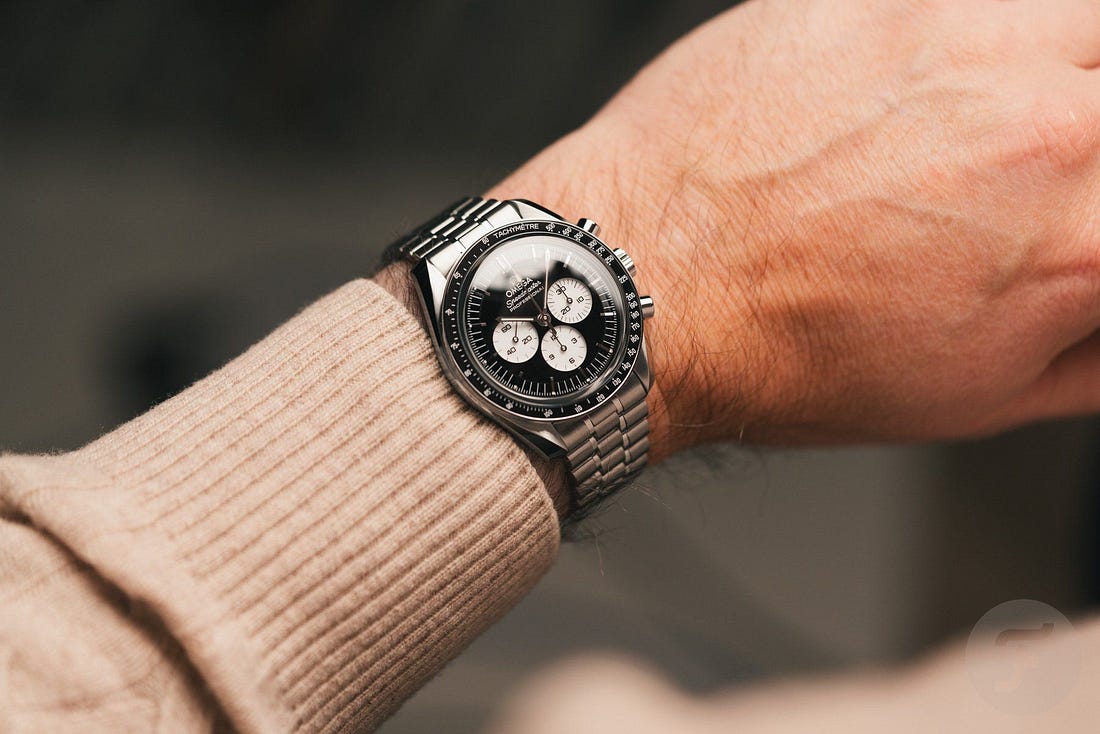
Which Omega Speedmaster Defined 2026?
Omega’s Speedmaster year brought a relatively restrained set of releases, including stainless-steel and Moonshine gold Reverse Panda Moonwatches, a green-dial gold model associated with Rory McIlroy, and seven updated Speedmaster 38 variations. With 92 Speedmaster references remaining within a reduced overall catalog of 535 watches, the collection still provides plenty of choice.
The strongest case for the year’s standout centers on the 42mm stainless-steel Reverse Panda. Its black-and-white double-plate step dial gives the familiar Moonwatch architecture a fresh visual emphasis, while the Co-Axial calibre 3861 maintains the modern technical foundation. The published European prices are €10,200 for steel and €48,600 for Moonshine gold.
The appeal rests in how much can change through a carefully judged dial treatment. Omega has not needed to abandon the Speedmaster’s established identity to create a version worth discussing. With the collection’s 70th anniversary approaching in 2027, this quieter year also leaves room for anticipation.
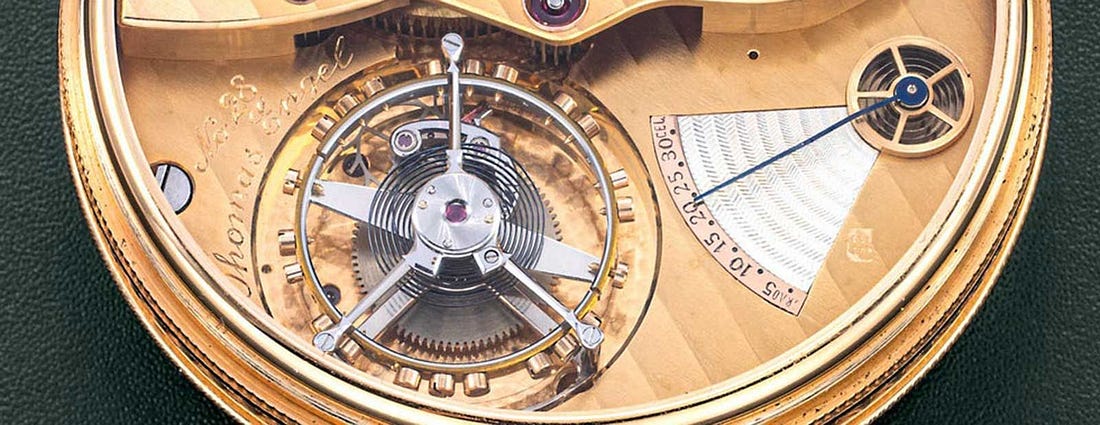
The Independent Watchmakers Who Made Creative Freedom Possible
Independent watchmaking’s current prominence owes much to makers who spent decades pursuing ideas outside the structures of large manufacturers. The AHCI, founded in 1985 by Vincent Calabrese and Svend Andersen, helped create a community in which technical invention, personal design, and entrepreneurial independence could reinforce one another.
This survey brings together figures including Philippe Dufour, Daniel Roth, Michel Parmigiani, Franck Muller, Christophe Claret, Paul Gerber, Dominique Loiseau, Antoine Preziuso, and Jean-Marc Wiederrecht. Their work ranges from restoration and exquisitely finished simple watches to tourbillons, sonneries, perpetual calendars, world timers, and playful mechanical displays.
What connects them is the willingness to give a specific idea sustained attention. Some changed the vocabulary of complications; others demonstrated how much expression could be found in finishing or proportion. Understanding those contributions provides a richer introduction to independent watchmaking than a ranking of its most expensive auction results.

How Spacewalks Shaped Konstantin Chaykin’s SC02C
Konstantin Chaykin’s SC02C grew from a Roscosmos research program that began in 2018. Watches developed through the program accompanied four spacewalks, including a six-hour outing in May 2026, providing experience that informed the production chronograph’s construction and display.
The intended role is straightforward: provide dependable elapsed-time information when radio communication is interrupted. A clear black dial, 12-hour chronograph, and rotating bezel support that task. Testing influenced the use of a flat anti-reflective sapphire crystal, a pressure-resistant case, reduced glare, and a simplified presentation.
The hand-wound K.20-5 movement reflects an emphasis on direct, reliable operation, and each of the 28 production watches will undergo laboratory testing. Chaykin’s fascination with space began with science fiction; this project brings that interest into contact with the demanding practicalities of equipment used beyond the spacecraft.
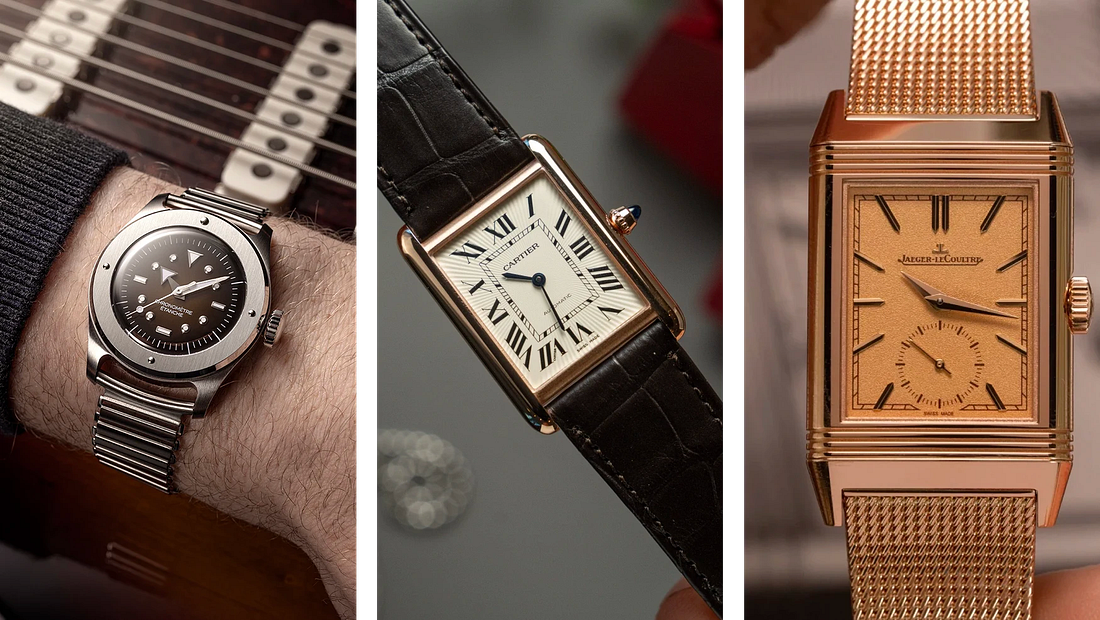
Eleven Time-Only Watches That Let the Essentials Speak
A time-only watch puts unusual pressure on apparently simple decisions. Without a calendar, chronograph, or rotating astronomical display competing for attention, the relationship between case, hands, markers, and dial becomes the central experience.
This selection stretches from the accessible Timex Marlin to the Vacheron Constantin Historiques 1921 and Jaeger-LeCoultre Reverso Tribute. Along the way are the Hamilton Khaki Field Murph, Serica Ref. 7505, Baltic Prismic, Tudor Black Bay 54, Grand Seiko SBGW297, Rolex Submariner, Cartier Tank Louis Cartier, and TAG Heuer Aquaracer Solargraph.
The range demonstrates how much variety can exist within a limited functional brief. Some emphasize elegance, others durability or distinctive geometry. For collectors considering what a watch needs to do, these models offer eleven different arguments for concentrating on the time itself.
New Watches
Converted prices below are approximate U.S. dollar equivalents using November 10 exchange rates. They preserve the original quoted tax basis and do not represent confirmed U.S. retail prices.
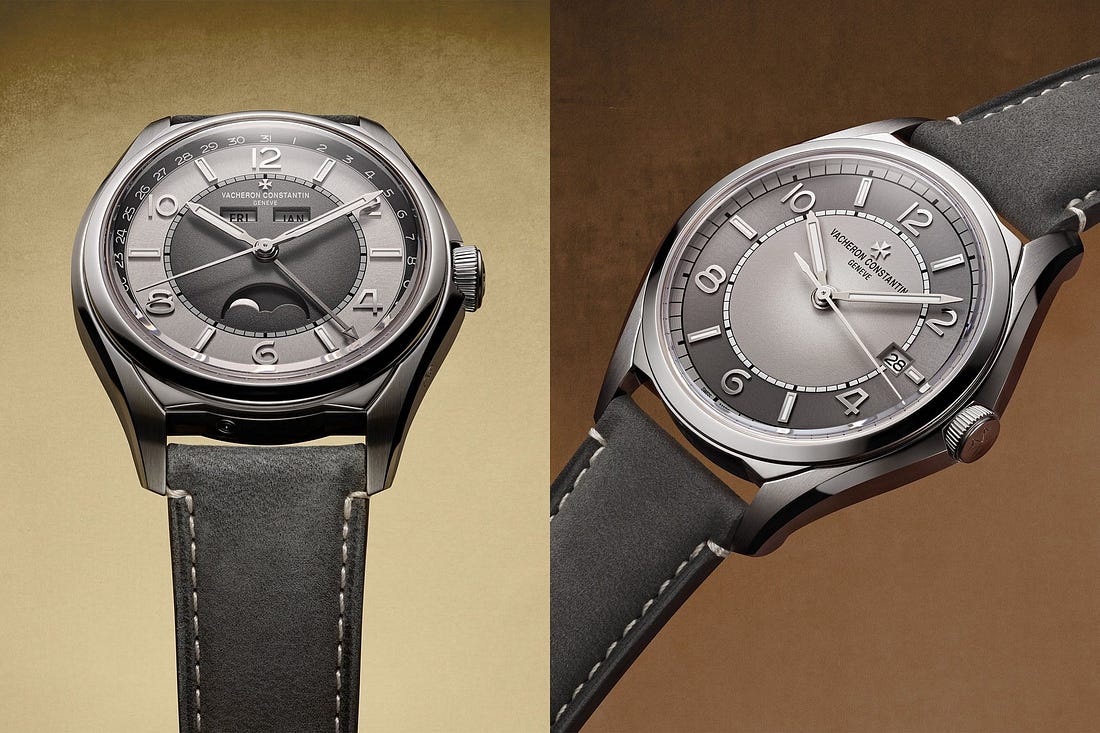
Vacheron Constantin Gives the Steel Fiftysix a New Perspective
Vacheron Constantin updates the Fiftysix Self-Winding and Complete Calendar with 40mm stainless-steel cases, two-tone grey sector dials, box-shaped sapphire crystals, and grey nubuck straps. More varied brushed and polished surfaces bring additional definition to the cases, while the restrained palette gives both watches a contemporary character without disturbing their mid-century foundations.
The Self-Winding pairs a light-grey opaline center with a darker chapter ring, a date display, and blue Super-LumiNova accents. Its automatic calibre 1326 provides 48 hours of power reserve. The Complete Calendar adds day, date, month, and precision moonphase indications, using the Hallmark of Geneva-certified calibre 2460 QCL/1 with a 40-hour reserve.
The calendar model’s darker gradient center and lighter sunburst chapter ring create a distinct identity within the pair. These are measured changes, but the finishing and dial treatment give collectors a fresh way to approach Vacheron’s comparatively informal collection. Price: approximately US$15,350 for the Self-Winding and US$35,950 for the Complete Calendar.
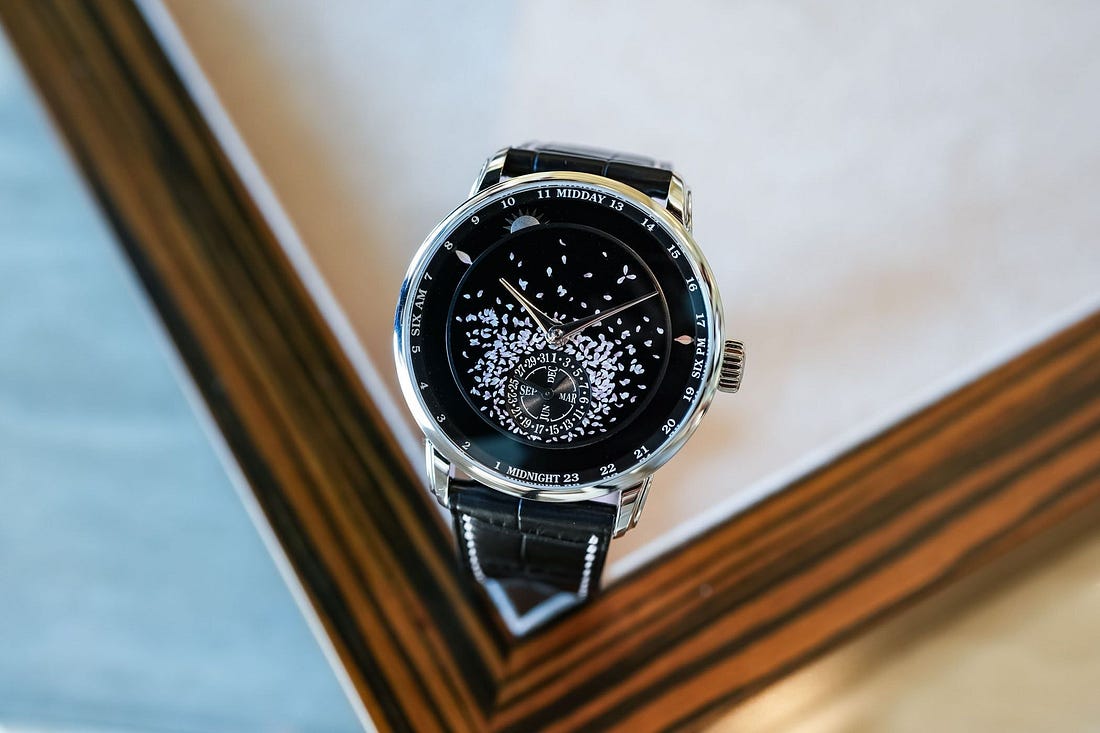
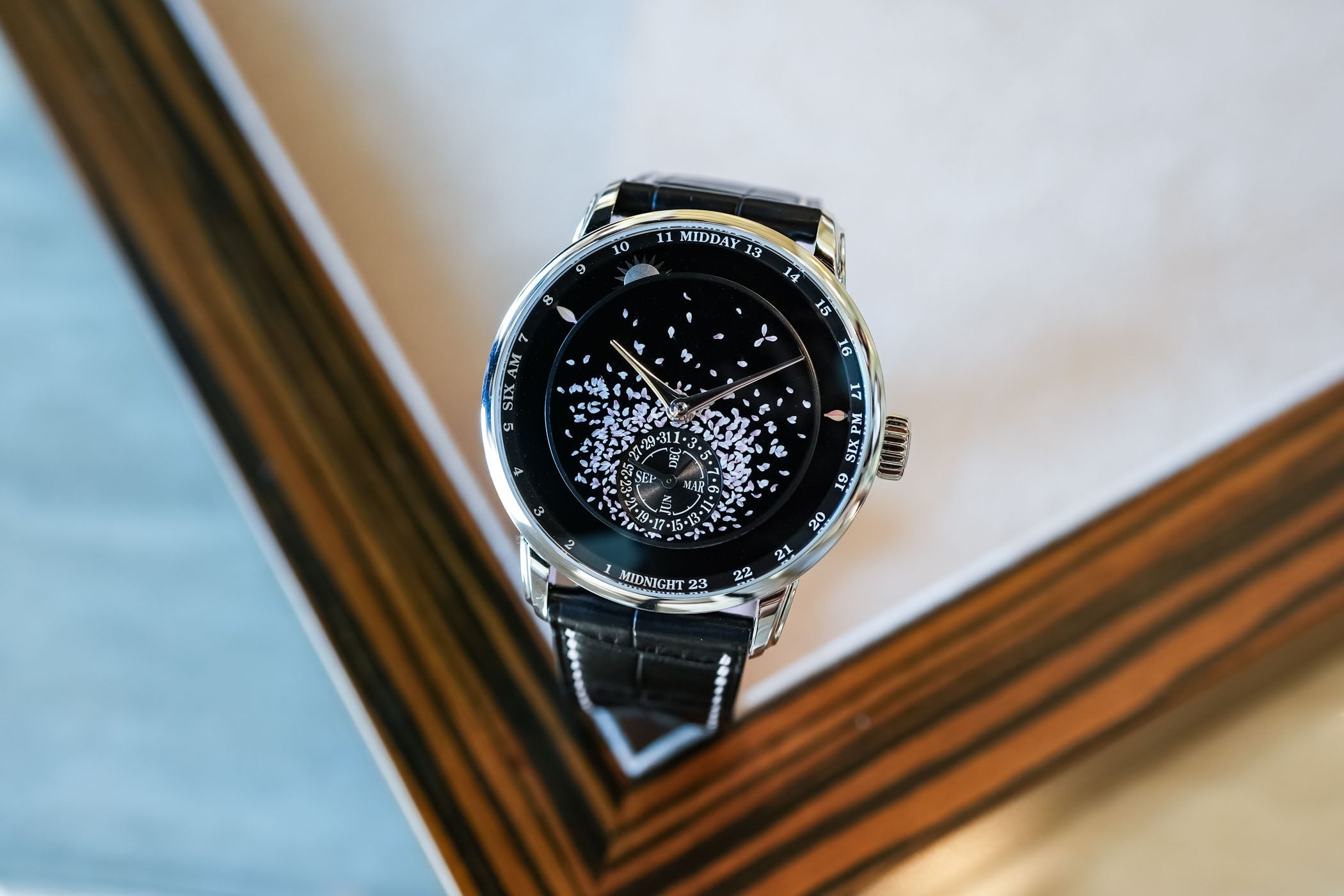
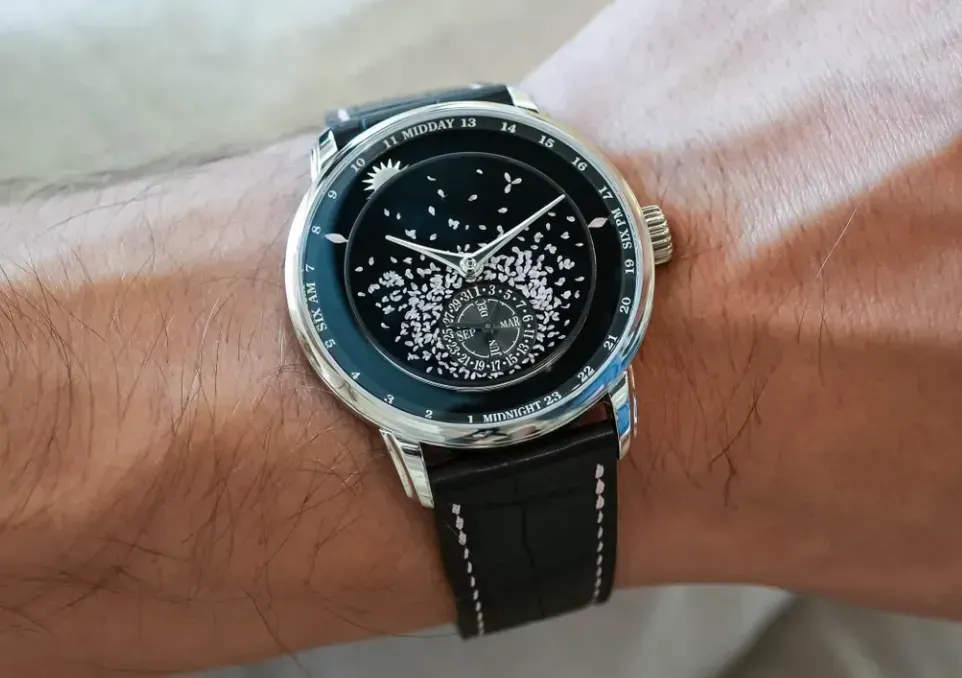
Krayon Anywhere Magnolia Turns Daylight Into a Floral Composition
Krayon’s Anywhere Magnolia takes inspiration from a magnolia tree near its Neuchâtel manufacture, using hand-painted petals against a black onyx dial to capture the fleeting character of spring. Two petals serve as sunrise and sunset indicators, moving with the calendar to describe the changing length of daylight at a location selected by the owner. A 24-hour scale and a date-and-month subdial complete the display.
The 39mm platinum case contains the manually wound C030 movement, whose 432 components deliver the astronomical indication and a 72-hour power reserve. A watchmaker configures the mechanism for the chosen location, making geography part of the ownership experience. The black alligator strap keeps attention on the dial’s miniature painting and the relationship between its decoration and function.
Limited to 15 pieces, the Magnolia combines an unusually personal complication with an individual hand-painted scene. Although the supplied story lists price on request, additional launch coverage quotes CHF178,000. Price: approximately US$216,900, converted from that published Swiss-franc price.
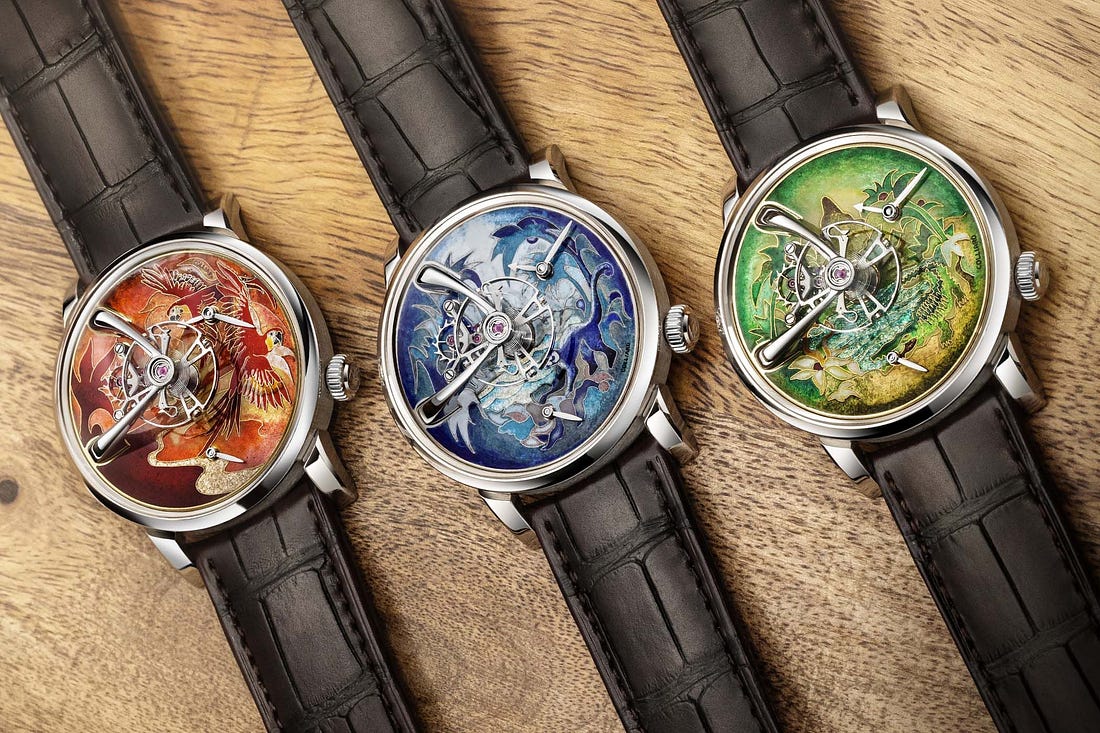
MB&F’s LM101 Becomes a Cloisonné Enamel Menagerie
MB&F introduces three platinum LM101 editions featuring cloisonné enamel compositions by Gabriel Colliard: monkeys in blue, macaws in red, and a crocodile in green. The animal scenes surround the watch’s suspended balance wheel, giving the movement’s familiar architecture a richly colored new setting. Each composition requires hand-bent gold wires and repeated firings, with small variations making every dial individual.
Accommodating the enamel required changes to the LM101 itself. MB&F thinned the dial plate and replaced the floating time and power-reserve subdials with longer hands, opening the composition while preserving the essential indications. Matching decorative treatment on the ratchet wheels extends the collaboration into the reverse side.
The manually wound movement offers 60 hours of power reserve and features a 14mm suspended balance with a double hairspring. Each colorway is limited to eight pieces, creating a total production of 24 watches across the three scenes. Price: US$131,000, excluding tax.
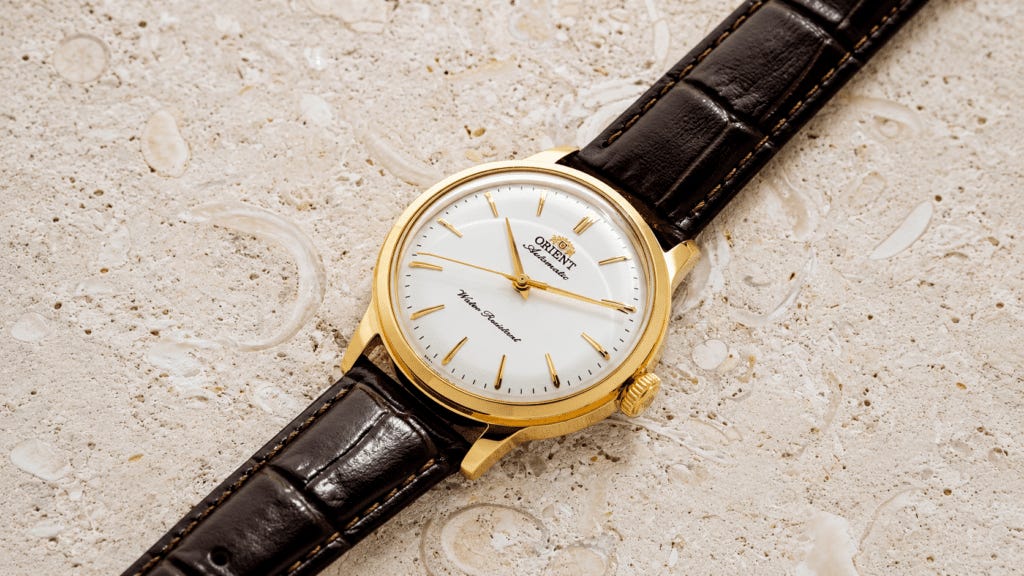
Orient’s Smaller Bambino Addresses a Familiar Complaint
The Orient Bambino Version 7 brings the collection down to a 36.4mm case, a welcome change for enthusiasts who liked the design but found earlier versions too large. The date-free dial uses applied baton markers and dauphine-style hands, with white, cream, muted-green, and gold-tone-case/silver-dial options. A domed crystal, curved lugs, and crocodile-embossed leather strap preserve the Bambino’s recognizable dress-watch character.
Inside is Orient’s automatic F6524 movement, with hand-winding, hacking seconds, and approximately 40 hours of power reserve. The watch measures 42.2mm from lug to lug, uses a mineral crystal, and carries a 30-meter water-resistance rating. At 12.3mm thick, it remains relatively substantial for a compact dress watch.
The smaller diameter and cleaner dial answer two common requests, although buyers should weigh the thickness alongside the improved proportions. Price: US$410 list, with a reported promotional price of US$305.
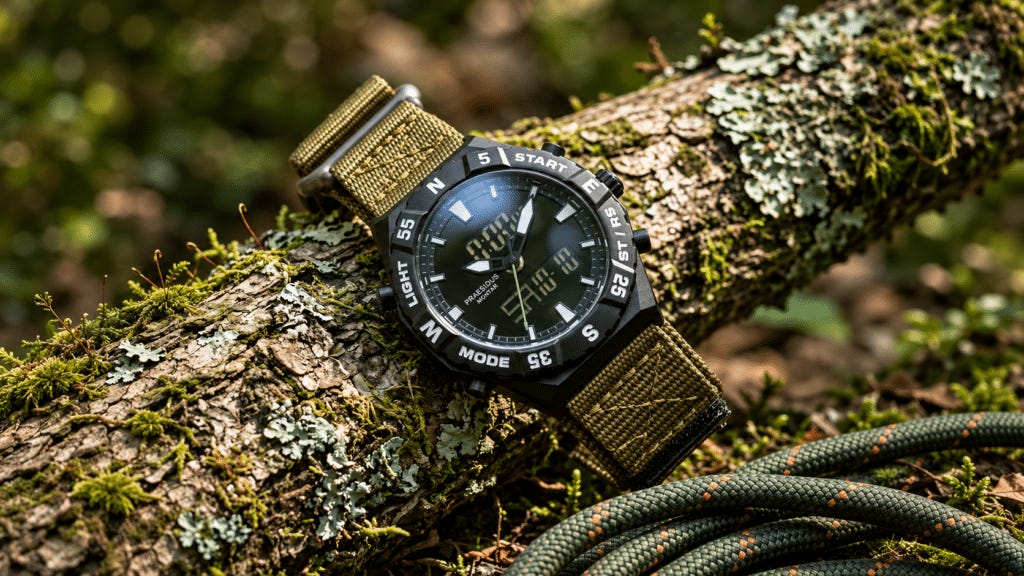
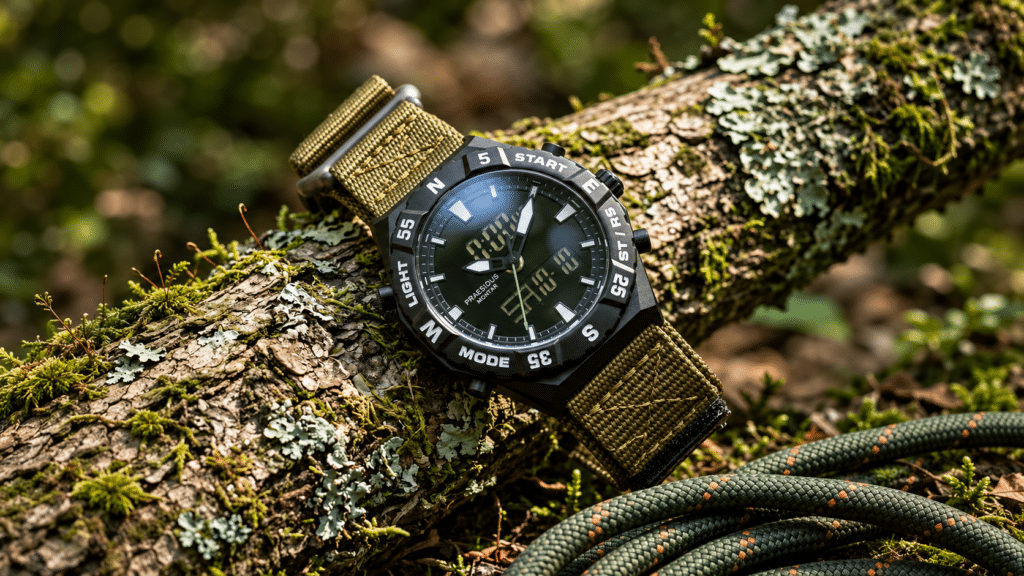
Praesidus Montar Ana-Digi Rewinds to the 1980s
Praesidus takes a sharp turn from traditional field-watch styling with the Montar Ana-Digi, a 44mm military-inspired design that would look comfortable beside an ’80s action-film wardrobe. Its black-coated steel case surrounds a layered analog-and-digital display, with four pushers and a rotating bezel carrying compass and dive-timing markings. The analog hands remain visible while the digital functions operate.
A multifunction quartz module supplies a stopwatch, alarm, second time zone, calendar, hourly chime, and backlight. The practical specification also includes 100-meter water resistance, Super-LumiNova, and a sapphire-coated mineral crystal. A canvas hook-and-loop strap reinforces the equipment-like appearance.
Four colorways are planned, with the first batch limited to 200 watches and shipping expected in early December. For buyers drawn to the period’s densely functional design language, the Montar offers considerable visual personality at an accessible price. Price: US$275.
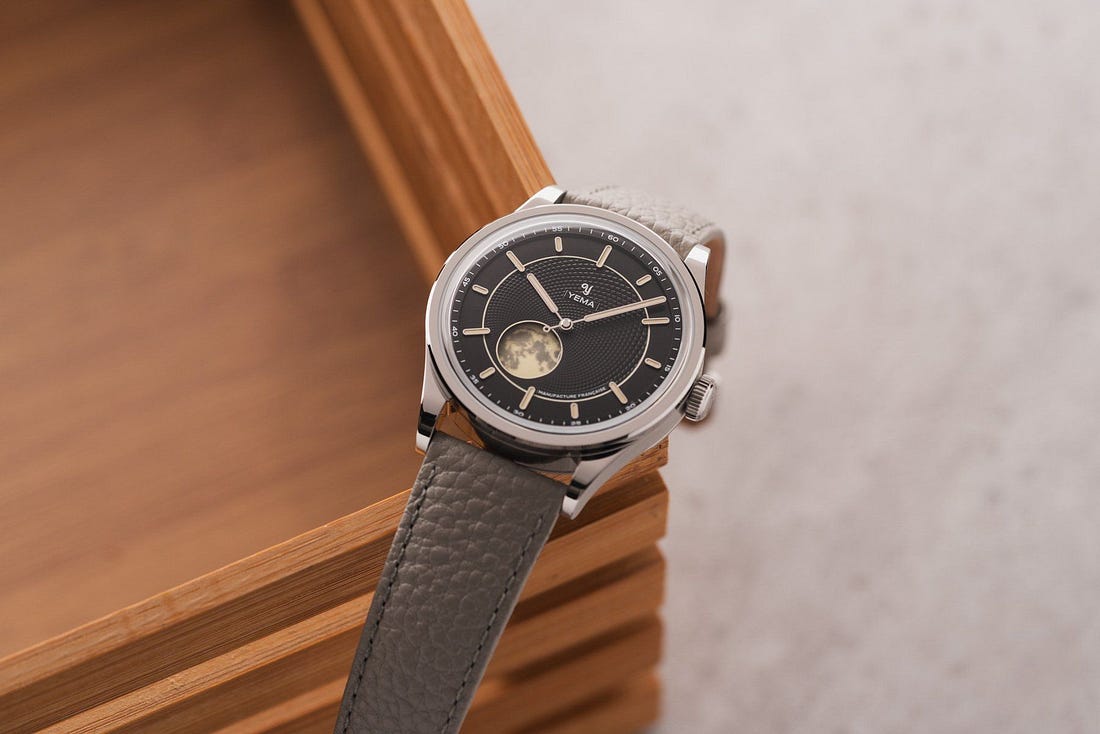
Yema Introduces Its First Moonphase With the Senans Grande Lune
Yema opens a new collection with the Senans Grande Lune CMM.22, its first moonphase watch. The 38.5mm steel case combines stepped surfaces with alternating brushed and polished finishes, framing a guilloché dial and an oversized luminous moonphase display. Black, blue, and champagne dial versions are available, each limited to 200 pieces.
The automatic CMM.22 adapts Yema’s CMM.20 micro-rotor platform to accommodate the lunar mechanism while keeping the movement 4.7mm thick. It runs at 28,800 vibrations per hour, provides 70 hours of power reserve, and carries a stated accuracy range of −3/+7 seconds per day. Water resistance is 50 meters.
A grey leather strap provides the standard configuration, with a mesh bracelet available as an alternative. The large moon display gives the Senans a clear focal point, while the compact diameter should help balance its contemporary case design. Price: approximately US$2,770 on leather or US$2,880 on the mesh bracelet.
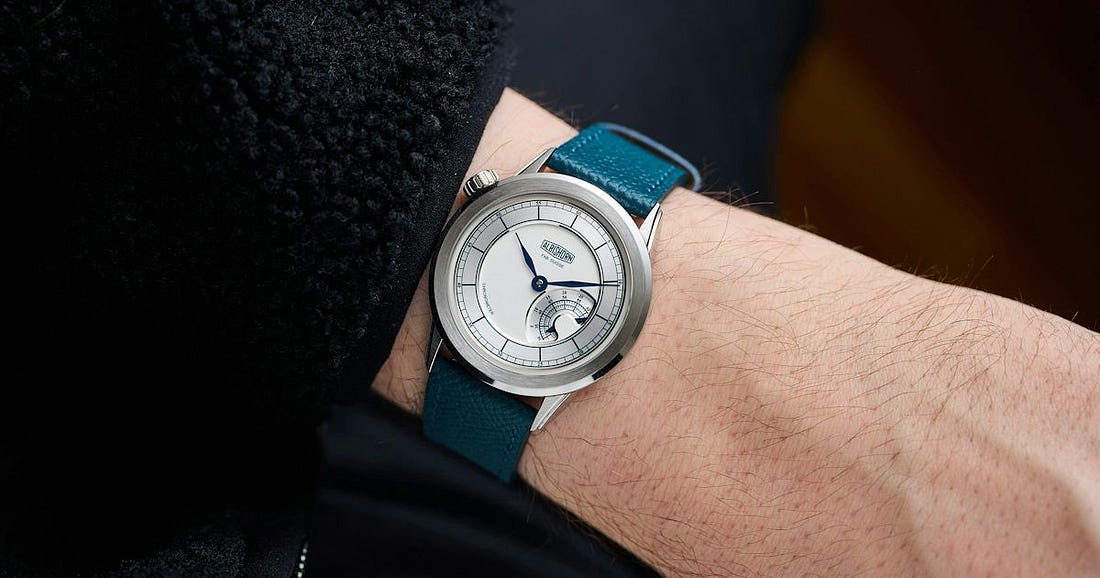
Albishorn Voisin Aérosport Brings Art Deco to the Dress Chronometer
Albishorn’s second model develops its “imaginary vintage” approach through the aerodynamic forms of Gabriel Voisin’s aviation and automotive designs, particularly the 1930s C28 Aérosport. The 38mm steel case combines stepped surfaces, flowing lines, and contrasting finishes. Classic silver-opaline and Ice Blue dials use layered sector layouts and a distinctive two-sided, 180-degree running-seconds display at four o’clock.
The hand-wound ALB04 movement is COSC-certified, runs at 4Hz, and provides 60 hours of power reserve. The watch is delivered with two leather straps, while an optional steel bracelet offers a different expression of its sculptural case. Its appeal lies in the way the historical influences are interpreted into a coherent new design rather than assembled as isolated vintage references.
Availability begins today, November 11, through Albishorn’s website, with limited production spread over three years. Both reports offer useful views of the case, display, and design background. Price: approximately US$4,200 with the leather straps or US$4,750 with the steel bracelet, excluding the quoted additional taxes, tariffs, and shipping.
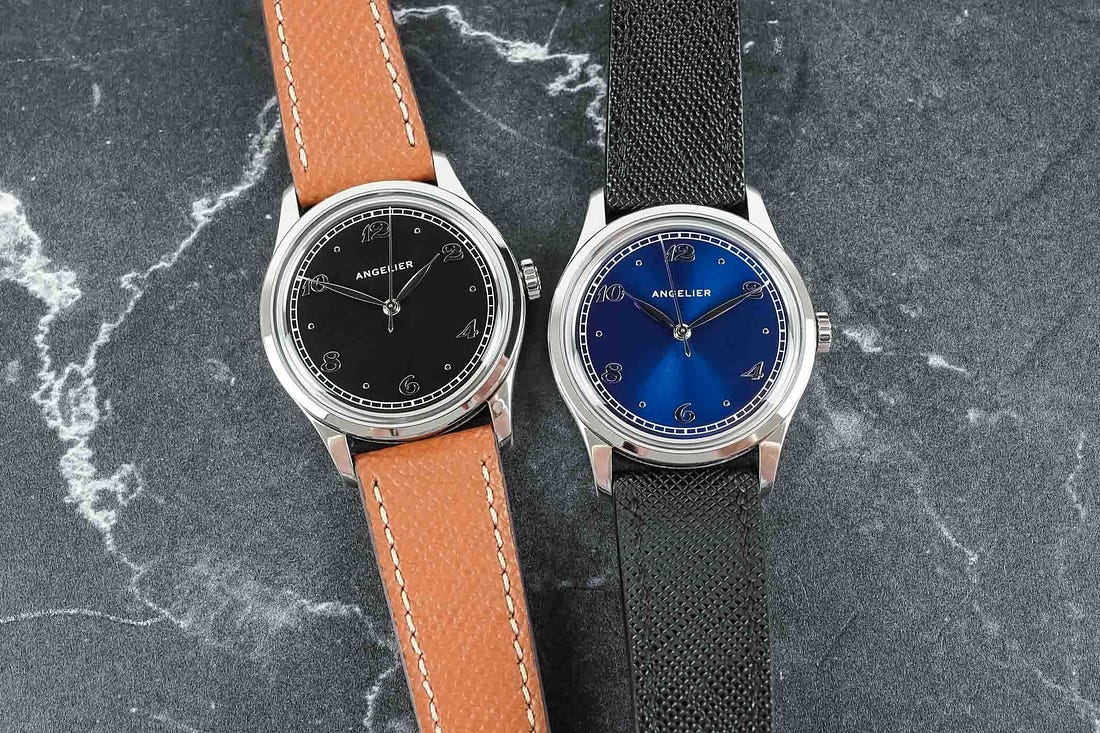
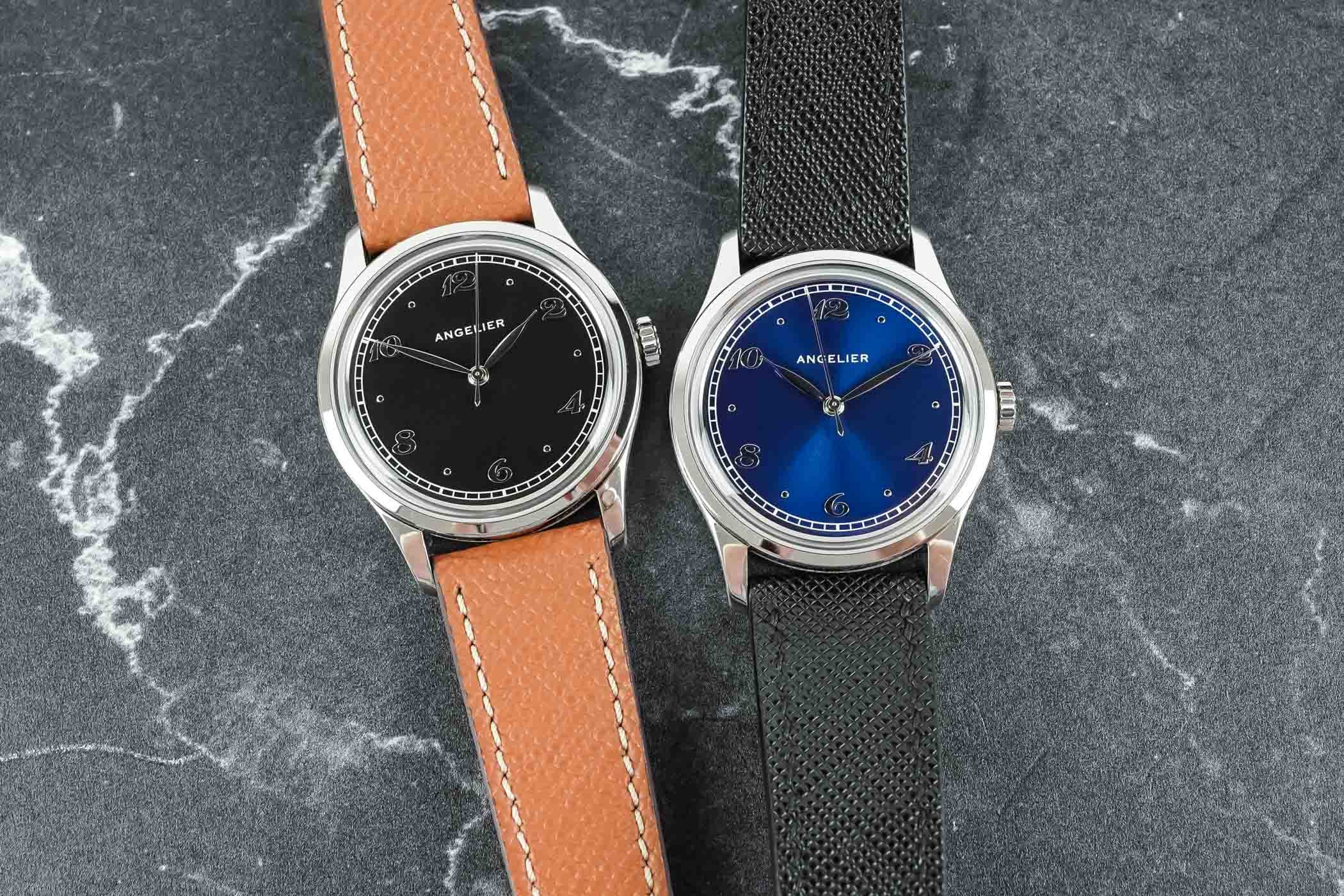
Angelier Launches a Compact Vintage-Inspired Dress Watch
Angelier’s debut Dress Watch draws on the restrained proportions of 1930s and 1940s designs, including the Patek Philippe Calatrava 96. Its 37.2mm steel case measures 8.7mm thick and combines a box-shaped sapphire crystal with 50-meter water resistance. Four dial options feature applied Breguet-style Arabic numerals, giving the watch a more decorative expression within its otherwise simple layout.
The no-date Miyota 9039 automatic movement provides approximately 42 hours of power reserve. Design and assembly take place in the Netherlands using internationally sourced components. The Kickstarter campaign has exceeded its €50,000 funding target, with delivery estimated for April 2027.
The dimensions are central to the proposition: a relatively slim automatic dress watch with vintage cues and modern crystal and water-resistance specifications. Shipping and applicable taxes are charged separately from the campaign pledge. Price: approximately US$540 at the standard Kickstarter pledge, with planned retail pricing of approximately US$780.
Comparisons
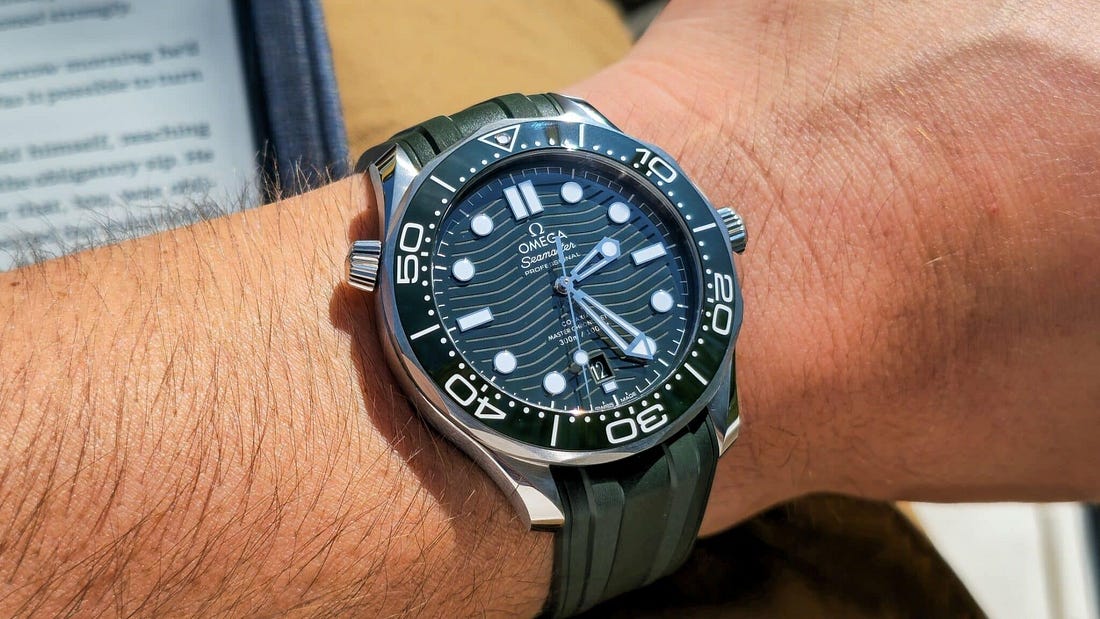
Omega Seamaster vs. Timex Deepwater: What Does the Extra US$6,030 Buy?
The US$6,300 Omega Seamaster Diver 300M and US$270 Timex Deepwater Meridian 200 share the broad outline of a modern dive watch, but their prices reflect very different approaches. Omega supplies a METAS-certified automatic movement, green ceramic dial and bezel, more elaborate finishing, and 300-meter water resistance. Timex counters with dependable quartz timekeeping, a sapphire crystal, and a 200-meter rating.
Hands-on impressions favor the Omega’s mechanical sophistication and refinement, although its bezel action does not fully meet expectations. The Timex earns praise for its satisfying crown and bezel operation, substantial construction, and comfortable case. Those details matter because they shape how the watch feels during ordinary use.
At more than 23 times the Timex’s price, the Seamaster asks its buyer to value the movement, execution, design, and overall ownership experience. The Meridian provides the stronger argument for practical value. The comparison is useful precisely because it allows both conclusions to stand: the Omega can feel special, and the Timex can deliver an impressive amount of watch for the money.
Reviews
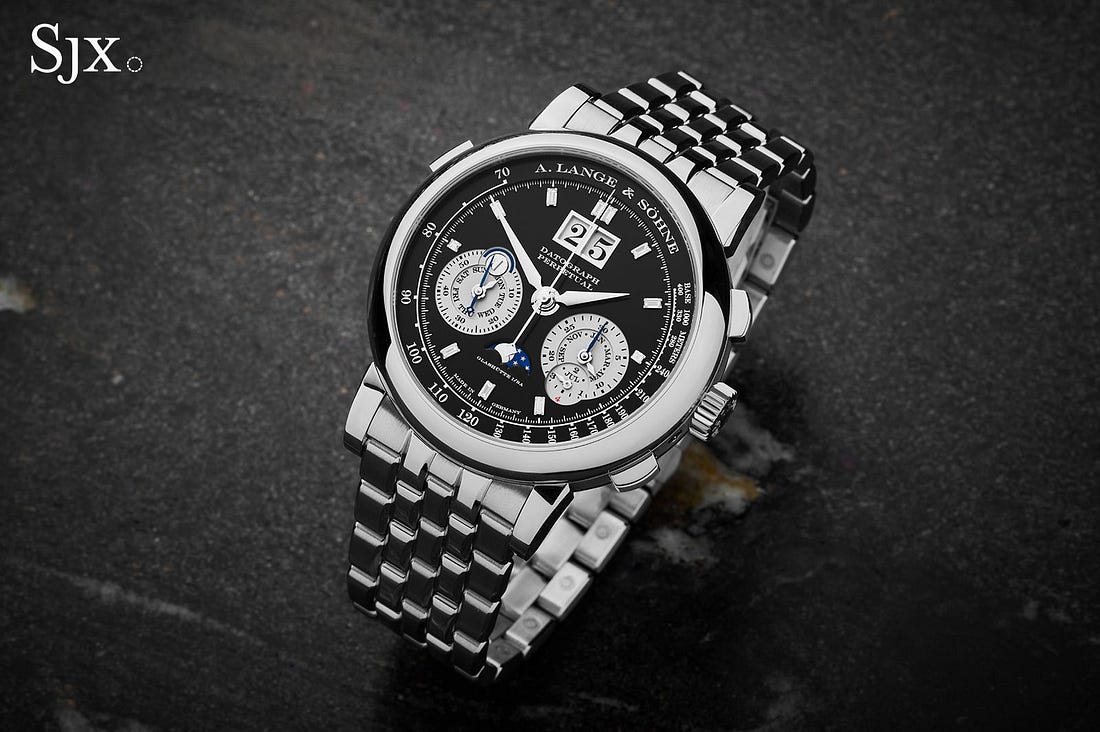
Lange’s Datograph Perpetual Adds a Platinum Bracelet—and Considerable Presence
The A. Lange & Söhne Datograph Perpetual ref. 410.136E pairs the established perpetual-calendar chronograph with a newly engineered platinum bracelet and discreet diamond hour markers. A black dial with silver subdials recalls the original Datograph’s visual character, while the case-and-bracelet combination gives this version a substantial physical presence.
The bracelet is related in design to the Odysseus bracelet, with hand-finished links and a practical sizing system. Inside the 41mm case, the manually wound L952.1 combines a flyback chronograph, perpetual calendar, and large date, with 36 hours of power reserve. The chronograph and date remain prominent and readable, although the smaller calendar indications require more attention.
Recessed pushers handle calendar adjustments, preserving the familiar operating compromises of a traditional complicated watch. Limited to 50 pieces and priced at US$276,000 before taxes, this Datograph Perpetual adds material weight and bracelet craftsmanship to an already ambitious mechanism. The review’s central question is how convincingly those additions work together on the wrist.
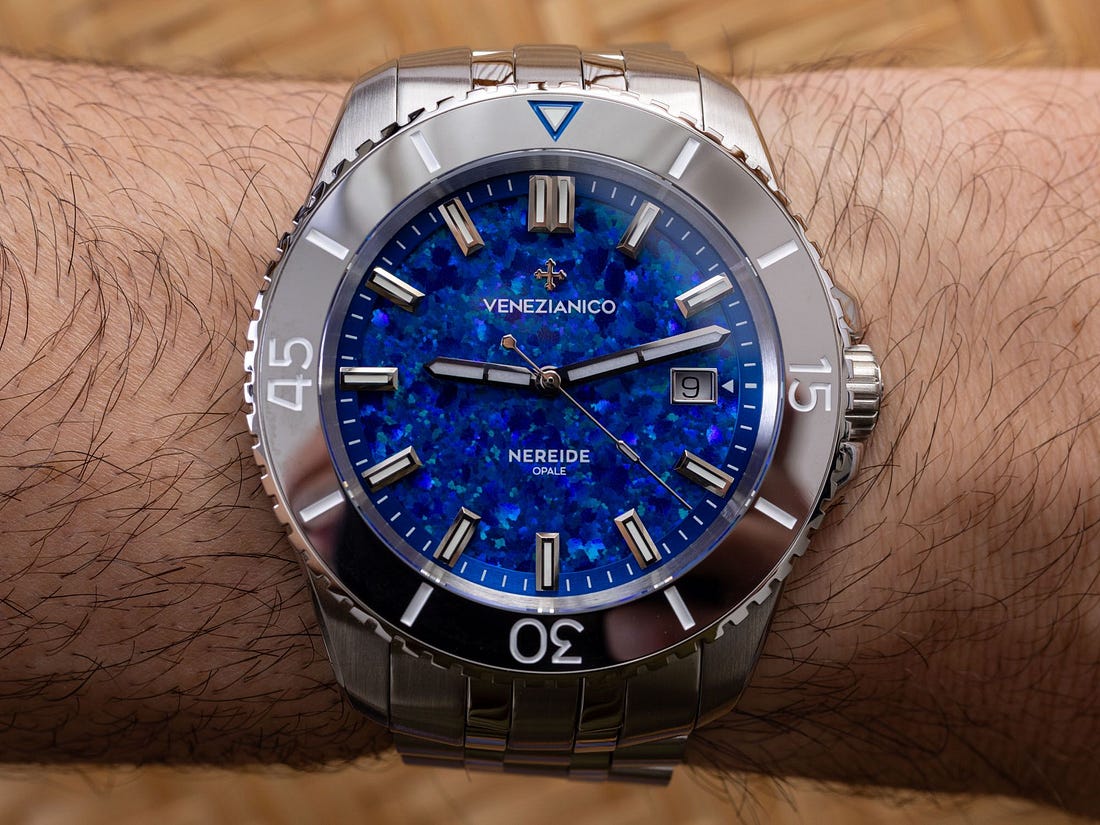
Venezianico Nereide Opale Blu Gives the Dive Watch a Different Surface
The Venezianico Nereide Opale Blu puts a lab-grown blue-and-green opal dial inside a 42mm steel diver’s case. Produced by Kyocera, the material varies in appearance from watch to watch, creating a decorative focal point within an otherwise familiar sporting format. Production is limited to 600 pieces.
The specification includes 200-meter water resistance, a tungsten bezel insert, a 120-click unidirectional bezel, sapphire crystal, and luminous hands and markers. A Swiss automatic Sellita SW200-1 supplies the date and more than 40 hours of power reserve, with a decorated rotor visible through the caseback.
The Sansovino bracelet improves comfort over the earlier design, although it lacks quick-release spring bars and the package includes no additional strap. At US$1,550, the watch’s proposition depends on how strongly the opal appeals to the buyer. The review finds a distinctive dial treatment that adds interest while retaining useful legibility and recognizable diver-watch functionality.
Events
HSNY Launches Chronometry Talks at the Morgan Library & Museum
The Horological Society of New York will hold its inaugural Chronometry Talks on December 3–4 at the Morgan Library & Museum. Conceived as an annual symposium, the event will examine precision timekeeping through history, science, craftsmanship, and its continuing influence on society.
The program brings together historians, watchmakers, auction specialists, astronomers, and other experts. Scheduled subjects include the origins of modern chronometry, Abraham-Louis Breguet, marine chronometers, American precision watches, George Daniels and independent watchmaking, Earth’s rotation, modern time standards, and the 10,000-Year Clock.
The breadth is the attraction. Collectors accustomed to discussing precision through daily rate figures will have an opportunity to explore the scientific and cultural systems behind those measurements. Tickets for the two-day program cost US$160 through HSNY, the nonprofit founded in 1866 to advance horological education.
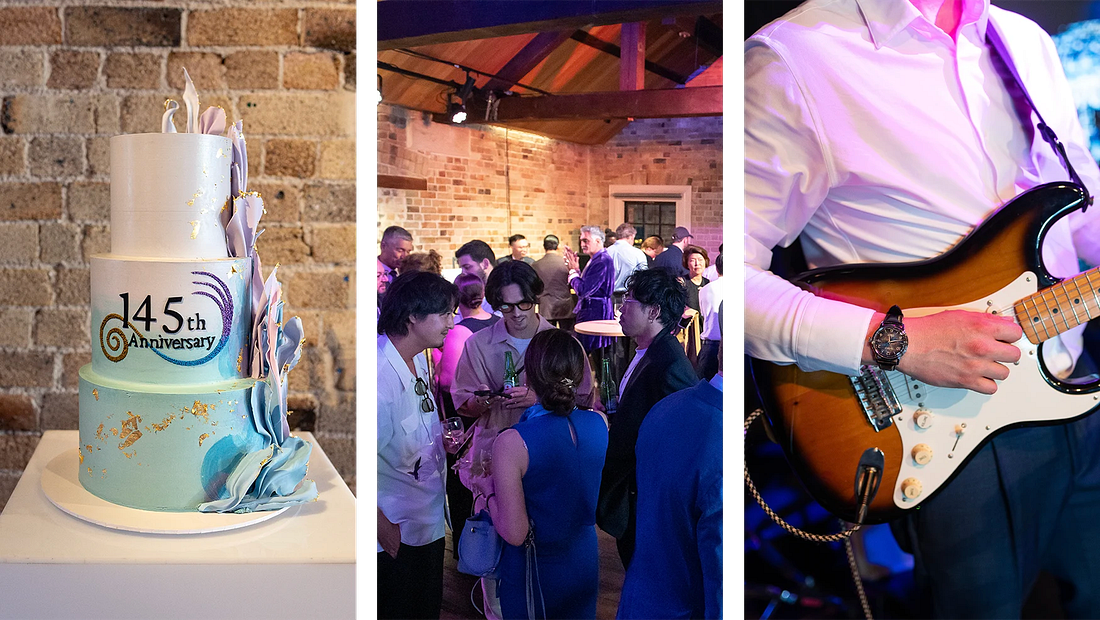
Seiko Celebrates 145 Years on Sydney Harbour
Seiko marked its 145th anniversary at Watersedge in Sydney’s The Rocks, gathering approximately 150 collectors, retail partners, media, and guests. Anniversary watches appeared alongside Prospex, King Seiko, and Presage collections, with racing simulators, Japanese calligraphy, and other experiences giving the evening a broader cultural setting.
Ambassadors Zac Stubblety-Cook and Ben Tudhope joined the celebration, which also included news of an expected extension of the brand’s Supercars and Team 18 partnership through Prospex. Japanese-Australian artist Kentaro Yoshida created an anniversary artwork, while live Japanese jazz and city pop supplied the soundtrack.
Gold, blue, and Edo purple connected the collection’s presentation to Seiko’s past, present, and future. The event also illustrated the breadth of the brand’s audience: people discovering their first mechanical watches can participate in the same conversation as collectors following its more specialized enthusiast offerings.
Podcasts
Fratello On Air Takes a Tour of German Watchmaking
Balazs and Mike explore German watch brands through a combination of company histories, personal experiences, and favorite models. Their route begins with Sinn in Frankfurt and continues through Hanhart, Tutima, Mühle Glashütte, Junghans, Nomos, Stowa, and Laco, moving between Glashütte, the Black Forest, and Pforzheim.
The emphasis falls on sportier watches, pilot chronographs, purposeful design, and the distinctive identities of manufacturers that can receive less international attention than their Swiss counterparts. The hosts also discuss their own watches: Mike wears a 1947 Breitling Chronomat 769 and recounts a demagnetizing experience, while Balazs has an Albishorn Type X-Graph on his wrist.
For listeners considering a German watch, the episode offers an introduction to the different traditions behind the category. It is also a reminder that geographic labels contain considerable variety, from industrial tool-watch thinking to restrained modern design.
Videos

Producer Michael Gets an Early Look at TAG Heuer’s Las Vegas Grand Prix Watches
ProducerMichael visits TAG Heuer in Las Vegas, where Daniela and Sandy introduce two Carrera watches created for the 2026 Las Vegas Formula 1 Grand Prix. The presentation centers on an early look at the limited editions and their connection to one of the sport’s most conspicuous race weekends.
Availability is restricted to the Forum Shops at Caesars Palace and the shops at Crystals. That local distribution makes the watches particularly relevant to collectors attending the race or following TAG Heuer’s event-specific releases. The supplied preview does not establish detailed specifications, production numbers, or pricing, leaving the video to provide the closer introduction.

A Podcast About Watches Considers the Next Hard-to-Get Releases
Andrew and James turn their attention to watches they expect to attract strong demand, discussing how interest develops around releases that may become difficult to obtain. The episode sits at the intersection of collecting enthusiasm, availability, and the market’s habit of deciding that certain watches deserve disproportionate attention.
The supplied description does not identify the specific models discussed. The useful question for viewers is how the hosts arrive at their expectations: whether through design, production constraints, brand momentum, or the behavior of collectors. It is a timely companion to an issue examining the relationship between desirability and price.
Auctions
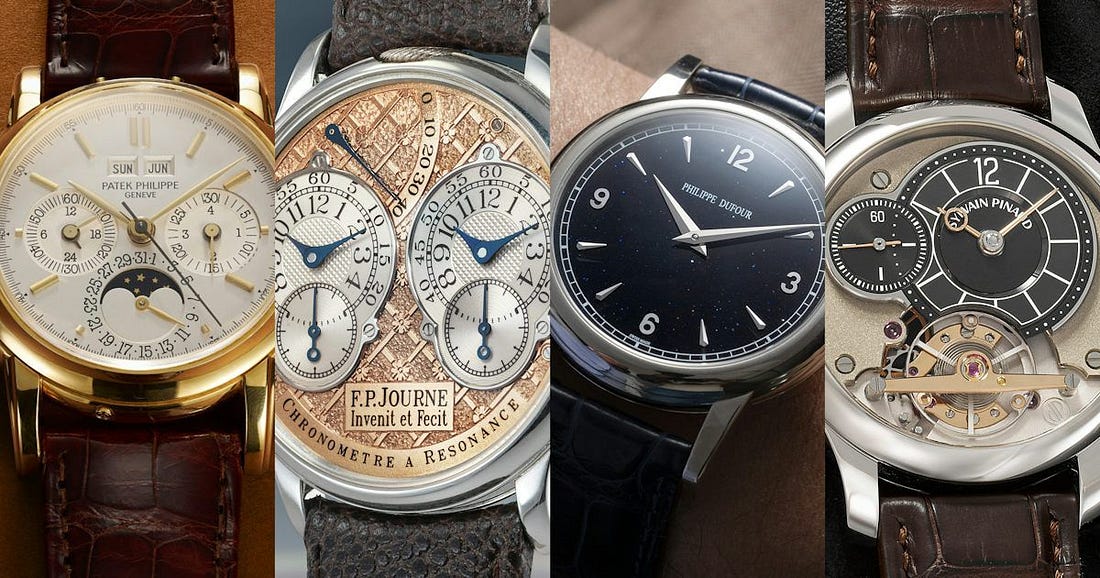
Three Lessons From Geneva’s Fall Auction Season
Geneva’s fall sales reinforced Phillips’ leading position, with a record US$112.3 million result, while Christie’s also established a record Geneva total. At the same time, attention is increasingly turning toward New York and its growing role in the international auction calendar.
F.P. Journe delivered some extraordinary prices, although conversations among dealers and collectors raised questions about market saturation and the depth of resale demand. Patek Philippe’s performance was strong overall but varied by model, illustrating why a brand-level conclusion can obscure meaningful differences between individual watches.
Independent and revival-era watchmakers supplied another important theme. Results for names including Sylvain Pinaud, Philippe Dufour, Kari Voutilainen, and Roger Smith reflected continuing appetite for distinctive craftsmanship and historically significant work. The lesson is to follow the quality and context of the watch closely: a spectacular total can contain several different market stories.
BuyingTime at Auction
Vacheron Sells at US$41,000 as a 99-Piece Ulysse Nardin Freak Takes the Stage
Yesterday’s auction of the 2024 Vacheron Constantin Traditionnelle Complete Calendar Openface ref. 4020T/000G-B655 ended with a winning bid of US$41,000, and the watch sold.
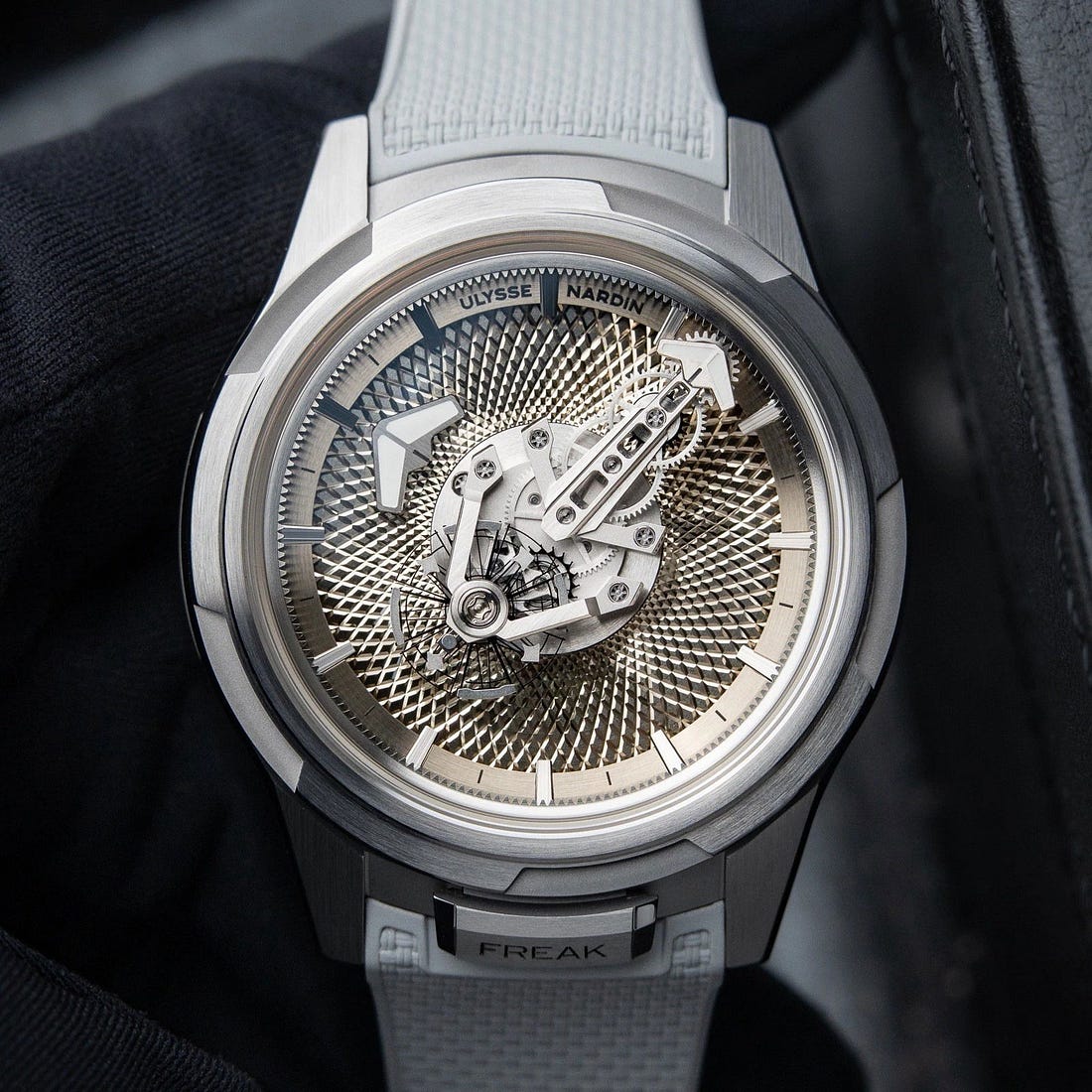
Today’s featured auction moves from white-gold calendar watchmaking to the 2026 Ulysse Nardin Freak ONE Guilloché ref. 2403-500LE-4A-GUI/3A. Limited to 99 pieces, this 44mm titanium example is located in the United States and comes with its box, papers, and product literature. The supplied report describes it as unworn, with the visible components rated excellent, while allowing for possible slight handling marks.
The Freak’s history begins in 2001, when Ulysse Nardin challenged conventional watch architecture with a rotating mechanism that told the time without ordinary hands or a crown. It also helped introduce silicon into mechanical watchmaking, making the collection a significant platform for materials and engineering innovation. The Freak ONE arrived in 2023 and won that year’s GPHG Iconic Watch Prize. This 2026 Guilloché edition adds a warmer decorative character through its sand-toned patterned hour disc, set against a light-grey titanium case and integrated textured rubber strap. Its personality comes from the relationship between traditional surface decoration and an unmistakably unconventional display.
The automatic UN-240 movement provides a 90-hour power reserve and uses Ulysse Nardin’s Grinder winding system, silicon technology, and DIAMonSIL escapement treatment. The flying carousel makes one revolution per hour to indicate minutes, while the rotating hour disc supplies the hours. Time is set through the bezel rather than a conventional crown. Despite the complicated appearance, its displayed functions remain hours and minutes; the mechanical interest lies in how those indications are produced. With 30-meter water resistance, this is an ambitious piece of high horology whose appeal centers on its construction and presentation.
Published U.S. retail pricing for this exact Guilloché reference is US$80,000. A publicly indexed dealer listing for an unworn 2026 example with box and papers advertises US$63,490, approximately 20.6% below retail, providing a useful secondary-market asking benchmark. That figure is an advertised price rather than a completed sale, and a reliable auction-value range for this specific new reference has not been established by the results verified for this report. The limited production and accompanying set strengthen the offering, but the final comparison should include buyer’s fees, taxes, warranty status, and condition. Bidding is scheduled to end at 1:50 p.m. EST today, Wednesday, November 11, 2026.
Current bid: $20,501
Losing Time
Some of Yesterday’s Big Losers at Auction on Grailzee
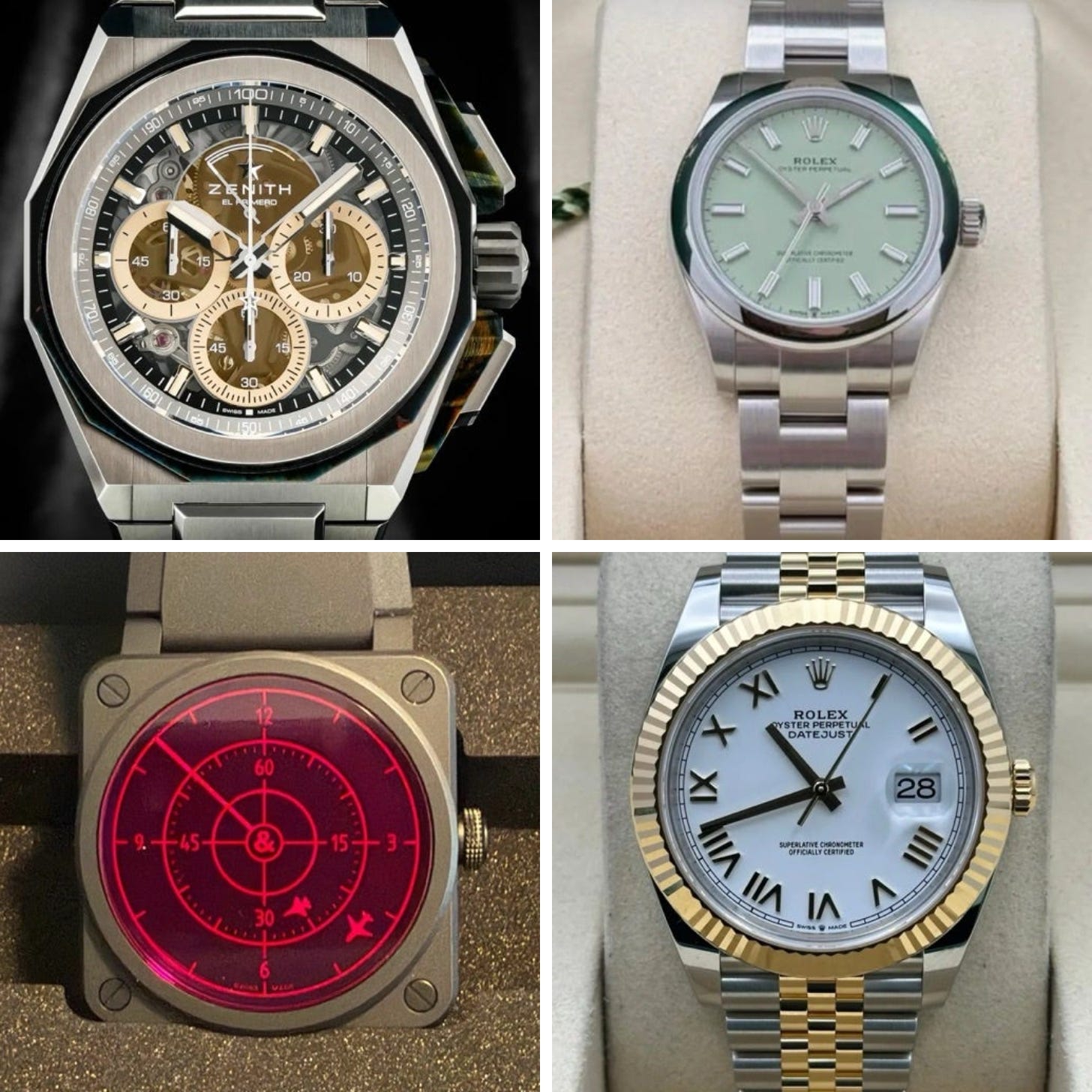
Four watches, four failed sales, and a useful reminder that an asking price is an aspiration until someone agrees to pay it.
The Zenith Defy Extreme Desert 45MM Skeleton Dial Titanium Bracelet (95.9200.9004/77.I001) came with a $20,500 ask and attracted a $5,800 bid—a $14,700 shortfall, or 71.7% below asking. “Extreme” turned out to describe the distance between the seller’s expectations and the bidding.
The 2026 Rolex Oyster Perpetual 31MM Pistachio Dial Oyster Bracelet (277200) sought $10,000 but topped out at $6,000, leaving a $4,000 gap, or 40.0% below asking. Pistachio may be an appealing flavor, but these bidders weren’t ordering the full-price scoop.
The 2021 Bell & Ross BR 03-92 Ceramic 42MM Black “Red Radar” Dial Rubber Strap (BR0392-RRDR-CE/SRB)asked $4,250 and drew $1,200—a $3,050 miss, or 71.8% below asking. The radar apparently detected everything except a buyer anywhere near the seller’s price. It narrowly edged the Zenith for the largest percentage shortfall.
The 2026 Rolex Datejust 41MM White Dial Two-Tone Jubilee Bracelet (126333) performed best in this particular contest of unmet expectations. Its $12,600 high bid fell $5,900 short of the $18,500 ask, or 31.9% below asking. Closest to the target, yes. Close enough to sell, apparently not.
Together, the four sellers sought $53,250 and attracted $25,600 in final bids—a combined $27,650 shortfall, or 51.9% below asking. Both Rolexes attracted bids closer to their asking prices than the Zenith or Bell & Ross, but none closed the gap. These results don’t establish fair market value or prove a broader market slump; they show that, in these auctions, seller expectations substantially outran bidder willingness. The asking prices made their speeches. The bidders offered a fairly blunt rebuttal.
Closing Time
Today’s watches span a remarkable distance: a $275 ana-digi, a hand-painted sunrise-and-sunset complication, a century of independent ideas, and an auction market capable of producing $203 million in a weekend.
There is room to enjoy all of it. Follow a maker you have overlooked, look more closely at a familiar design, or spend a few minutes learning what makes the watch already on your wrist interesting. The best collecting days leave you with something beyond a price to remember.
Thank you for spending part of your day with BuyingTime. We’ll see you tomorrow.