Richard Mille Meets a Real Auction Room—and the Room Blinks
Grailzee put three Richard Mille RM 011s before a watch-buying audience and asked the most inconvenient question in modern luxury: what will people actually pay when the timer is running and the dealer rhetoric is switched off?
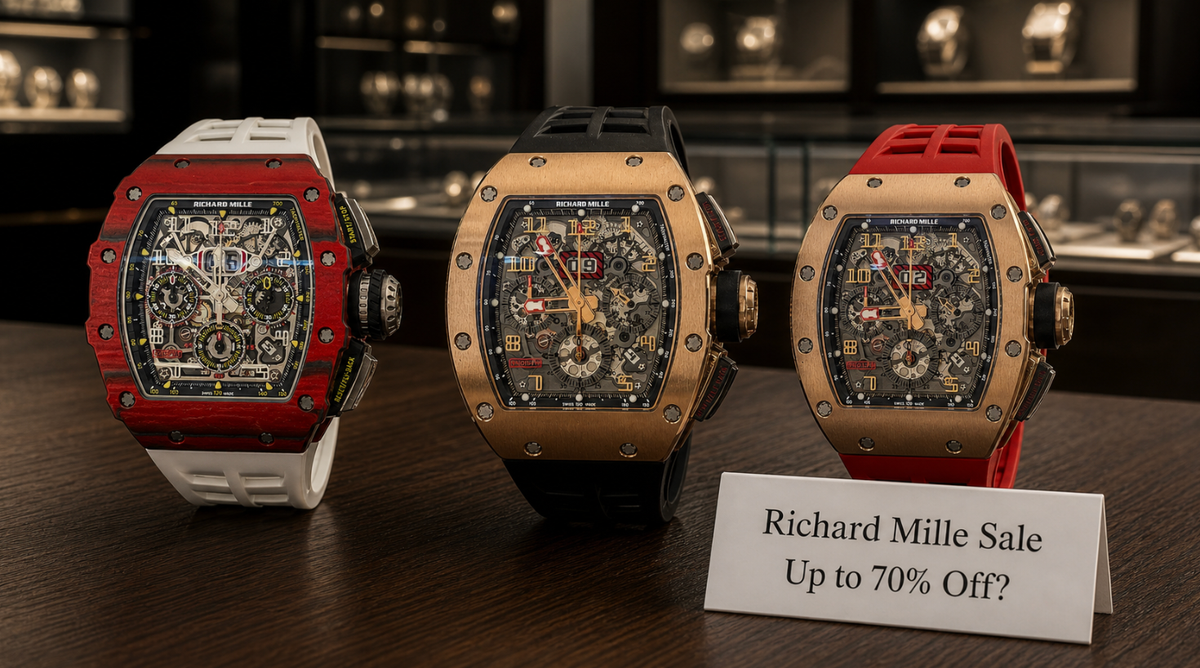
On Thursday night (August 13, 2026), Grailzee (grailzee.com) put three Richard Mille RM 011s before a watch-buying audience and asked the most inconvenient question in modern luxury: what will people actually pay when the timer is running and the dealer rhetoric is switched off?
The answer was not flattering.
Richard Mille has long sold the fantasy of the all-too-rich: Formula 1 materials, exotic composites, skeletonized movements and the unmistakable tonneau case that announces itself from the next zip code. It is engineering as conspicuous consumption—a wrist-mounted supercar for buyers who need their possessions to enter the room a few seconds before they do.
But at auction, the fantasy has to survive contact with a bid button.
| Grailzee lot | Highest bid at close | Comparison point | Gap |
|---|---|---|---|
| RM 011 “Felipe Massa” (RM011 AK RG) | $30,001 | $215,000 dealer ask for a comparable RM011 AK RG | 86% below ask |
| 2018 RM 11-03 FQ TPT | $39,600 | $278,995 dealer ask for a comparable red FQ TPT | 86% below ask |
| 2022 RM 011 AM-Ti | $39,500 | $215,900 Phillips result for a comparable AM-Ti in late 2025 | 82% below that auction result |
The $30,001 bid on the rose-gold RM011 AK RG is especially bracing beside a $215,000 dealer listing. The $39,600 bid on the red FQ TPT looks equally lonely next to published dealer asks around $279,000. And EveryWatch records a comparable RM011 AM-Ti selling through Phillips for $215,900 in December 2025.
Those are not small discounts. They are the sort of gaps that make a spreadsheet clear its throat before telling you that the “investment” portion of the pitch may be wearing a rubber strap.
A necessary adult note: dealer asks are not transactions, and a high bid is not necessarily a completed sale. Grailzee itself labels some RM 11-03 FQ TPT auctions as having failed to meet reserve. Condition, completeness, provenance, service history and whether a seller actually accepts the bid all matter. Nor does one night on one platform establish a universal market price. It does, however, establish something useful: in this particular room, on this particular night, nobody wanted to underwrite retail-dealer optimism.
The value is real—just not necessarily where the price tag says it is
Calling every Richard Mille “worthless” would be lazy. The brand is a legitimate Swiss high-watchmaking operation founded by Richard Mille and Dominique Guenat in 2001. Its early RM 001 was deliberately launched as a six-figure tourbillon; the brand’s own history makes clear that the stratospheric positioning was there from the beginning. The RM 011 arrived in 2006, and its flyback chronograph, annual calendar, variable-geometry rotor and F1-inflected design became one of the company’s signature acts. Richard Mille’s official history documents both the six-figure debut and the RM 011’s introduction.
That is real product development. Exotic materials, lightweight construction and unusually complicated architecture do not assemble themselves out of motivational quotes and carbon fiber wallpaper.
But there is a canyon between “real engineering” and “every asking price is real value.” The RM 011 market has been fueled by scarcity, celebrity associations, the sports-and-entertainment ecosystem and a decade of gray-market momentum. In a dealer showroom, that package can be sold as a passport to a certain universe. In a live auction, the prospective buyer is more likely to ask a blunt question: “Fine. But what am I actually buying at this number?”
Thursday’s bids supplied an answer that dealers will not enjoy framing.
Was Richard Mille’s pricing born from a typo?
The entertaining rumor is that an early Richard Mille listing accidentally added a zero—turning something like $14,500 into $145,000—and that buyers rushed in because the price itself was the feature.
It is a good story. It is also unsupported.
There is no credible contemporaneous evidence for the typo tale, and it clashes with the company’s documented original strategy: the RM 001 launched in 2001 at a six-figure price point. Richard Mille was not accidentally priced like a Veblen good; it was designed to be one. The typo story survives because it is a neater explanation for the phenomenon than the real one: sophisticated product, tiny production, hard luxury marketing and a clientele for whom signaling matters at least as much as horology.
Miami heat, or market fever breaking?
Perhaps Richard Mille is more valuable in Miami, Dubai and the private-room economy than it is to a broad national pool of watch collectors who visit auction sites like Grailzee and Bezel. That is plausible. The brand’s appeal has always been unusually dependent on context: the supercar valet, the courtside seat, the athlete’s locker room, the nightclub table, the social-media flex.
Put the same watch in front of buyers who also lust after Patek Philippe, Audemars Piguet and A. Lange & Söhne—brands whose appeal is rooted more deeply in design lineage, finishing and collector history—and the RM can begin to look like a wonderfully engineered object carrying a great deal of lifestyle markup.
That does not make an RM purchase “stupid” for everyone. If you love the machine, understand the servicing and liquidity risks, and can afford for the watch to behave like jewelry rather than an investment, buy what delights you. The stupid purchase is paying a heroic premium because someone in a loud showroom convinced you that a dealer ask is a market fact.
For a useful look at how this world is marketed, visit Timepiece Trading’s YouTube channel. Its “I Made Over $100M Selling Richard Mille & Rolex in 3 Years!” video is less a valuation seminar than a reminder that lifestyle spectacle is a powerful sales tool. Watch it with the sound on, then look again at the Grailzee bids.
The inexpensive cure
If what you really want is the oversized, technical, absurdly extroverted silhouette, there are cheaper ways to scratch the itch. Tsar Bomba sells plenty of tonneau-shaped, interchangeable-component watches in the roughly $300–$1,000 range. And if restraint has already left the building, Invicta has an entire under-$100 section.
Neither is a Richard Mille. That is the point. They will not deliver the movement architecture, materials science or social signaling of a genuine RM. They may, however, deliver 90 percent of the visual shout for a fraction of one percent of the money—and leave enough capital for a good watch that the market actually wants when it is time to sell.