Secondary Watch Market Showing Signs of Accelerating Stress as Dealer Buy Prices Collapse
Grailzee and Bezel are now experiencing what appears to be a record number of watches failing to meet reserve prices.
The secondary luxury watch market appears to be entering another significant contraction phase, with data tracked by WatchCharts (watchcharts.com) showing that average secondary market pricing has been falling for the past three weeks at an annualized average growth rate (AAGR) of negative 28.1%. More concerning than the headline decline itself is what is happening underneath the surface: dealer buy prices are falling rapidly while advertised retail asking prices remain artificially elevated.
That widening disconnect is becoming one of the clearest warning signs yet that the modern secondary watch ecosystem may be under far greater stress than many resellers are willing to publicly acknowledge.
According to Buying Time (buyingtime.news) research, online auction platforms including Grailzee (grailzee.com) and Bezel (getbezel.com) are now experiencing what appears to be a record number of watches failing to meet reserve prices. Just one month ago, newer-model Rolex sports watches routinely attracted aggressive bidding activity, particularly in no-reserve formats that encouraged momentum and buyer urgency. That activity has now largely evaporated.
In recent weeks, Buying Time observed that no-reserve auctions for modern Rolex models have nearly disappeared entirely from major online platforms. The few remaining no-reserve listings are increasingly concentrated around older, slower-moving, or less desirable inventory. That shift is not accidental. Sellers and auction platforms appear increasingly unwilling to expose modern inventory to true market pricing discovery for fear that realized prices could reset expectations lower across the industry.
Perhaps the strongest evidence of deteriorating market conditions comes from the rapidly expanding spread between dealer retail pricing and dealer acquisition offers. Historically, secondary watch dealers operated with healthy but manageable spreads between what they would pay for inventory and what they hoped to resell that inventory for. That spread has now widened dramatically.
One notable example tracked by Buying Time involves the 2025 Rolex Explorer II Polar reference 226570. Watchfinder & Co. (watchfinder.com) recently listed the watch for approximately $13,500 while simultaneously offering only $9,190 to purchase the same model from sellers. That creates a delta of $4,310 between buy and sell pricing.
At Bob’s Watches (bobswatches.com), the same watch is currently listed around $13,395 while the company is offering approximately $9,200 to acquire inventory, creating another unusually large spread of roughly $4,195.
Buying Time research indicates that advertised retail prices for this reference have remained relatively stable online, while dealer acquisition offers have fallen by more than 15% in only a matter of weeks. In practical terms, dealers are already repricing the market downward internally while attempting to avoid public-facing retail markdowns that could trigger broader panic among sellers and collectors.
Another revealing sign of stress inside the secondary market is the dramatic expansion in the profit margins many resellers now appear to require before taking inventory risk. Dealers such as WatchGuys (watchguys.com) have publicly discussed in videos and online content how a traditional target on many modern luxury watch flips was often around $1,500 in gross profit per transaction. In the current environment, however, market behavior suggests many resellers are now seeking two or even three times that spread before agreeing to purchase inventory. That shift reflects growing fear surrounding holding costs, slower inventory turns, declining buyer demand, and the possibility that prices could continue falling while watches sit unsold in dealer safes. In essence, dealers are demanding far larger cushions simply to justify the risk of owning inventory in a rapidly weakening market. Do they deserve it?
That strategy may not be sustainable for much longer.
The growing delta between buy and sell pricing strongly suggests that major resellers are becoming increasingly concerned about liquidity risk and inventory exposure. Companies including WatchGuys (watchguys.com), Bob’s Watches (bobswatches.com), and Watchfinder & Co. (watchfinder.com) appear to be positioning defensively as buyer demand weakens and inventory turnover slows.
The danger for the industry is obvious. Dealers accumulated massive inventories during the post-pandemic luxury boom when stimulus spending, cheap capital, crypto wealth, and speculative flipping pushed watch prices to historic highs. That environment no longer exists. Financing costs are higher, discretionary spending is weakening, and consumer confidence has deteriorated sharply.
Importantly, this downturn cannot simply be blamed on tariffs or temporary trade disruptions. The broader issue appears tied to weakening economic conditions among American consumers and growing uncertainty surrounding the current economic environment. Luxury watches remain highly discretionary purchases, and secondary market pricing often acts as an early warning indicator for declining consumer confidence among upper-middle-class buyers.
Auction activity may now be revealing the true state of demand more accurately than dealer listings themselves. Across multiple platforms, newer Rolex models are increasingly failing to meet reserve prices — and in some cases not even approaching them. That represents a significant shift from conditions earlier this spring when buyers aggressively chased nearly any modern steel Rolex placed into auction.
The disappearance of no-reserve auctions for desirable modern inventory may ultimately become one of the clearest indicators that market participants themselves no longer trust current pricing levels.
For buyers, the current environment could eventually create meaningful opportunities if retail asking prices finally begin adjusting downward to reflect collapsing dealer acquisition values. For sellers, however, the situation is becoming increasingly difficult. Many owners still anchor expectations to peak 2022 and 2023 pricing, while dealers are quietly repricing inventory risk much lower behind the scenes.
Buying Time believes the secondary watch market remains under substantial stress and that further declines across multiple categories appear increasingly likely unless buyer demand materially improves. The next several months may determine whether the luxury watch secondary market experiences a gradual correction — or a far more aggressive repricing event.
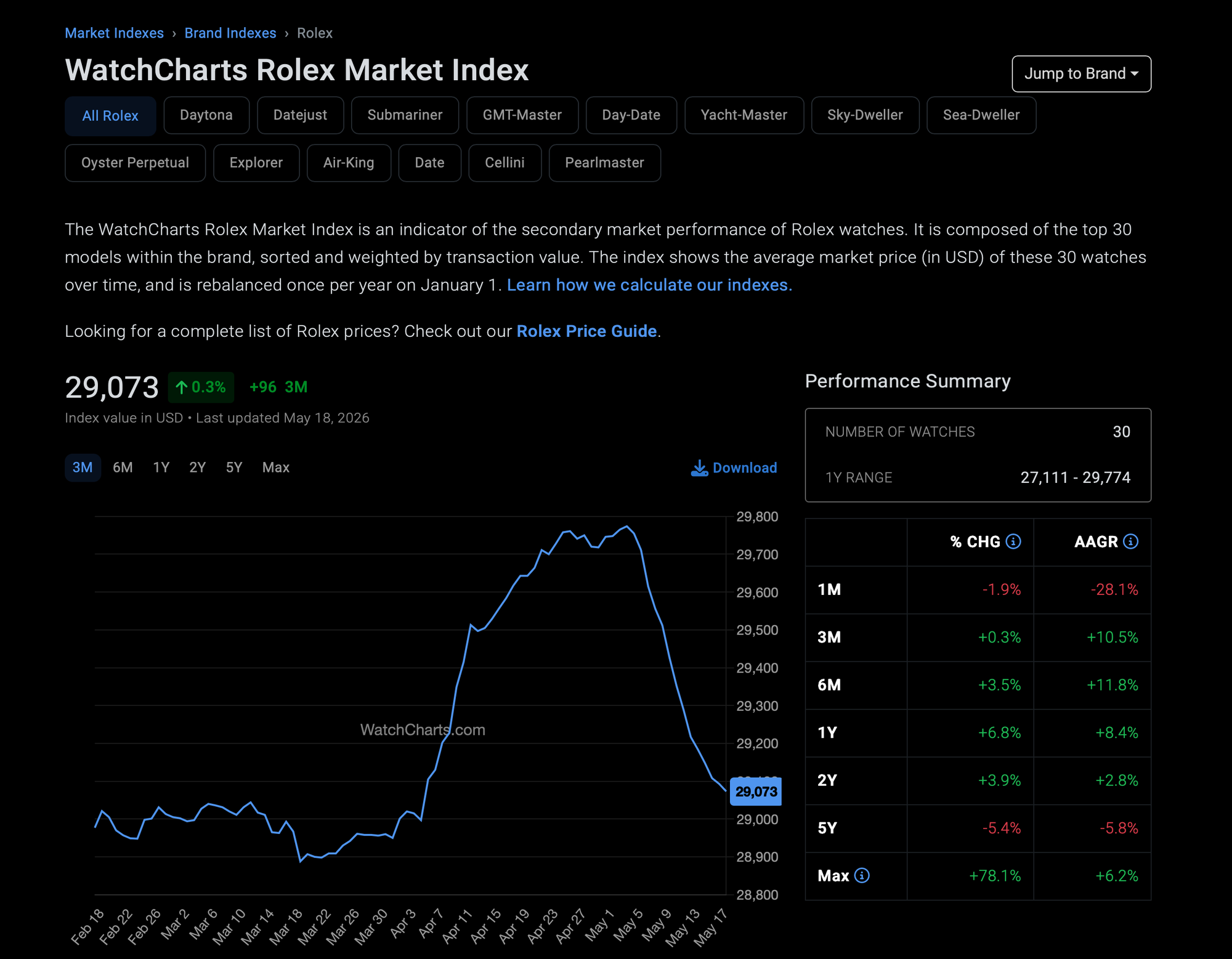
Note the last few weeks.