Stop Trying to Out-Rolex Rolex
The Swiss watch industry does not need more brands chasing the same crown. It needs brands confident enough to offer something else.
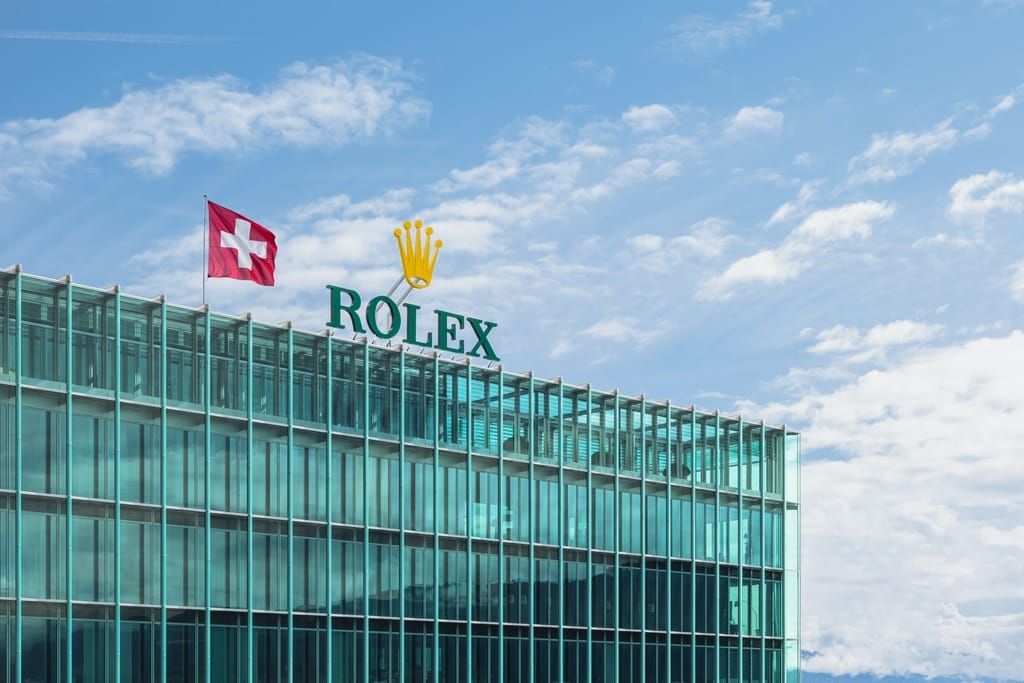
The Swiss watch industry has a Rolex problem. But the problem is not simply that Rolex is too successful. It is that too many competitors appear to misunderstand what its success represents.
They see expensive steel watches, recognizable designs, substantial production, powerful distribution, and extraordinary demand. Then they try to reproduce that combination through higher prices, upgraded movements, celebrity partnerships, boutique expansion, and another polished sports watch with a ceramic bezel.
When the expected growth fails to materialize, the response is often another repositioning. Prices rise again. Production falls. Distribution contracts. Management starts talking about exclusivity, rarity, and moving upmarket.
Somewhere in that process, the customer who actually liked the brand gets left behind.
The fundamental mistake is treating Rolex as a product proposition that can be replicated rather than a cultural position that has accumulated over generations. A competitor can make a watch that is thinner, more complicated, more elaborately finished, or more resistant to magnetic fields. It cannot simply manufacture the public understanding attached to the Rolex name.
Rolex deserves serious competition. Buyers benefit when other manufacturers challenge its products, service, pricing, and assumptions. But competing with Rolex is not the same as trying to become Rolex.
For most of the industry, the smarter ambition is to become indispensable for a different reason.
Rolex became the noun
Ask someone with little interest in watches to name an expensive watch. There is a good chance the answer will be Rolex.
Not necessarily Patek Philippe. Not Jaeger-LeCoultre. Almost certainly not Zenith.
Rolex occupies the space between a brand name and a category shorthand. Much as Kleenex, Band-Aid, and Q-tip are used conversationally beyond their precise branded products, Rolex communicates an idea larger than the watches themselves: an expensive, successful-person watch.
This is a cultural analogy, not a claim that Rolex has become a legally generic trademark. People do not ordinarily call an Omega “a Rolex.” But they understand the Rolex reference without requiring an explanation.
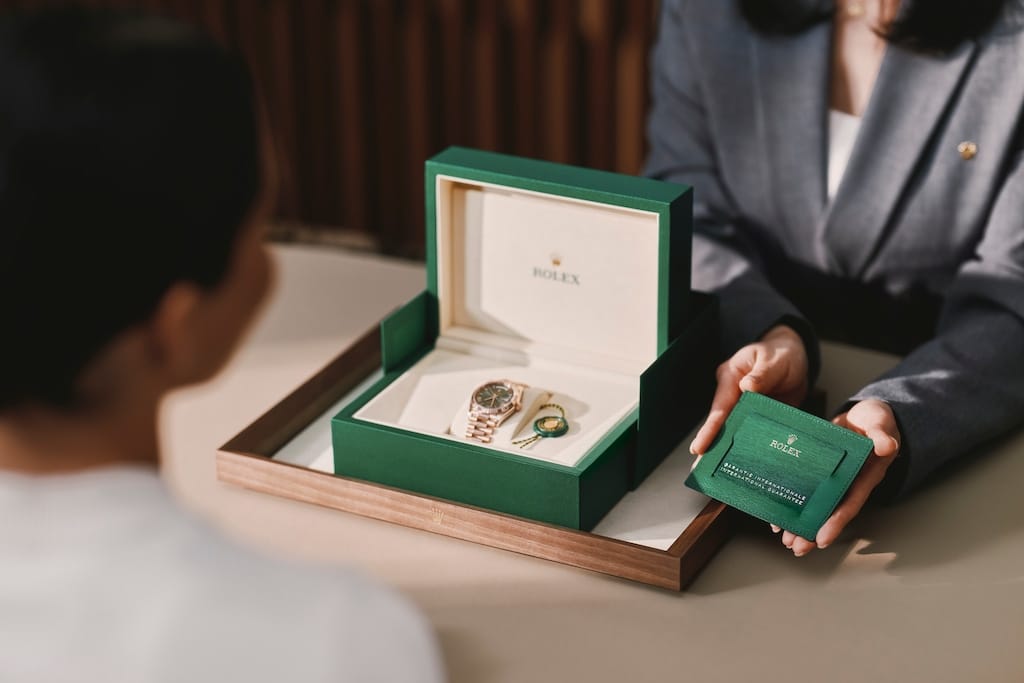
That recognition is measurable. A 2024 U.S. survey put Rolex’s aided brand awareness at 85%. Recognition does not establish that everyone wants one, but it demonstrates how far the name reaches beyond the enthusiast community.
For the buyer, that familiarity removes uncertainty. For the observer, it makes the message legible.
“I bought a Rolex” already contains an explanation: a milestone, a reward, an achievement, a financial arrival. “I bought a Zenith” may require a second sentence.
That second sentence is not a problem for an enthusiast. Explaining the El Primero might be part of the pleasure. But a significant portion of the luxury market is not shopping for an explanation. It is shopping for an answer.
Rolex already supplies one.
The path of least resistance
This is where the Toyota Camry comparison becomes useful.
A Camry and a Rolex occupy radically different economic and emotional categories. One is mainstream transportation; the other is discretionary luxury. The comparison is not about price, prestige, or whether either product is objectively the best choice for everyone.
It is about how people choose.
“I need a midsize sedan.”
“Buy a Camry.”
“I want a nice watch.”
“Buy a Rolex.”
Both answers reduce a complicated purchase to a familiar recommendation. The buyer does not have to investigate every alternative, establish a hierarchy of technical differences, or defend the decision afterward.
The Camry’s continuing position as America’s best-selling sedan illustrates the strength of that established place in its category.

For enthusiasts, research is entertainment. Comparing movements, bracelets, case proportions, service costs, and historical references is part of ownership.
For everyone else, research is work.
A successful default brand absorbs some of that work on the customer’s behalf. Its reputation becomes a substitute for expertise.
A Zenith might be a more satisfying choice for a particular person. A JLC might be more elegant. An Omega might offer the preferred combination of design and engineering. But discovering those preferences requires effort.
Rolex often enters the conversation before the comparison process even begins. That is an enormous advantage, and another specification on a product page does little to overcome it.
Social recognition is part of the product
Watch enthusiasts sometimes dismiss status buying as though it were an illegitimate use of a watch. That misses the nature of luxury.
A luxury purchase can be about craftsmanship, aesthetics, history, belonging, accomplishment, or recognition. Frequently, it is about several at once.
Rolex is unusually effective because its message reaches people who know nothing about watchmaking. A technically extraordinary watch has limited signaling value if its audience cannot identify it.
Social media amplifies that advantage. The athlete has a Rolex. The entrepreneur has a Rolex. The successful person on a carefully curated feed has a Rolex. Over time, the watch becomes part of the visual vocabulary of success.
Research on influencer exposure supports the broader mechanism: social comparison and fear of missing out can encourage conspicuous consumption. That does not explain every Rolex purchase, but it helps explain why repeated visibility matters.
The same mechanism operates in professional environments.
“Dress for the job you want” is, in part, an instruction to adopt the recognizable cues of the group you hope to join. In an office where senior employees wear Rolex, an aspiring colleague may see one as part of that uniform.
It does not prove competence, and no watch guarantees advancement. In some workplaces, conspicuous spending can be counterproductive. Research into luxury watches at work emphasizes precisely that contextual complexity.
Nevertheless, the signal only works when others can read it.
An equally expensive Blancpain might communicate discernment to a collector and nothing at all to a manager. Rolex has the advantage of being understood by both.
Its recognizability is not incidental to the purchase. For many customers, it is a substantial part of what they are buying.
Rolex does not have to be haute horlogerie
None of this requires pretending Rolex makes mediocre watches.
Its success rests on a credible product. Familiar designs would not have the same enduring authority if the underlying ownership experience consistently disappointed.
But Rolex’s core identity is not traditional haute horlogerie: exceptional hand finishing, artisanal movement construction, rare complications, and the celebration of mechanical craft as an end in itself.
It is better understood as highly accomplished industrial luxury watchmaking.
That distinction is not an insult. Industrial consistency is difficult. Producing large numbers of mechanical watches to demanding standards is a different achievement from finishing a handful of movements to an extraordinary artisanal level.

Nor does conventional presentation mean an absence of innovation. Rolex develops technical solutions, and watches such as the Sky-Dweller and Land-Dweller complicate any claim that it never does anything unusual. The important distinction is that the customer-facing proposition remains familiar.
The owner usually wants a recognizable watch that displays time clearly and fits ordinary life—not a lesson in unconventional time indication.
That strengthens the Camry analogy. Neither product needs to make its owner an enthusiast.
A manufacturer can build something more exotic and still fail to build something more desirable to the default buyer. The assumption that mechanical sophistication naturally translates into broader market demand is one of the watch industry’s recurring strategic errors.
Sometimes conventionality is precisely the point.
A foundation can afford patience
Rolex’s ownership structure reinforces its cultural advantage.
Rolex is a commercial business owned by the Hans Wilsdorf Foundation, not a publicly traded company. The charitable foundation and the operating company should not be confused: Rolex is not a nonprofit watch factory unconcerned with financial performance.
It still needs sound economics. It still has costs, employees, investment requirements, and competitive pressures. Its foundation ownership does not magically guarantee wise decisions.
But it removes certain demands.
There is no public share price requiring a fresh narrative every quarter. No private-equity exit needs preparing. No family inheritance has to divide control among competing heirs.
That creates room for an unusually long planning horizon.

Publicly traded groups can think long term, too. Some do. The difference is not that their managers are incapable of patience; it is that patience must compete with other institutional priorities.
Rolex can preserve an identity without constantly explaining why it has not reinvented it.
For competitors, this produces an awkward mismatch. They are challenging an institution whose value compounds through continuity while often being judged on much shorter financial timelines.
Rolex does not need to win every novelty cycle. It needs to remain convincingly Rolex.
That is a much easier position to defend than a perpetual promise of transformation.
Tudor shows what cannot be transferred
Tudor is a particularly useful warning against assuming Rolex’s success can be reproduced from the same ingredients.
Hans Wilsdorf created Tudor to provide a more modestly priced watch backed by Rolex’s standards and support. Its historical relationship with Rolex is not a marketing invention; it is central to the brand’s origins.
Yet Tudor did not inherit Rolex’s place in the public imagination.
It has credible products, recognizable enthusiast models, and genuine appeal. None of that automatically makes it the default luxury-watch answer below Rolex.
The ownership relationship can even create ambiguity. What reassures one buyer—its connection to Rolex—may tell another that it is the less prestigious alternative.

This does not make Tudor a failure. A substantial specialist watch business is not unsuccessful merely because it does not dominate its price bracket. Nor does secondary-market depreciation, by itself, establish poor product quality or weak profitability.
Tudor is also not a perfectly controlled experiment. Its positioning, distribution, history, and strategic boundaries differ from Rolex’s.
Nevertheless, it demonstrates an important limitation: Rolex’s cultural meaning does not pass through an ownership chart.
If that meaning were easily transferable, Tudor would have an advantage no independent challenger could match. Its experience should make other brands cautious about assuming they can achieve through product development and advertising what Rolex’s own closely related brand has not inherited.
Zenith exposes the premiumization trap
Zenith makes the problem more tangible because there is a visible long-term pattern.
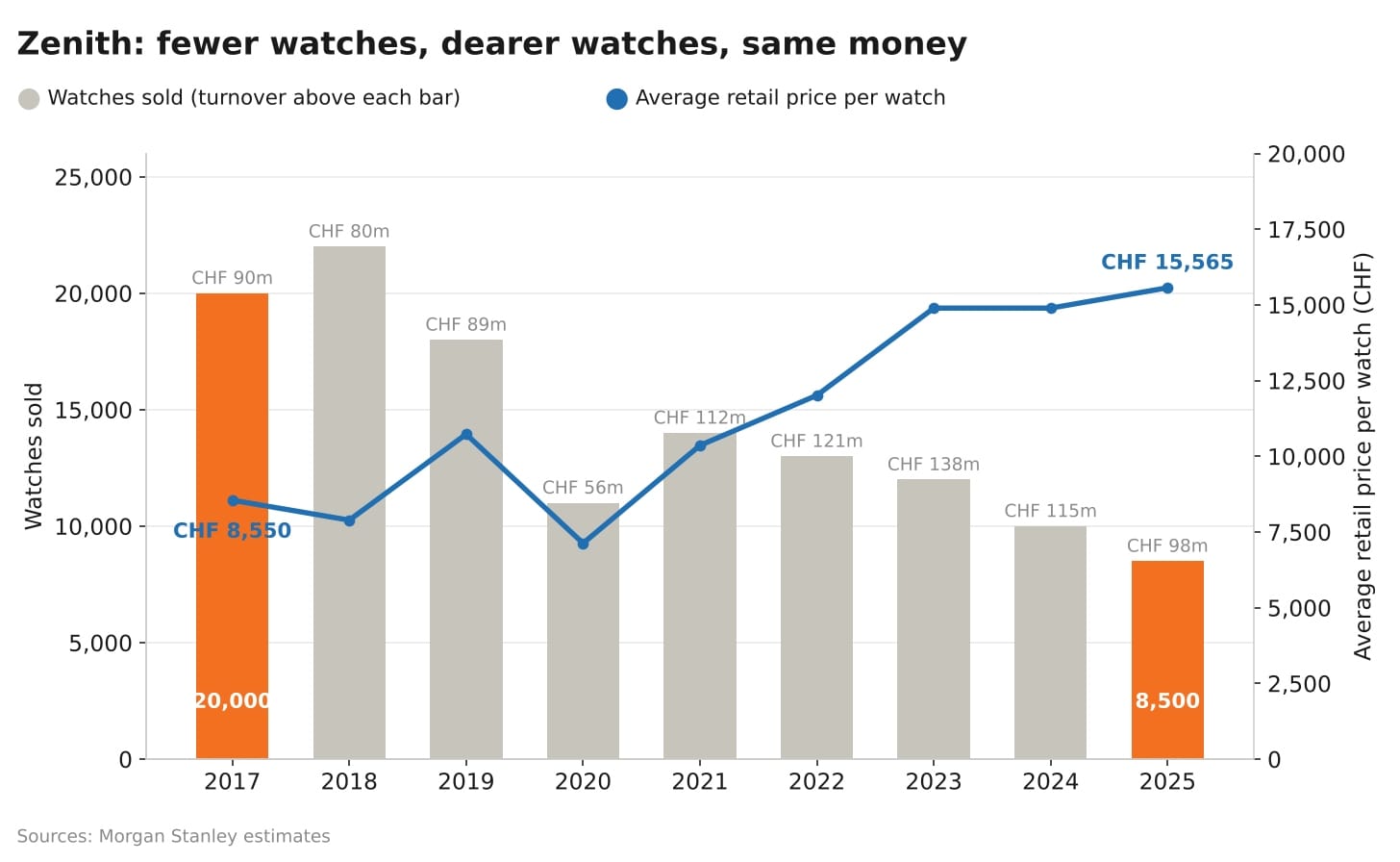
The chart based on Morgan Stanley estimates shows annual volume reaching about 22,000 watches in 2018, then declining to 8,500 in 2025. Across the same period, estimated average retail price roughly doubled.
Use 2017 as the comparison point and the picture is equally revealing: 20,000 watches, CHF 90 million in turnover, and an average retail price of CHF 8,550. By 2025, those figures were 8,500 watches, CHF 98 million, and CHF 15,565.
In other words, units fell 57.5%, average retail price rose about 82%, and nominal turnover increased less than 9% over eight years.
There are important qualifications.
These are analyst estimates, not an audited Zenith financial series. Average retail price reflects product mix as well as changes in like-for-like pricing. It should not be confused with Zenith’s recognized revenue per watch; the chart’s turnover and retail-price series are not the same accounting measure.
The data also does not prove that higher prices caused the entire decline. Economic conditions, regional demand, distribution, and product decisions all matter.
But it does present a difficult question for the strategy.
Zenith sold far fewer watches without achieving a proportionate improvement in turnover. From the chart’s CHF 138 million revenue high in 2023, turnover then fell to CHF 98 million in 2025.
Premiumization may have supported revenue temporarily. It did not make the business immune to falling demand.
The enthusiast does not necessarily move with the brand
The common assumption behind moving upmarket is that a brand’s existing customers will either follow or be replaced by wealthier ones.
Neither outcome is automatic.
An enthusiast who buys a Zenith at one price has not pledged unlimited loyalty to the name. The decision may depend on a particular relationship between mechanical substance, history, design, individuality, and cost.
Change the cost substantially and the decision changes.
That is true even when the customer can afford more. Ability to pay is not willingness to pay.
A buyer may gladly purchase a manufacture chronograph at $8,000 and reject it at $12,000—not because $12,000 is impossible, but because the comparison set has changed.
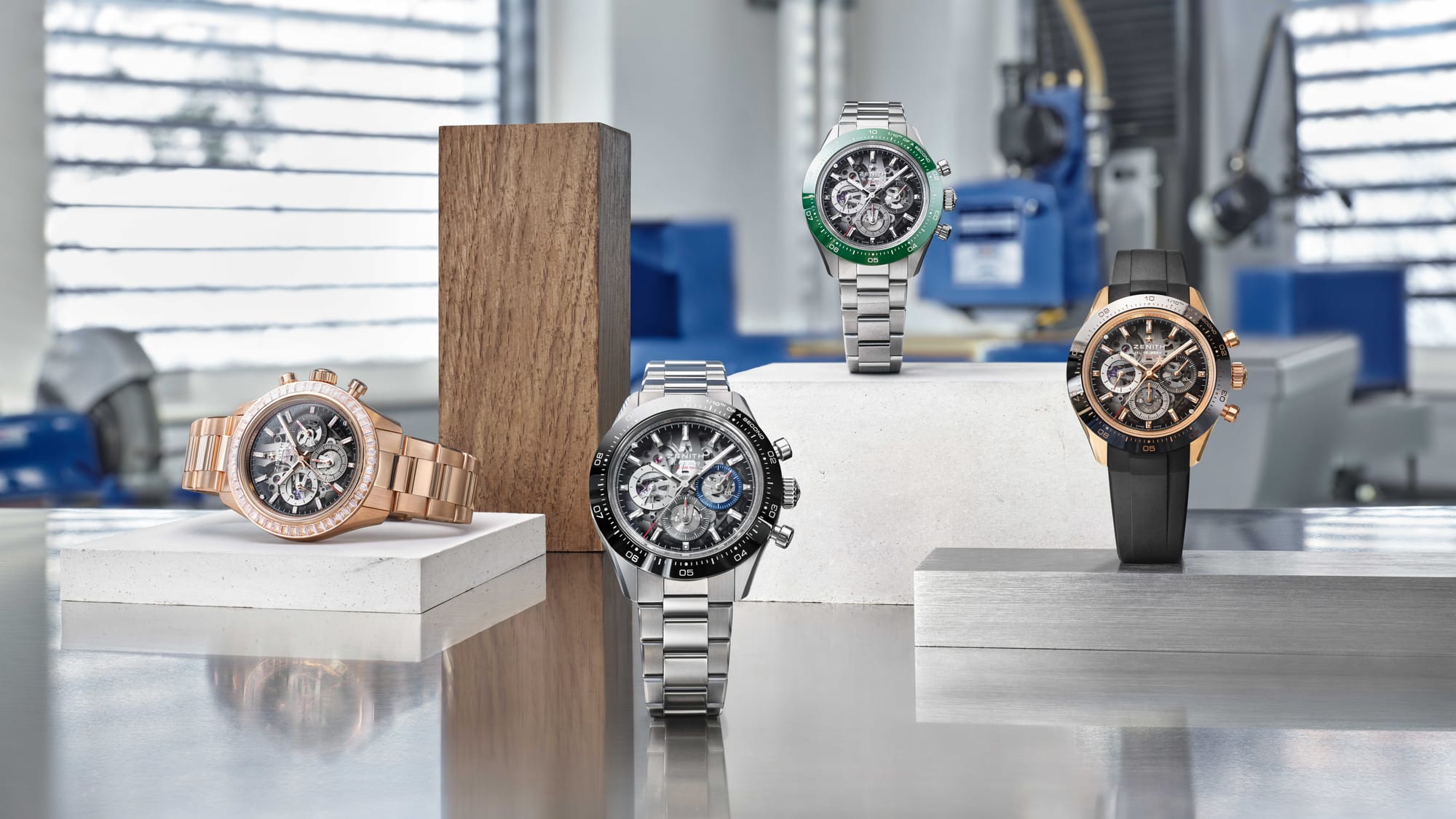
They may buy a used example. They may choose another brand. They may buy nothing.
The manufacturer can retain an admirer while losing a new-watch customer.
This is especially dangerous for enthusiast-oriented brands because those customers contribute more than the immediate transaction. They discuss the watches, introduce friends to them, and provide informed explanations for why an unfamiliar name deserves attention.
A strategy that prices them out risks losing both sales and unpaid advocacy.
The brand then has to acquire a replacement audience that may be less interested in its technical history and more interested in the recognition it still lacks.
That is not simply moving upmarket. It is changing the business’s customer proposition.
Higher prices are not a substitute for stronger demand
The latest Zenith restructuring makes this tension particularly acute.
Reporting describes a move toward a substantially smaller, higher-end operation, with the G.F.J. becoming central to its future direction. Management has acknowledged the difficulty facing its existing market segment, while recent coverage also points to genuine collector interest in its higher-end work.
There is a credible case for Zenith making exceptional, expensive watches. Its history and engineering competence are real. A serious high-end collection is not inherently misplaced.
The questionable leap is from “Zenith can make compelling haute horlogerie” to “haute horlogerie should replace the commercial center of Zenith.”
Those are different propositions.
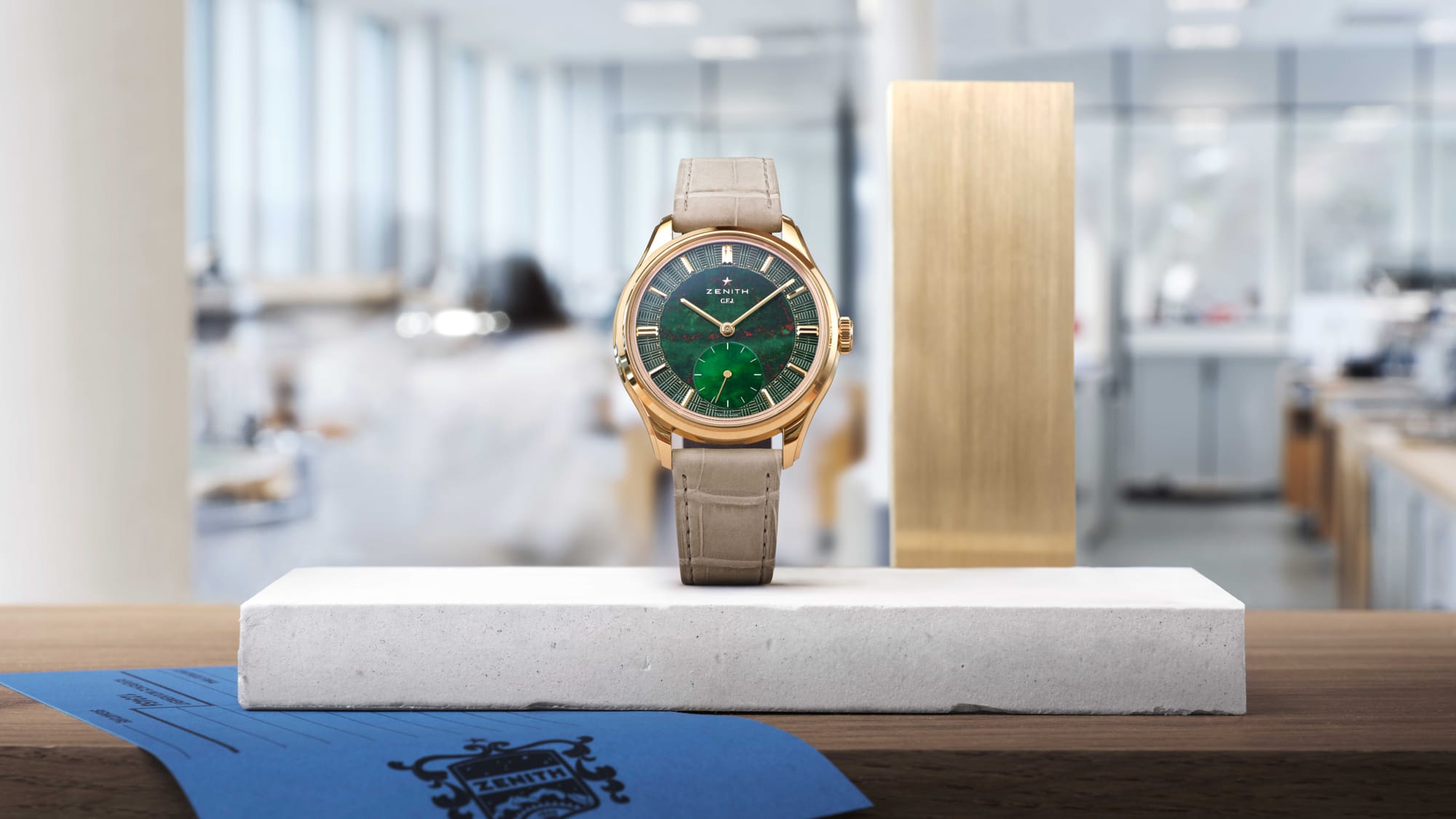
A successful limited edition does not establish the depth of demand required to support an entire manufacture. A handful of collectors seeking something unusual is not necessarily a repeatable customer base at much higher volumes or across multiple collections.
Nor does producing fewer watches automatically make them more desirable.
Scarcity creates pricing power when demand exceeds supply. Reducing production because demand is weak may be necessary, but it is not the same economic condition.
The danger is mistaking a smaller business with higher prices for a more prestigious business with stronger demand. The first can be achieved through management decisions. The second requires customers to agree.
Omega faces a different version of the problem
Omega is not Zenith. Its scale, public recognition, product range, and cultural reach are different.
It also has legitimate reasons to compete directly with Rolex in diving watches. Sharing a category is not evidence of imitation, and a revised Planet Ocean can address real product shortcomings without being reducible to a Submariner pursuit.
The strategic danger begins when matching Rolex’s price or prestige becomes the objective rather than a consequence of making a compelling Omega.
The question should not be whether Omega can build a competitive black-dial steel diver. It plainly can.
The question is whether the customer wants that specific Omega when a Rolex is equally obtainable.
The Speedmaster provides the clearest answer. Its appeal does not require the buyer to have been rejected by a Rolex dealer. It has an independent identity.
The Seamaster Diver 300M also offers a recognizable design vocabulary rather than simply asking for acceptance as another version of the category leader.
The Planet Ocean needs that same confidence: a reason to choose it positively, not merely a collection of specifications intended to defeat the Submariner in a comparison table.
Rolex should be a competitor in Omega’s market, not the organizing principle of Omega’s identity.
The financial logic can undermine the brand logic
The frustration is that premiumization can look entirely reasonable from inside a corporate presentation.
Sell fewer units at a higher average price. Reduce distribution. Protect margins. Focus on affluent customers. Introduce more exclusive products.
Every element can be justified under the right circumstances.
The trouble is that the spreadsheet cannot confer prestige. It can model higher prices more easily than it can create the willingness to pay them.
The incentives also favor visible changes. A repositioning, a new boutique concept, and an ambitious collection can be presented as action. Preserving a coherent core range and improving it patiently is less dramatic.
Yet the latter may be what the brand needs.
It would be too broad to blame business schools or public markets categorically. Differentiation, customer retention, and durable competitive advantage are hardly alien business concepts. Public ownership does not compel strategic impatience.
But the practical tension is real. The executive who sacrifices near-term growth to protect a twenty-year customer relationship may not be the executive who receives credit when it pays off.
Rolex’s continuity compounds across generations. Its competitors often have to justify theirs within a management tenure.
Repeated reinvention can become the expensive substitute for sustained execution.
Build a customer ladder, not an escape hatch
The alternative is not to freeze prices forever or forbid ambitious watchmaking.
It is to build upward without abandoning the foundation.
A coherent brand can maintain attainable core models, offer genuinely improved versions above them, and produce rare halo pieces whose construction and finishing justify a different price category.
The higher tier should expand what the brand can do, not announce that its established customers no longer matter.
For Zenith, that suggests preserving an identifiable, realistically priced El Primero-centered offering while allowing exceptional work to exist above it.
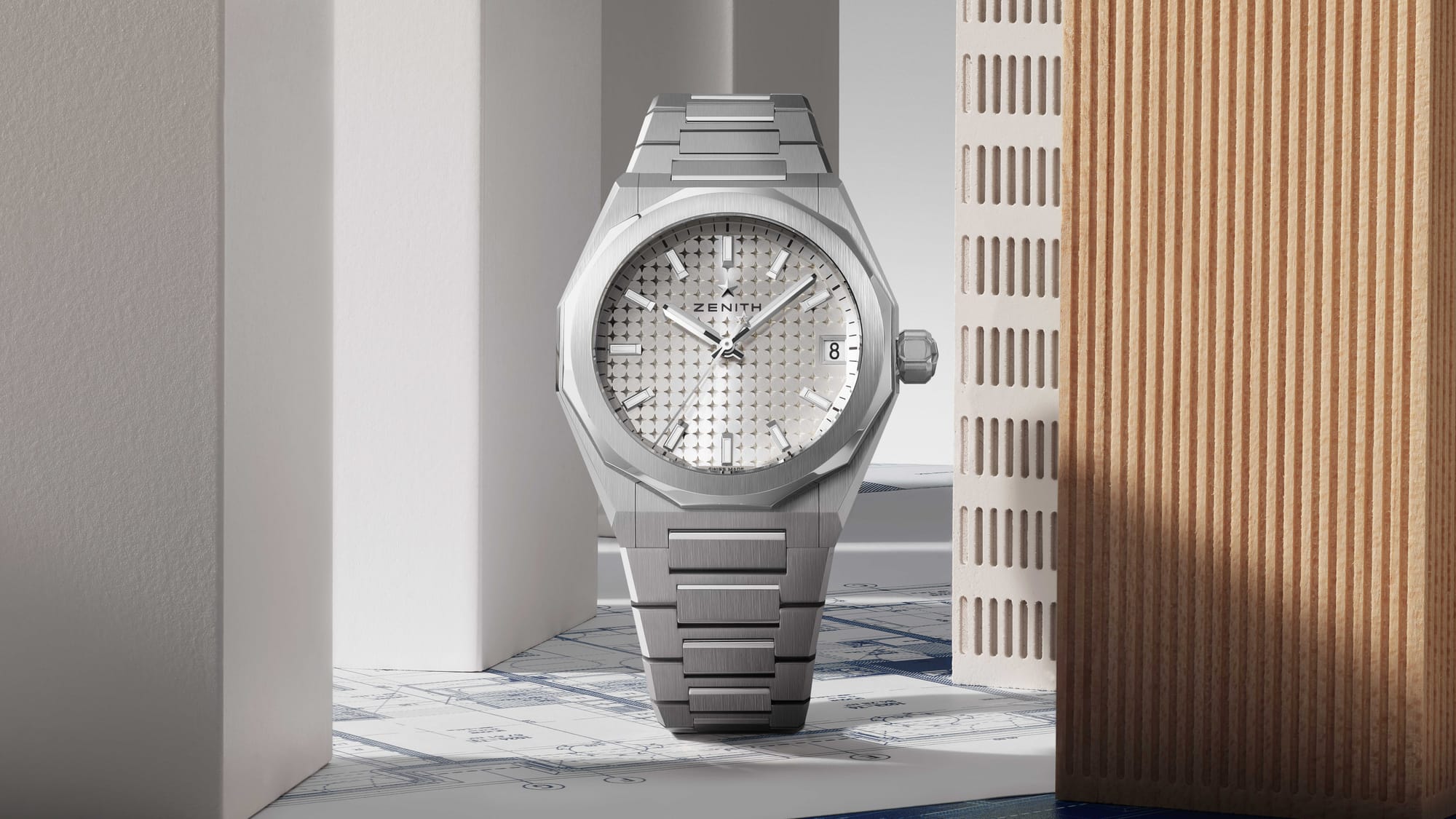
It also makes the group-manufacture idea worth serious consideration. Zenith’s movement expertise could provide strategic value beyond the number of Zenith-branded watches sold. LVMH had already discussed expanding that role across its watch businesses.
That would require proper investment, appropriate caliber architecture, transparent attribution, and service planning. It is not a free solution.
But it builds on an existing capability rather than requiring a new social meaning to appear on command.
It gives Zenith another basis for relevance: not merely a brand trying to attract a smaller group of richer buyers, but an engineering institution making the wider portfolio stronger.
Coexistence is not defeat
Rolex is not invulnerable, and no company should be declared the permanent winner of history.
Its reputation could weaken. Consumer tastes could shift. Competitors could take meaningful share. None of those possibilities should be dismissed.
But a strategy does not become sensible merely because displacement is theoretically possible.
For most brands, the realistic opportunity is to build a business customers would miss—not to replace Rolex as the public’s shorthand for success.

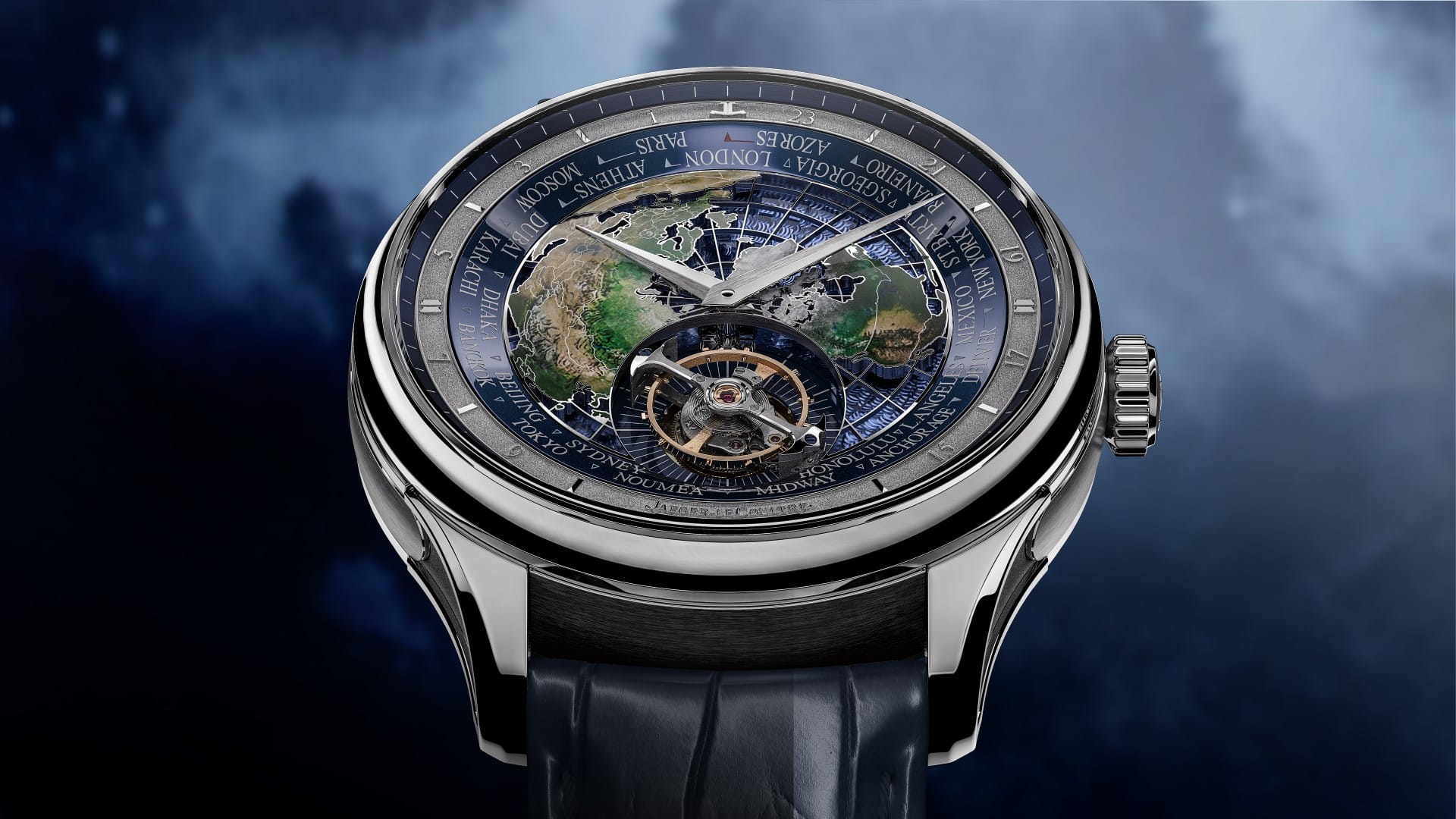
Zenith can mean chronograph expertise and individuality. JLC can mean a particular form of elegance and mechanical depth. Cartier can mean design rather than instrument-watch status. Omega can build on watches people desire specifically because they are Omega.
These are not consolation prizes.
A profitable, respected, durable specialist is a better outcome than a confused brand that repeatedly abandons its customers while pursuing someone else’s identity.
The useful test is straightforward:
Would someone still choose this watch if the Rolex they wanted were available today at retail?
If the answer is yes, understand why and strengthen it. If the answer is no, a higher price and a more exclusive sales pitch are unlikely to solve the underlying problem.
Rolex became the noun. The rest of the industry does not need to spend its future trying to replace that word.
It needs to give people something else worth saying.