Swiss Diplomacy, Presidential Optics, and a Rolex Desk Clock: When Tariffs Meet Timepieces
Tick, Tock, Mr. President
Ah yes, the delicate art of international diplomacy. Some nations send trade delegations. Others dispatch central bankers. And in certain rarefied corners of the global economy, apparently, you bring a very nice clock.
Last year, Swiss watch executives — notably not as part of an official Swiss government trade mission — made their way to Washington to meet with President Trump. The optics were, let’s say, memorable. Luxury industry leaders, representing brands that sell $10,000 to $500,000 mechanical jewelry, discussing tariff policy with a president who has never been shy about his appreciation for shiny objects.
Not long after those meetings, tariffs on certain Swiss goods were adjusted downward. A coincidence? Perhaps. Trade policy is complicated, after all. Global supply chains. Bilateral balances. Section 122 authorities. The usual bedtime reading.
Still, it was hard not to notice the choreography.
Then there was the U.S. Open Tennis Championships, where Trump appeared as a guest in the Rolex box — the VIP perch sponsored by Rolex — smiling for cameras in a setting that quite literally oozes Swiss luxury branding. Add in reported meetings with Rolex leadership, and the tableau begins to resemble something between a Davos breakout session and a very expensive lifestyle shoot.
Now, none of this proves anything improper. Access is not illegality. Gifts — when properly disclosed and compliant with ethics rules — are a time-honored diplomatic gesture. Presidents meet business leaders all the time. Luxury executives are allowed to advocate for their industries. That’s how Washington works.
But let’s not pretend the optics aren’t extraordinary.
The global watch industry was facing tariff pressure. Executives met the president. Luxury items were exchanged as tokens of appreciation. Tariff relief followed. The Swiss government itself was not formally leading this effort. It was corporate diplomacy at its most glittering.
Fast forward to today. The Supreme Court has struck down Trump’s emergency tariffs. In response, he has reimposed a 15 percent global import tax and signaled that additional industry-specific tariffs may follow. The uncertainty is back. American consumers will once again pay more for imported watches. Swiss manufacturers will once again recalibrate pricing and distribution.
Which brings us to a simple, unavoidable, slightly awkward question:
Now that tariffs are rising again, will the gifts be returned?
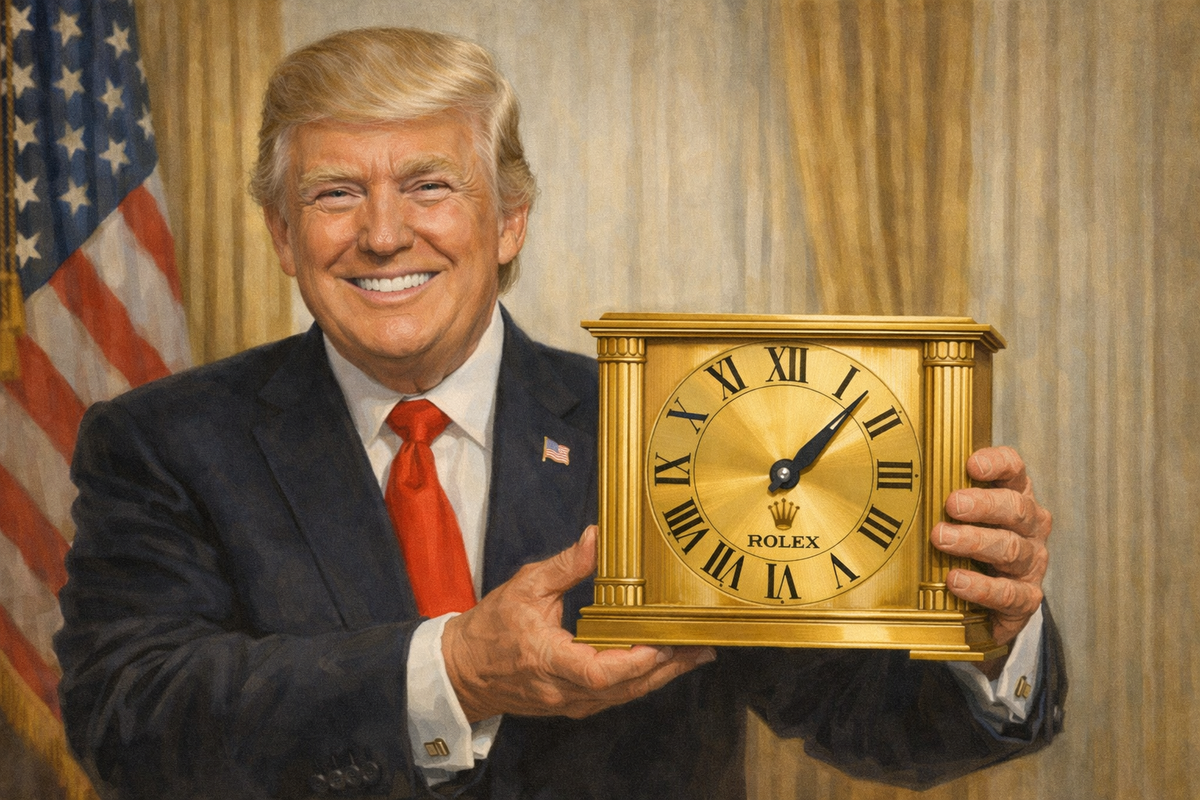
If Swiss executives presented the president with luxury tokens — including, as reported, a Rolex desk clock — were those gestures symbolic of a policy détente that no longer exists? If the tariff relief was temporary but the keepsakes are permanent, how should that look to American retailers absorbing higher costs?
Of course, no one expects the Oval Office to box up a desk clock and ship it back to Geneva with a polite note. That’s not how these things work. But in an era where trade policy shifts at the speed of a social media post, symbolism carries weight.
The watch industry trades on precision. On permanence. On engineering that endures for generations.
Trade policy, lately, feels more like a chronograph with a stuck reset pusher.
And as tariffs tick higher once again, one can’t help but wonder: was the meeting about long-term economic strategy — or just very good timing?