Tariffs, Timepieces, and Turbulence: Trump’s Latest Trade War Puts the Global Watch Industry on Edge
The global watch industry faces turmoil as the recent Supreme Court ruling against President Trump's emergency tariffs has led to new, higher tariffs, creating ongoing uncertainty.
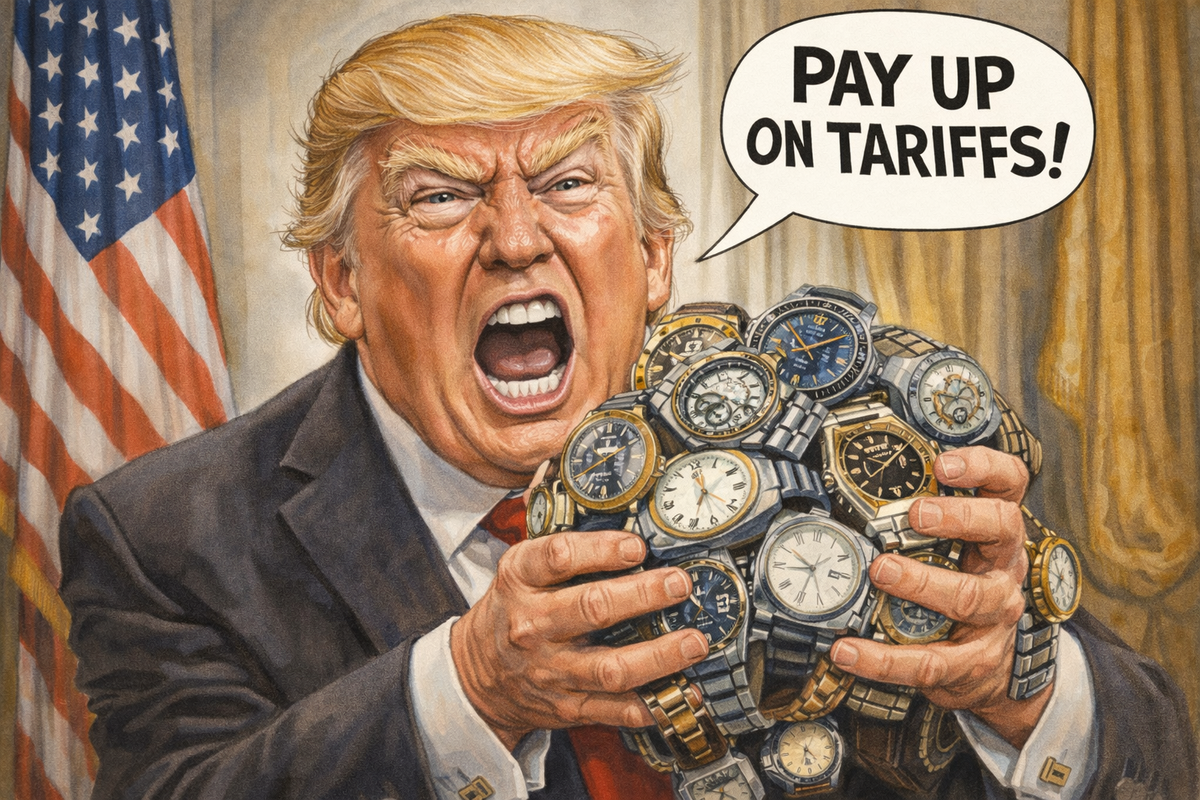
The global watch industry thought it had reached the end of a bruising chapter when the Supreme Court invalidated President Donald Trump’s emergency tariffs. Instead, it has entered a more complicated and potentially more corrosive phase — one defined not just by higher duties and legal uncertainty, but by troubling optics that now hang over the relationship between Washington and luxury goods.
The Court’s ruling made clear that Trump had exceeded his authority under the International Economic Emergency Powers Act when he imposed sweeping tariffs on goods from nearly every country. For more than a year, those duties injected chaos into global trade. The watch industry — built on Swiss manufacturing, German components, Asian suppliers, and American retail — was caught squarely in the blast radius. Importers paid billions in duties. Retailers raised prices. Consumers absorbed the hit.
Rather than step back, the administration immediately pivoted. Within hours of the decision, Trump ordered a new 10 percent tariff on all imports under Section 122 of a 1974 trade statute. By the next morning, the rate was raised to 15 percent. The new global levy is technically limited to 150 days, but it is expected to be followed by additional “national security” tariffs and country-specific duties that could take months to implement. In other words, the uncertainty continues.
For companies such as Rolex, Patek Philippe, Audemars Piguet and Omega, the United States is too important a market to ignore. A 15 percent blanket tariff on imports functions as a direct price escalator. Even if brands attempt to absorb part of the cost, the arithmetic is unforgiving. Margins compress or retail prices rise. In many cases, both happen.
The first round of tariffs drained more than $100 billion from the broader economy last year and contributed to upward pressure on inflation. While some analysts suggested the Supreme Court’s decision could briefly stimulate economic activity by removing those emergency duties, Trump’s rapid replacement tariffs blunt that effect. Companies are now left wondering what portion of the $134 billion collected under the invalidated tariffs will be refunded — and when. The president has warned that importers and the government may spend years in court fighting over repayment. For distributors who fronted the duties, that is a cash-flow nightmare. For retailers and end consumers who absorbed higher prices, the “ripple effect” is likely to produce commercial disputes up and down the supply chain.
But beyond the balance sheets lies a more delicate problem: perception.
Luxury watches are not generic commodities. They are symbols of precision, exclusivity, and proximity to power. When trade policy directly targets industries associated with wealth and status, it inevitably invites scrutiny about motive and influence. Even absent any proven wrongdoing, the optics become combustible. If the administration publicly admires, receives, or associates itself with high-end luxury goods from foreign manufacturers while simultaneously rewriting the tariff framework that governs those imports, questions are bound to surface — fairly or unfairly.
The watch industry is acutely aware of this. Swiss executives operate in a culture that prizes discretion. Brands such as Rolex avoid overt political alignment precisely because their appeal rests on neutrality and global prestige. Independent makers like F.P. Journe thrive on artisanal credibility, not geopolitical entanglement. Yet sweeping tariffs have dragged them into domestic U.S. politics. They now find themselves discussed not just in financial terms but in symbolic ones.
That symbolism matters. If policy decisions appear impulsive — announced on social media, modified overnight, replaced after judicial rebuke — it feeds a narrative that trade is being conducted as political theater rather than strategic governance. Investors notice. Retailers hesitate. Consumers delay purchases. Capital expenditures stall. JPMorgan economists have already warned that heightened trade-policy uncertainty can act as a headwind to business investment. In a discretionary category like luxury watches, hesitation quickly translates into slower sell-through.
Polling suggests voters oppose the tariffs by nearly two to one. Yet the administration appears determined to reconstruct its tariff architecture under alternative legal authorities. The Supreme Court, despite being dominated by conservative justices — including three appointed by Trump — flatly rejected the idea that a president could unilaterally impose tariffs “at any rate, for any amount of time.” That judicial rebuke underscores how far the executive branch had stretched its authority.
The watch industry’s frustration is therefore twofold. First, the direct economic damage: higher prices for American consumers, compressed margins, distorted supply chains, and delayed expansion plans. Second, the reputational hazard: being inadvertently cast as part of a broader political spectacle.
In Geneva, Le Brassus, and Biel, executives are asking quiet but urgent questions. How do you plan production cycles measured in years when tariff regimes change in days (or minutes in this case)? How do you maintain brand stability when retail prices must be recalculated every quarter? And perhaps most importantly, who restores order? Congress? The courts again? Market backlash?
Luxury watches are engineered to measure time with microscopic precision. Trade policy, at the moment, feels anything but precise. Until there is a coherent and durable framework governing imports, the global watch industry will remain trapped between legal battles, political optics, and the simple economic truth that American consumers are paying more because of it.