The Watch in Your Head
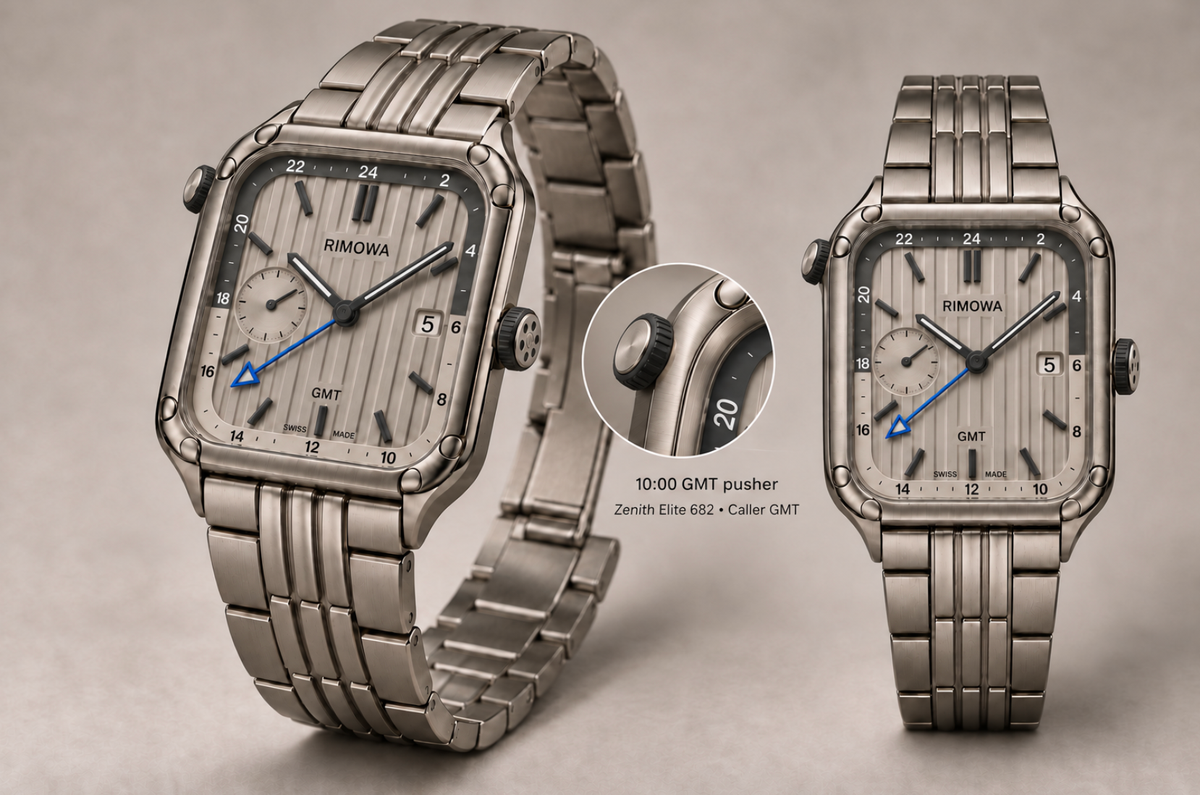
A Rimowa-inspired experiment shows how AI can turn a watch idea into product images, a specification sheet and an advertising campaign—and points toward a future in which a personal mechanical watch could arrive in weeks. Hello LVMH.
There is a watch you have probably designed without ever drawing it. A case shape you wish someone would make. A dial in a particular shade. A bracelet that belongs with the case. Perhaps a GMT hand because you travel, or because someone important to you lives six time zones away.
Until recently, that watch might have stayed in your head. Artificial intelligence is making it possible to put it on the page, examine it from different angles, change your mind and develop a surprisingly complete presentation around it. Product images. A proposed specification sheet. An advertisement showing where the watch belongs in someone's life.
That journey can now occupy a few focused hours. Manufacturing the watch takes longer. But shrinking the distance between imagining something and being able to show it to another person is already a substantial change.
For Buying Time, the example began with a simple question: What would a watch look like if it shared the design language of a Rimowa suitcase?
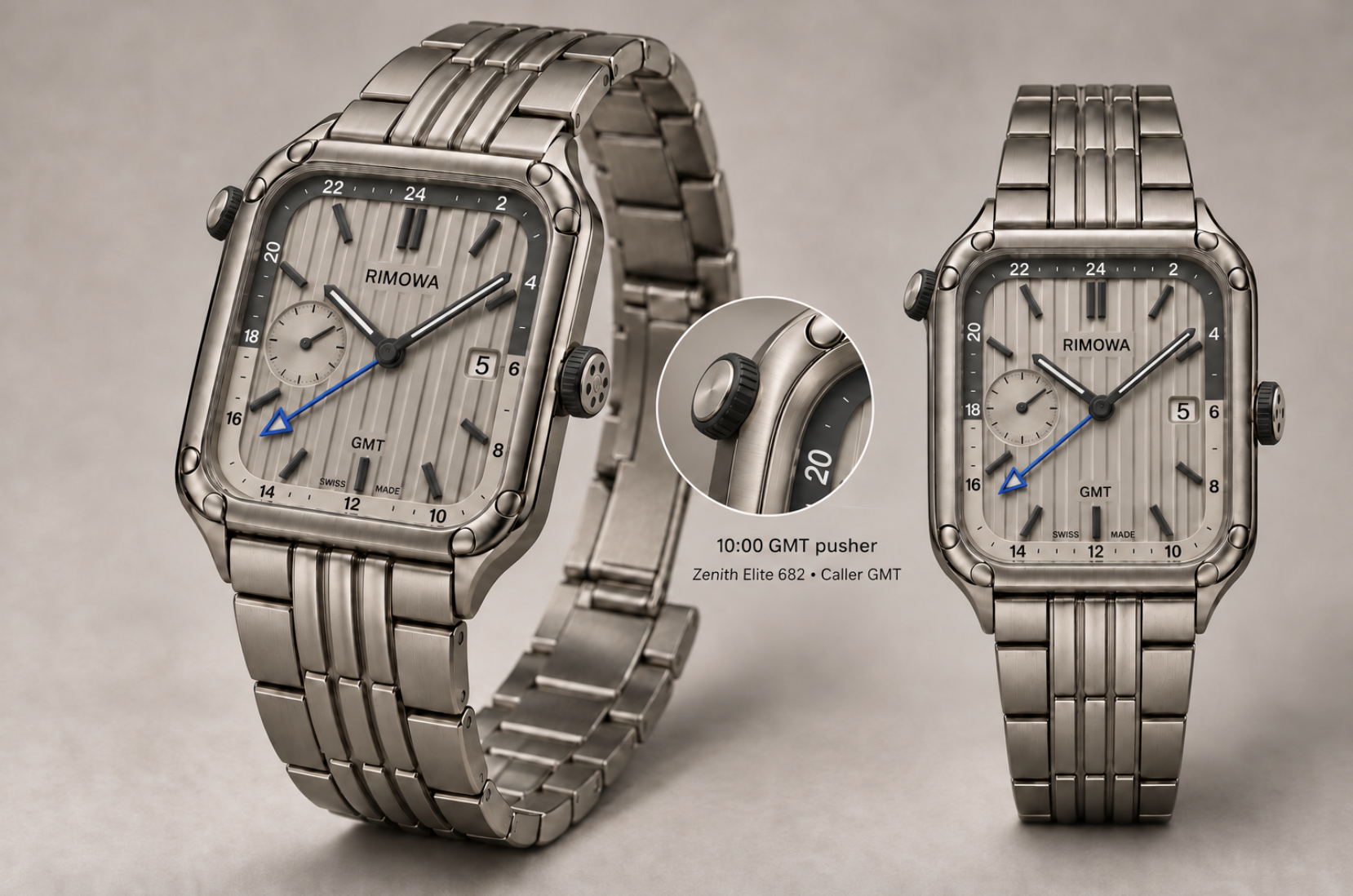
The developed titanium GMT concept. This is an AI-generated product visualization, not a photograph of a manufactured watch or an official Rimowa–Zenith collaboration.
The connection was more interesting than putting a luggage company's name on a dial. The suitcase's grooves could become the watch's visual structure, continuing across the dial and into an articulated bracelet. Reinforced corners could suggest luggage hardware. A rounded rectangular case could carry those details without becoming a miniature suitcase strapped to a wrist.
The design evolved from silver to a warmer, brushed titanium appearance. A blue GMT hand added a second time zone and gave the travel theme a practical purpose. Then came a smaller detail that made the exercise much more personal: could the crown echo a Rimowa luggage wheel?
The first attempt missed. AI produced a wheel-like crown, but it did not match the actual caster. A reference photograph and human correction brought it closer: a solid disc, six circular recesses, a central hub and a dark outer rim. A separate GMT pusher later received its own titanium-and-rubber treatment.
That exchange explains much of AI's value in design. You do not need to know how to render brushed titanium to decide that you prefer it. You do need to recognize when a detail feels wrong, supply a better reference and insist on the change. The human contribution is intention, taste and judgment, exercised repeatedly.
The accumulated project contains a dozen numbered design and campaign images, a specification sheet and several advertisement revisions. Its records span more than one date; this was an evolving exercise, not a documented start-to-finish speed trial. Nevertheless, the workflow makes the larger point tangible: a few hours of active work can now carry an idea far enough to discuss the product, its technical requirements and its presentation together.
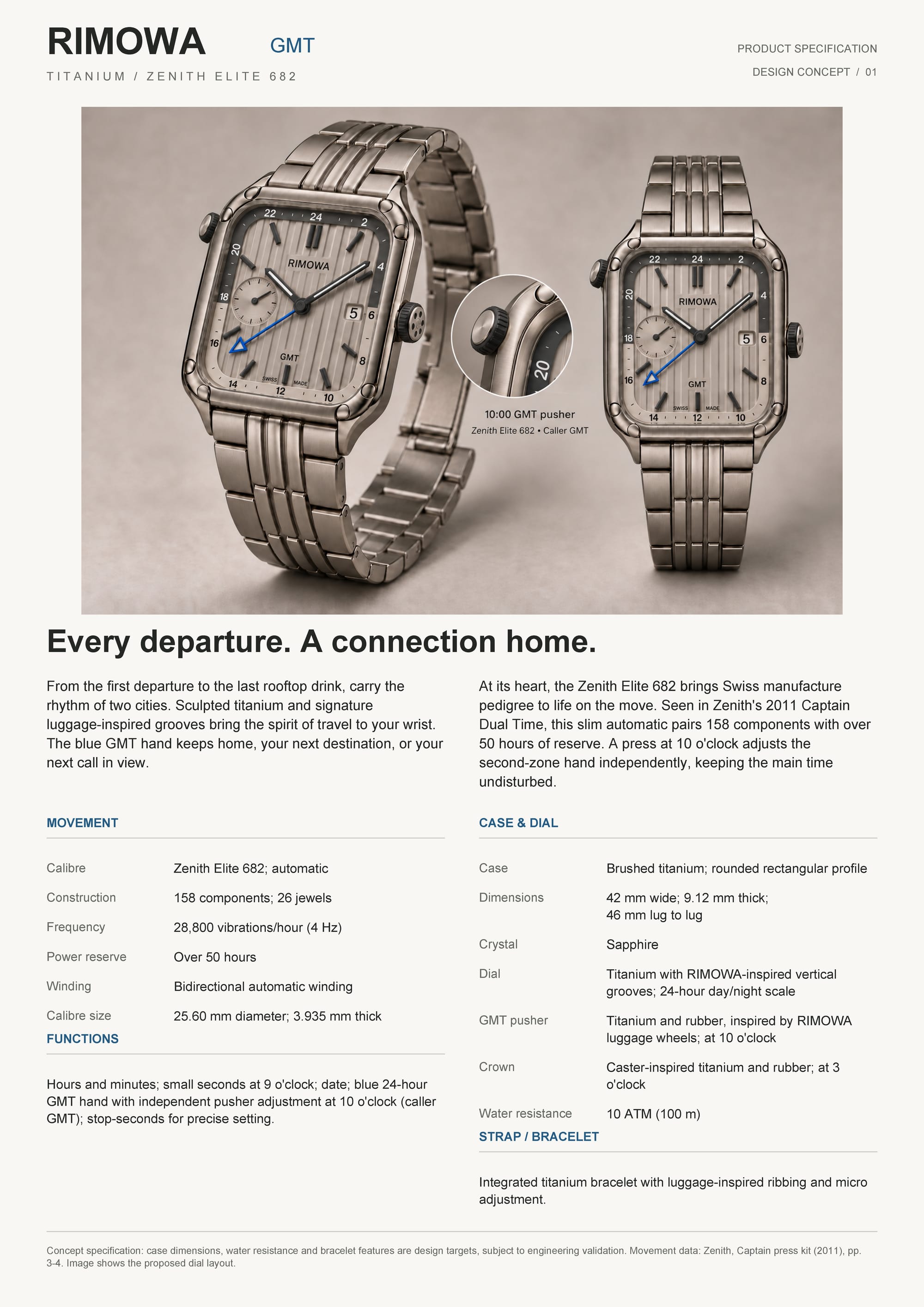
The specification sheet combines published movement information with proposed watch specifications. Case dimensions, construction and water resistance remain design targets.
The proposed mechanical heart is the Zenith Elite 682, a slim automatic GMT movement. Zenith's 2011 Captain technical release lists a diameter of 25.60mm, a height of 3.935mm and more than 50 hours of power reserve. It also describes the second-zone hand being adjusted through a pusher at 10 o'clock. This is a "caller" GMT. These are useful facts around which to develop a concept, although a historical specification does not establish that movements are available for a new project.
Here AI can begin doing something beyond producing pictures. Given reliable movement drawings and a properly dimensioned case model, an AI-assisted engineering workflow can help screen candidate movements, organize measurements, operate design software and identify questions that need resolving. Does the movement clear the internal case walls? Does the winding stem meet the crown at the correct height? Is there room above the dial for the hands and below the movement for the rotor? Can the GMT pusher reach its mechanism without interfering with another component?
Those checks require actual geometry. A 25.60mm movement and a case described as 42mm wide do not, by themselves, establish a fit. External width tells us little about the available cavity, and movement thickness alone cannot establish the finished watch's thickness. The dial, hand stack, crystal, caseback, seals and working clearances all have to be accommodated.
There is already a revealing discrepancy in this project: the concept puts the date at 3 o'clock, while Zenith's published Captain Dual Time specification lists it at 6. A production project would need to establish whether the desired layout is achievable and what changes it requires. AI can help surface that conflict before it becomes an expensive physical mistake. It cannot make the conflict disappear by drawing an attractive date window.
Connected to appropriate design tools, AI can also help prepare case sections, exploded views, component lists and assembly documentation. Autodesk already describes AI-powered drawing automation that creates two-dimensional drawings from three-dimensional models. The meaningful distinction is between a diagram generated from checked geometry and an illustration that merely resembles an engineering drawing. A watchmaker or engineer still has to approve the construction, and physical prototypes must establish how it performs.
The same AI-assisted process can address another question surprisingly early: why would anyone want this watch?
For the Rimowa concept, the answer was already present in the design. A watch that matches your suitcase belongs to a world of departures, connections and familiar objects carried far from home. The GMT hand adds an emotional possibility: your wrist can show where you are and keep another place close.
The resulting advertisement places the watch on the wrist of a traveler pulling a Rimowa suitcase in an airport lounge. Its headline is straightforward: “Every departure. A connection home.” The product and its story reinforce each other. The grooves connect watch and luggage; the second time zone connects the journey with someone or somewhere else.
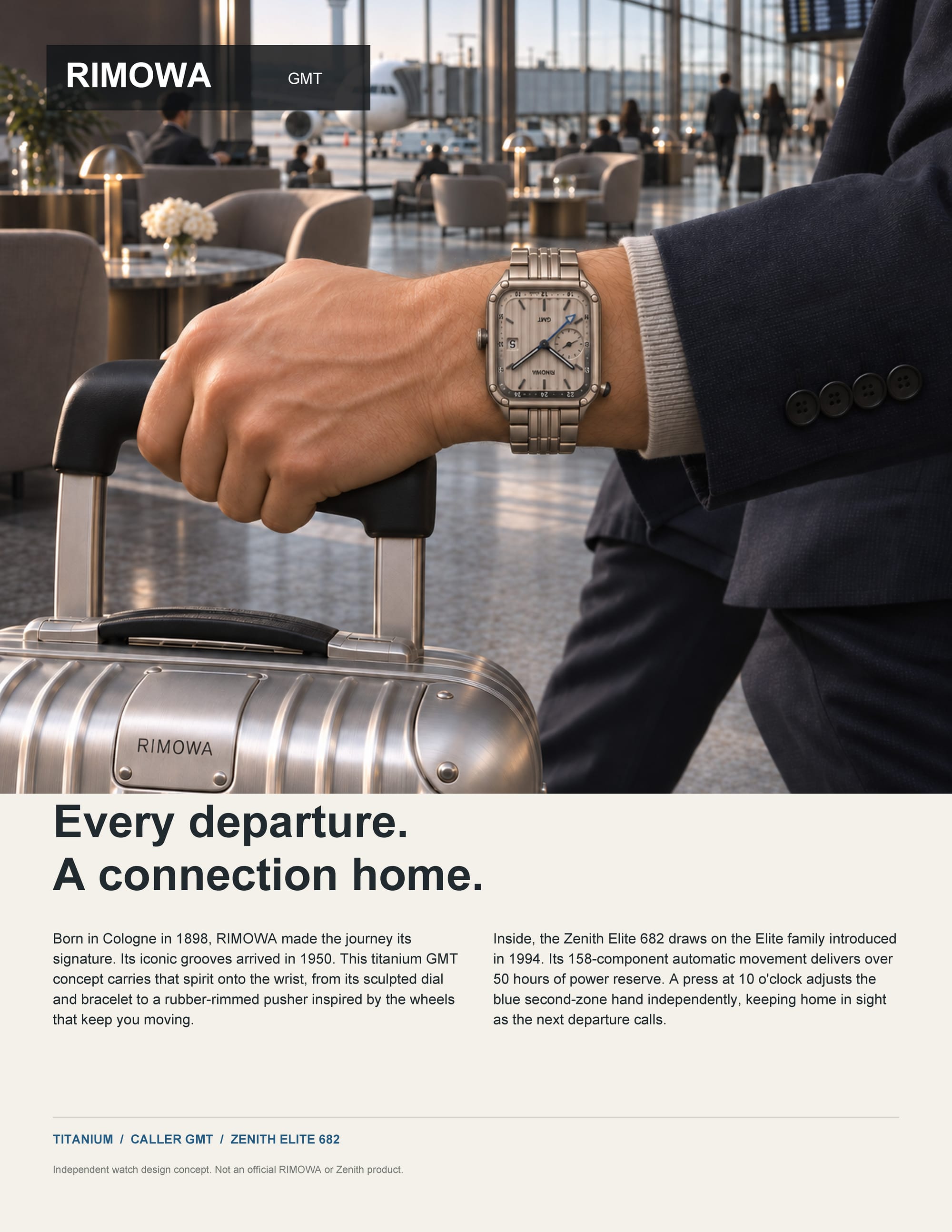
The latest airport advertisement turns the design idea into a travel campaign. (The scene and watch are AI-generated concept imagery.)
AI made it possible to explore that campaign before a physical sample existed. It also introduced errors. The watch's placement, bracelet, dial arrangement and orientation needed repeated attention. Those revisions are part of the lesson. When a generated image casually moves a subdial or changes the bracelet, someone must compare it with the approved design. A coherent campaign depends on keeping the actual product consistent across every image.
Now extend the process one step further. Imagine describing a personal watch, refining it on screen and sending an approved design to a manufacturer. A few weeks later, a mechanical watch arrives that exists because you wanted it to.
I believe that experience is closer than many collectors assume. Its first convincing form will probably use available movements, established sealing systems and proven component interfaces, with freedom concentrated in case contours, dial textures, colors, hands and personal details. The engineering beneath the design can be familiar while the watch itself feels unmistakably yours.
Parts of that future already exist separately. Protolabs advertises machined parts in as little as one day and automated feedback on manufacturing difficulties. Apiar uses additive manufacturing for intricate titanium watch cases. These demonstrate useful production capabilities; neither establishes a universal service that turns a prompt into a finished watch in weeks. Indeed, Apiar's Gen1.0 product page currently describes a target delivery time of four months, a reminder that making a complete watch involves much more than forming a case.
My expectation is that the breakthrough will come from joining those separate capabilities. An AI interface translates what the owner wants. A design system keeps changes inside known engineering limits. A manufacturer produces the custom components. A watchmaker assembles, regulates and tests the result. Much of the waiting between those stages could shrink as information passes cleanly from one to the next.
A few weeks becomes plausible when components are in stock, production capacity is available and customization stays within a validated construction. A new movement, unusual complication or elaborate integrated bracelet is a different undertaking. Even the Rimowa concept's seemingly simple ribbed bracelet presents questions about articulation, pins, comfort, finishing and its junction with the case. Bespoke does not automatically mean easy, inexpensive or quick.
What happens to the specialness of mechanical watches when more people can design one?
Some scarcity may lose its force. If attractive images and endless variations become easy to produce, appearance alone will have to compete harder for our attention. Execution will matter more: the feel of the crown, the transition between brushed and polished surfaces, the way the bracelet falls around the wrist, the confidence that someone has regulated and tested the movement properly.
Personal meaning could become more important, too. A watch might take its texture from a building you love, its palette from a memorable journey or its proportions from what actually suits your wrist. An owner could collaborate with a small workshop on a piece that carries a private story without requiring the resources of a watch company. The strongest results will still need restraint. A personal watch does not have to display every idea its owner has ever had.
AI could help preserve the watch afterward as well. If the original design, materials, component references and service instructions remain available, future repairers have a better starting point. A genuinely personal watch deserves a plan for replacement parts and maintenance. Uniqueness becomes much less appealing if a broken custom component makes the whole object unserviceable.
There is room here for independent watchmakers to gain customers who previously could not explain what they wanted. AI can help make that conversation visible and reduce the effort spent preparing alternatives. The craftsperson can spend more time resolving proportions, improving tactile details and making an object worth keeping.
The Rimowa experiment has already traveled a considerable distance: from a thought about a suitcase to a recognizable watch, a proposed technical identity and a campaign about travel and home. The remaining distance is measured in metal, tolerances, skilled labor and testing.
I expect that distance to shrink. And when a watch imagined in a conversation can reach its owner's wrist a few weeks later, the pleasure will still be mechanical: a spring storing energy, a balance oscillating, hands moving across a dial. The new element will be the knowledge that this particular expression of those old pleasures began with an idea of your own.