Tudor Quietly Raises Prices Again—Fourth Increase in 15 Months Appears Online Without Announcement
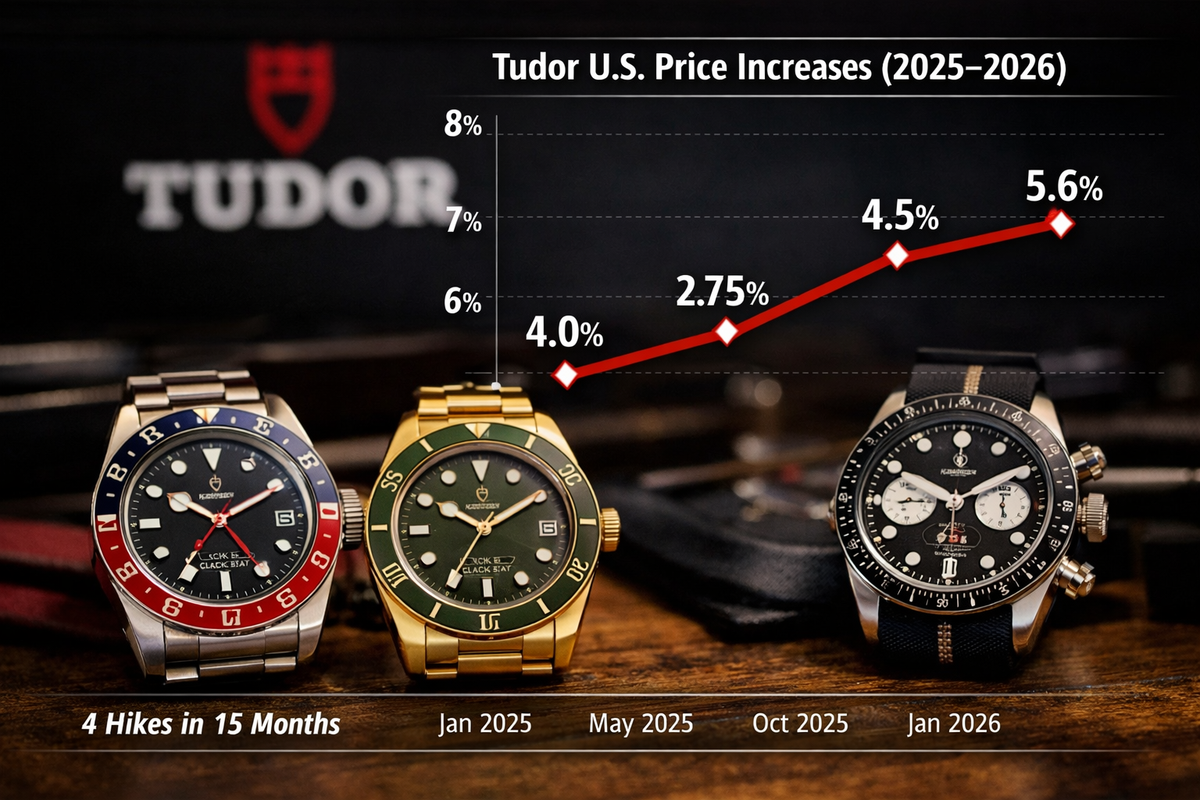
Tudor has once again raised U.S. prices across its lineup—this time without any formal announcement—marking what appears to be the brand’s fourth price increase in just 15 months. The latest hikes are now visible directly on Tudor’s website, continuing a pattern of incremental but relentless increases that began in early 2025.
The move follows a clear sequence: a January 2025 increase, another in May, a further reported adjustment on October 1, and a January 1, 2026 hike. Now, with fresh pricing quietly embedded across Tudor’s online catalog, the brand appears to be continuing that cadence into 2026—without explanation, disclosure, or customer-facing communication.
That lack of transparency is becoming part of the story. Tudor does not publish dated U.S. price increase notices, instead relying on boilerplate language on its website stating that it “reserves the right to modify the prices and models at any time.” In practice, that means consumers only discover price hikes after the fact—when the numbers have already changed.
The scale of the increases also undercuts any attempt to dismiss them as minor adjustments. Based on documented examples from 2025 through early 2026, Tudor’s U.S. price hikes have ranged from 2.75% to 7.9%, with a simple average of just over 5%. The Black Bay GMT “Pepsi,” for example, rose from $4,375 to $4,550 in January 2025, then climbed again to $4,675 in May. By January 2026, industry reporting showed simple steel models up about 4.5% on average, the carbon Black Bay Chrono jumping roughly 6%, and the gold Black Bay 58 on bracelet surging 7.9% to $39,400. These are not rounding errors—they are meaningful, repeated increases across steel, carbon, and precious-metal models that compound quickly over time.
Here are a few examples of the increases from the beginning of 2026:
- Pelagos 39 (M25407N-0001): $5,475 → $5,625 = +$150 (+2.74%)
- BLACK BAY 58 GMT (M7939G1A0NRU-0001): $5,125 → $5,525 = +$400 (+7.80%)
- Black Bay 41mm Steel / Steel Bracelet (M7941A1A0NU-003): $5,100 → $5,450 = +$350 (+6.86%)
- Black Bay Chrono 41mm Steel / Steel Bracelet (M79360N-0014): $6,775 → $7,000 = +$225 (+3.32%)
- Black Bay 58 18K Yellow Gold / Gold Bracelet (M79018V-0006): $39,400 → $40,500 = +$1,100 (+2.79%)
- BLACK BAY CERAMIC (M79210CNU-0007): $5,975 → $6,125 = +$150 (+2.51%)
Even taken individually, those numbers may seem manageable. But stacked across four—or now possibly five—moves in just over a year, the cumulative effect is significant. What was once positioned as “accessible Swiss luxury” is steadily creeping into a different pricing tier.
The broader macro backdrop helps explain—but does not fully excuse—the pattern. U.S. trade policy has been anything but stable. A rolling series of tariff changes targeting Swiss imports began in April 2025, with rates fluctuating from a baseline 10% to as high as 39% before settling into a revised framework later in the year. That kind of volatility creates real cost pressure for Swiss brands exporting into the U.S.
At the same time, currency has worked against Tudor. The U.S. dollar weakened materially against the Swiss franc over the same period, falling roughly 13% from January 2025 to January 2026. Since production costs are largely CHF-denominated, that shift directly increases the effective cost of doing business in the U.S. market.
Still, the timing and frequency of Tudor’s increases suggest more than just reactive pricing. The January 2025 hike, for example, came before the tariff regime even took effect, and later increases do not map cleanly to specific policy changes. Instead, what emerges is a pattern of opportunistic repricing in a volatile environment—using tariffs, currency, and inflation as cover for steady upward movement.
And that’s where the criticism sharpens. While tariffs tied to the policies of Donald Trump and broader inflationary pressures have clearly contributed to rising costs across the luxury goods sector, Tudor’s approach has been notably opaque. Rather than communicate changes directly, the brand has allowed prices to drift upward in the background, leaving consumers to connect the dots themselves.
For a company that built its reputation on value relative to its parent brand Rolex, that strategy carries risk. Repeated, unannounced price increases erode trust—and over time, they may also erode the very positioning that made Tudor so compelling in the first place.
The latest update on Tudor’s website confirms one thing clearly: the price increases aren’t slowing down. Whether customers continue to tolerate the silence around them is another question entirely.
Buying Time Analysis: Tudor's ongoing price increases, marked by a lack of transparency and communication, raise concerns about consumer trust and the brand's positioning as a value-driven alternative to Rolex in an increasingly volatile market.