Issue #279 | Buying Time - October 29, 2026
Security concerns, changing retail relationships and extraordinary craftsmanship raise a simple question: how much freedom does your watch give you to enjoy it?
Buying Time in 30 Seconds
Today’s watch world offers an uncomfortable contrast. Luxury watches are becoming more visible through larger retail networks, sporting partnerships and international exhibitions, while some owners are becoming less comfortable wearing them in public. Reports of theft-related selling in London and Bucherer’s latest Rolex boutique takeover show two very different sides of the business of desirability.
Elsewhere, the emphasis returns to the objects themselves. Vacheron Constantin’s inaugural horological concours celebrates exceptional historical watches, Jaeger-LeCoultre revisits its archives, and enamel and guilloché demonstrate why craftsmanship rewards close attention. New releases span E.C. Andersson’s US$995 Cpt, Nomadic’s rectangular Dána 141, Grand Seiko’s latest Spring Drive interpretation and spectacular tourbillons from Girard-Perregaux and Laurent Ferrier.
Yesterday’s platinum Hermès Slim d’Hermès reached US$11,850 against a US$20,000 reserve and remained unsold. Today’s auction features a 2024 Breguet Tradition 7067 GMT in white gold, reference 7067BB/G1/9W6, offered with box and papers. Bidding is scheduled to close at 6:35 p.m. EDT on Thursday, October 29, 2026.
Time Graphing Today’s Watch Universe
The Freedom to Enjoy What You Own
A watch can be an extraordinary object and still become an inconvenient possession. It can be beautifully made, historically significant and worth a considerable amount of money, yet spend most of its life in a safe because its owner no longer feels comfortable wearing it. At that point, the conversation about value needs to include something beyond movements, materials and resale prices. It needs to include enjoyment.
That is the thread running through today’s issue. Watches promise pleasure in many forms: the satisfaction of winding a movement, the usefulness of a second time zone, the discovery of an unfamiliar maker, or the quiet pleasure of looking at a dial someone spent days decorating. But the industry also surrounds those pleasures with considerations that can complicate ownership. Security, access, status, scarcity and price all compete for attention.
The most troubling example is today’s report on owners selling luxury goods because they fear becoming targets. There is an important distinction between owning something valuable and feeling free to use it. If wearing a watch turns an ordinary walk into a calculation about sleeves, neighborhoods and who might be watching, part of the ownership experience has already been lost.
That does not mean every collector should abandon expensive watches. It does mean that the practical circumstances of ownership deserve a place in the buying decision. A watch that suits your life has an advantage over one that requires you to reorganize your life around it. The price on the receipt cannot tell you which is which.
Meanwhile, the commercial machinery of luxury continues to expand. Bucherer’s takeover of another Rolex boutique illustrates how the route from manufacturer to customer is changing. Rolex’s ownership of Bucherer gives these transitions a significance beyond an ordinary change of retailer. The brand is increasingly present in the business surrounding the product, as well as in the product itself.
For customers, that makes the quality of the relationship especially important. A beautiful showroom can introduce a watch, but service, expertise and straightforward treatment are what make ownership easier over time. Today’s conversation with Roldorf & Co. founder Jason Gallop offers an appealing perspective: put watchmaking where customers can see it and make the workshop part of the experience. There is something reassuring about a retailer whose ability to sell a watch is accompanied by an ability to care for it.
Several other stories suggest ways to reconnect with the object itself. Vacheron Constantin’s first Concours d’Élégance Horlogère encourages collectors to look at historical watches through engineering, design and preservation. These are qualities that survive after a launch campaign ends. A watch does not need to be new to offer something worth discovering.
The same principle animates Jaeger-LeCoultre’s Collectibles program. A Memovox Parking or Futurematic can introduce an unfamiliar idea about what a wristwatch might do and how it might look. Their appeal comes partly from encountering a solution to a problem that contemporary watchmaking may no longer prioritize. Collecting becomes more interesting when it involves curiosity alongside recognition.
Then there is the slower pleasure of understanding how something is made. Today’s exploration of enamel describes a craft that can demand repeated firings and tolerate very little error. Such work is easy to compress into a sentence on a product page. It becomes more meaningful when you understand how much can go wrong before the finished dial exists.
That attention does not belong exclusively to the most expensive end of the market. The Invicta and San Martin comparison asks useful questions about crystals, bracelets, finishing and what an additional expenditure actually buys. Those are sensible questions at almost any price. They keep the evaluation attached to the watch rather than allowing the logo to complete it.
The reviews offer another reminder that satisfaction is personal. An unusual Pulsar tool watch and a manually wound Vacheron Constantin Patrimonyshare little in price or purpose, yet each can reward the owner who understands why it belongs on the wrist. A useful alarm and an elegantly restrained dial are different pleasures. Neither requires universal approval.
Yesterday’s Hermès auction provides the market’s contribution to this discussion. A US$20,000 reserve met an US$11,850 high bid. That was a disagreement about a transaction, not a verdict on whether the watch was interesting. Today’s Breguet will undergo the same process: distinctive mechanics and a considerable history will meet the amount someone is prepared to spend.
The collector’s job is to keep those judgments in proportion. Understand the price. Understand the watch. Understand the circumstances in which you will own it. Then leave enough room for the reason most of us became interested in watches in the first place: the pleasure of having one on our wrist.
-Michael Wolf
News

Fear of Theft Is Changing How Some Owners View Luxury Goods
Reports of luxury-goods crime in London are influencing more than insurance decisions. Some owners are choosing to sell watches, jewelry and handbags because they feel less comfortable using them, with pawnbrokers reporting customers who explicitly cite personal security as their reason for parting with expensive possessions.
The supplied report places losses from luxury-goods robberies in the West End at approximately £1 million a month. It also describes continuing violence against retail workers and a national week of action against retail crime scheduled to begin November 9. For the watch business, the concern reaches beyond stolen inventory: when ownership begins to feel burdensome, desirability can give way to reluctance, particularly among customers considering conspicuous, high-value pieces.

Bucherer Will Take Over Ben Bridge’s Honolulu Rolex Boutique
Bucherer will assume control of Ben Bridge’s standalone Rolex boutique in Honolulu at the beginning of 2027, bringing its Hawaiian Rolex presence to four locations. Existing employees will be offered positions with Bucherer, while Ben Bridge will retain its multi-brand showroom and Tudor boutique in the islands.
The change continues the reshaping of Rolex’s retail network under a company the watchmaker itself owns. Ben Bridge’s Rolex footprint has contracted from 22 locations in 2019 to ten, according to the report, while Bucherer has become increasingly prominent in new boutique openings and ownership transitions. For customers, the immediate change is the name operating the store; for the industry, it is another example of Rolex gaining influence over the retail environment surrounding its watches.
Features
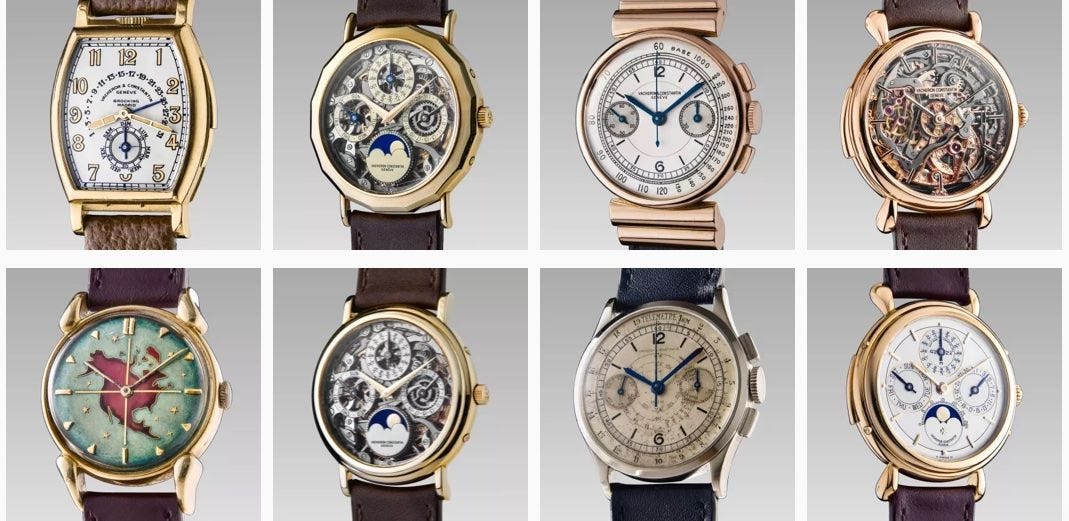
Vacheron Constantin’s First Horological Concours Gives Historical Watches a New Stage
Vacheron Constantin’s inaugural Concours d’Élégance Horlogère, organized with Phillips, applies the spirit of the automotive concours to watch collecting. Thirty-four finalists, selected from more than 550 submissions, bring together watches dating from 1755 through 1999, with attention directed toward engineering, design, rarity and historical importance.
The finalists will be exhibited at Geneva’s Hôtel Président Wilson from November 4 through November 8, ahead of the November 10 awards announcement. Seven category winners and a possible Best in Show create a competitive framework, but the public exhibition may be the event’s greatest immediate attraction. Privately owned watches that are usually dispersed across collections will briefly become available for a much wider audience to examine and appreciate.

Reading Time at HSNY: The Fascination and Fragility of Enamel
Vitreous enamel begins with powdered glass, but its transformation into a watch dial demands a combination of preparation, heat and judgment. Applied to metal and fired in a kiln, the material produces a durable, luminous surface whose apparent simplicity can conceal considerable difficulty.
This exploration follows enamel through its decorative history and explains techniques including champlevé, cloisonné and grand feu. Contemporary watchmaking provides the connection between historical practice and today’s collectors, while the Horological Society of New York supplies an educational setting for understanding the craft. The most revealing detail is the possibility of failure: repeated work does not guarantee a successful final firing. A flawless dial represents both the artisan’s skill and everything that had to go right before the watch could be completed.

An IWC Perpetual Calendar Finds a Different Rhythm in Svalbard
An Arctic journey places the IWC Perpetual Calendar 42 in surroundings far removed from the customary presentation of a complicated watch. Gravel roads, ATV travel, mud and cold replace the boutique counter, while Longyearbyen’s landscape supplies a reminder that even a sophisticated calendar is ultimately worn one moment at a time.
The story combines observations about the watch’s wearability with the experience of Svalbard’s unusual light, isolation and wildlife precautions. Its deeper interest lies in the author’s response to that environment: fewer distractions, a stronger sense of focus and a renewed commitment to personal creative work. The watch becomes a companion to an experience rather than its sole subject, giving the account a more reflective character than a conventional specification-led review.
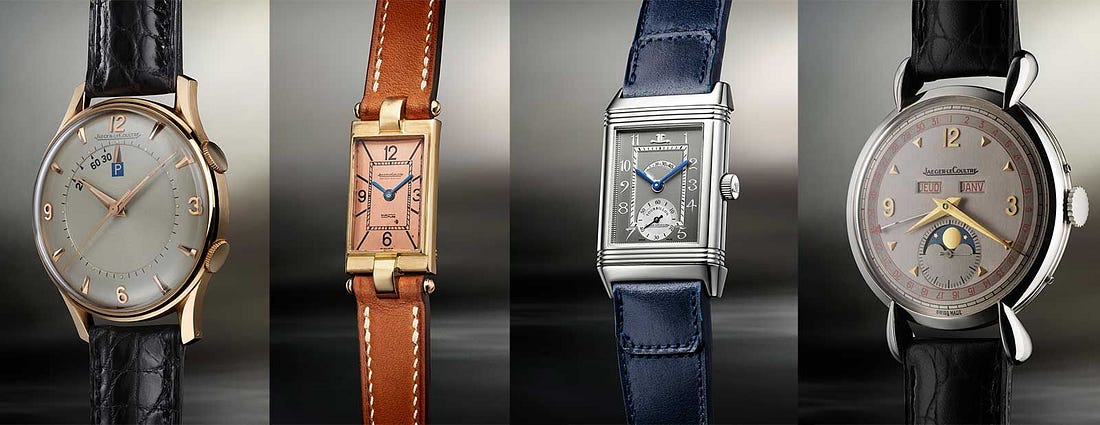
Jaeger-LeCoultre’s Collectibles Program Makes Its Archives Wearable
Jaeger-LeCoultre’s Collectibles program brings restored historical watches back into circulation with the support of the manufacture. Its Hong Kong exhibition gathered pieces from the Duoplan, Reverso and Memovox families alongside other precision-focused designs, connecting the brand’s modern identity to the variety of its earlier work.
Highlights discussed include a diamond-set platinum Caliber 101, secret watches, unusual Reversos, a 1949 triple calendar, a Futurematic “Porthole” and the Memovox Parking. Together, they demonstrate how many forms useful mechanical invention can take. Restoration and archival documentation help buyers understand what they are acquiring, while the watches themselves offer an alternative to collecting solely through current production. The attraction is access to a more eccentric and sometimes surprising Jaeger-LeCoultre.

Breitling Taps the Dallas Cowboys’ Reach Beyond Football
Breitling is extending its sporting presence through a partnership with the Dallas Cowboys and the Dallas Cowboys Cheerleaders. The association combines the team’s international recognition with the cheerleaders’ substantial cultural and social-media audience, broadening the exposure available through a conventional football sponsorship.
Three Cowboys-themed watches bring the partnership into the collection: the Chronomat GMT Automatic 40, Endurance Pro 44 and Chronomat B01 42. The reported price range runs from US$4,600 to US$9,600, with the most restricted edition limited to 104 pieces. For Breitling, the opportunity is to connect its watches with a recognizable community and its rituals. For buyers, the decision remains whether the colors, branding and limited production add something meaningful to a watch they already want.
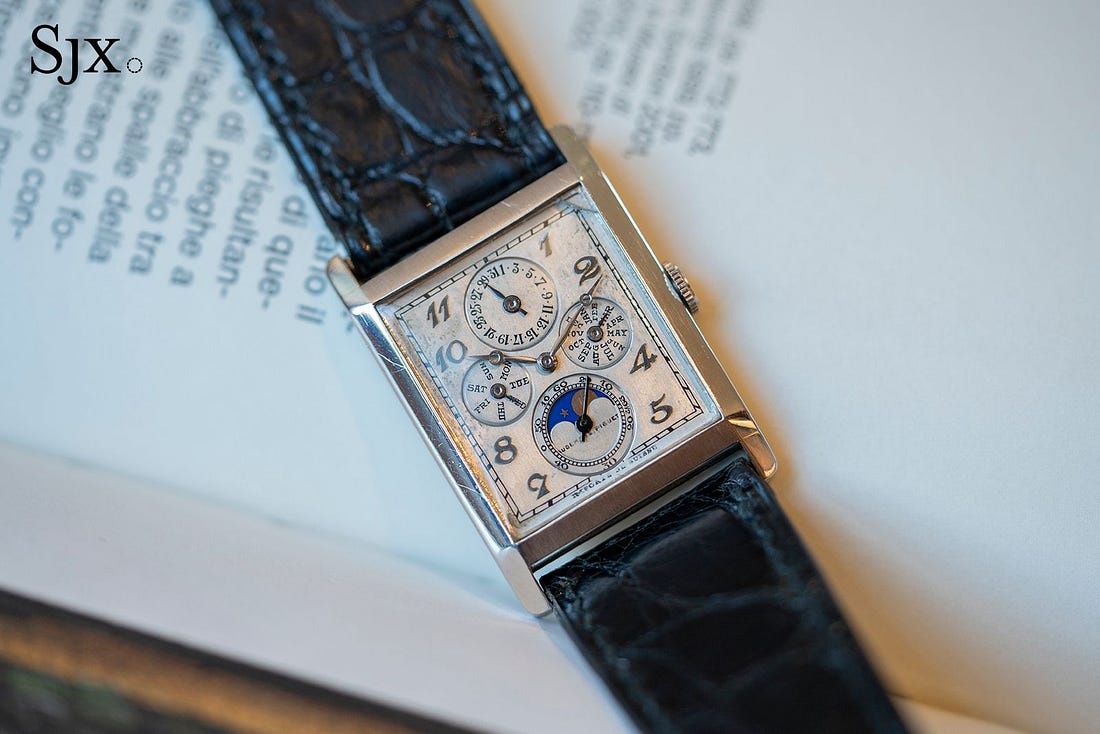
A 1927 Audemars Piguet Reveals the Early Language of Complicated Wristwatches
A platinum Audemars Piguet triple calendar from 1927 offers a glimpse of complicated wristwatch production before standardization became the norm. Its rectangular case, moon phase and Breguet numerals surround the caliber 10GHSM, placing substantial mechanical ambition inside an unusually elegant early wristwatch.
The example was sold through Van Cleef & Arpels in Paris and belongs to a small historical production group reported to number fewer than 50 pieces across three decades. Its condition includes evidence of age and earlier cleaning, making preservation part of the assessment rather than an incidental detail. Offered through Monaco Legend Auctions with a €200,000–€400,000 estimate, it invites collectors to weigh rarity, provenance and historical importance alongside the physical evidence of a long life.
New Watches
Converted dollar figures are approximate currency equivalents, rather than confirmed U.S. retail prices. Conversions use approximately US$1.1133 per euro and US$1.204 per Swiss franc.

Bell & Ross BR-05 Chrono Snow Rocket Brings Speed-Skiing Colors to the Wrist
Bell & Ross celebrates speed skier Simon Billy with a 250-piece chronograph that translates snow and competition equipment into a particularly energetic dial. A matte white background, red italic numerals, red hands and a tachymeter give the BR-05 Chrono Snow Rocket an identity distinct from the standard collection.
The stainless-steel case measures 42 mm, with 100-meter water resistance and the automatic BR-CAL.326 delivering a 60-hour power reserve. A red skier motif appears on the sapphire caseback, and buyers can choose a red rubber strap or an integrated steel bracelet. The combination gives the collaboration a clear visual purpose while retaining the familiar rounded-square BR-05 architecture. Price: US$7,200 on rubber or US$7,700 on the steel bracelet.
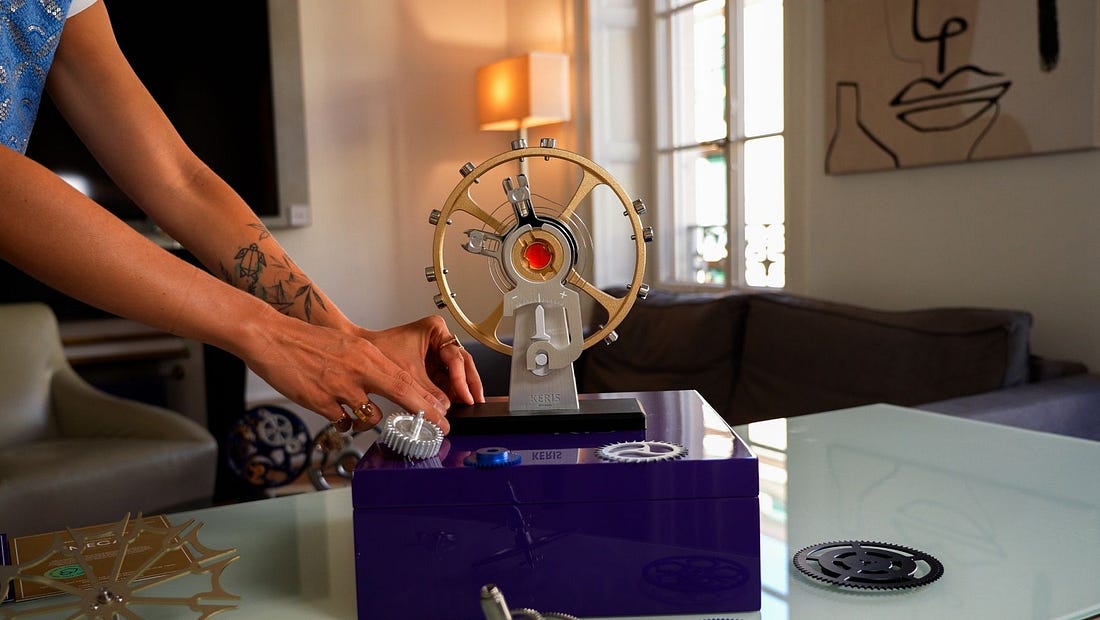
Keris Enlarges the Watch’s Beating Heart Into a Desktop Sculpture
Keris’s The Oscillator takes the balance assembly out of its miniature setting and makes its motion the main attraction. Standing approximately 27 cm tall with a wheel about 21 cm across, the kinetic sculpture turns a familiar watchmaking component into an object that can be studied from across a desk.
Brushed, polished and micro-bead-blasted surfaces give the structure visual depth, while a gentle push starts the oscillation. The engraved date 1675 refers to the historical development of the balance spring, connecting the modern object to the mechanism it celebrates. It does not tell the time, but it offers a particularly direct way to appreciate the motion that regulates many mechanical watches. Price: US$5,000, as listed by London Jewelers.
Go Deeper · Go Deeper: U.S. Pricing
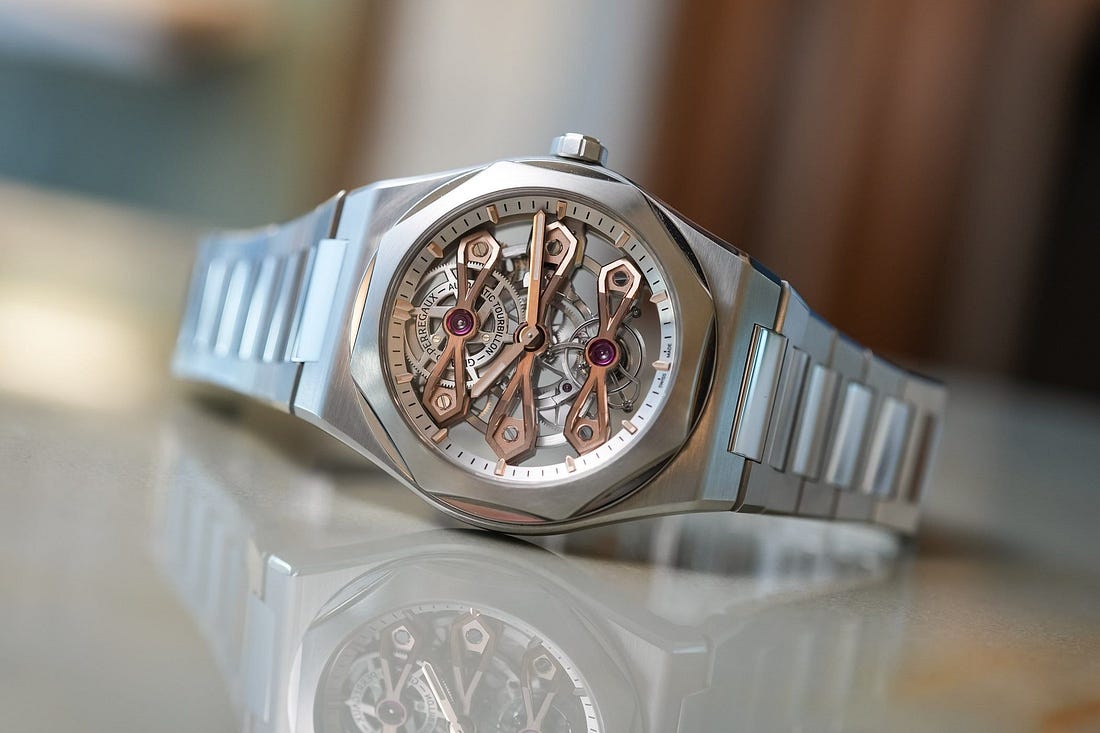
Girard-Perregaux Laureato Fifty Three Gold Bridges Makes Its Mechanics the Main Event
The Laureato Fifty Three Gold Bridges brings Girard-Perregaux’s celebrated bridge architecture into the permanent collection in a 41 mm stainless-steel case with a white-gold bezel. Its open display combines rose-gold accents with three prominent bridges, giving the movement a structural role in the watch’s appearance.
The automatic GP9620-2856 includes a one-minute tourbillon, platinum micro-rotor and 55-hour power reserve, with extensive hand finishing across its complex architecture. An integrated steel bracelet with a micro-adjustment clasp and 50-meter water resistance provide practical concessions within an exceptionally ambitious mechanical sports watch. The appeal rests on the relationship between the recognizable Laureato exterior and the much less conventional view inside it. Price: US$182,000.
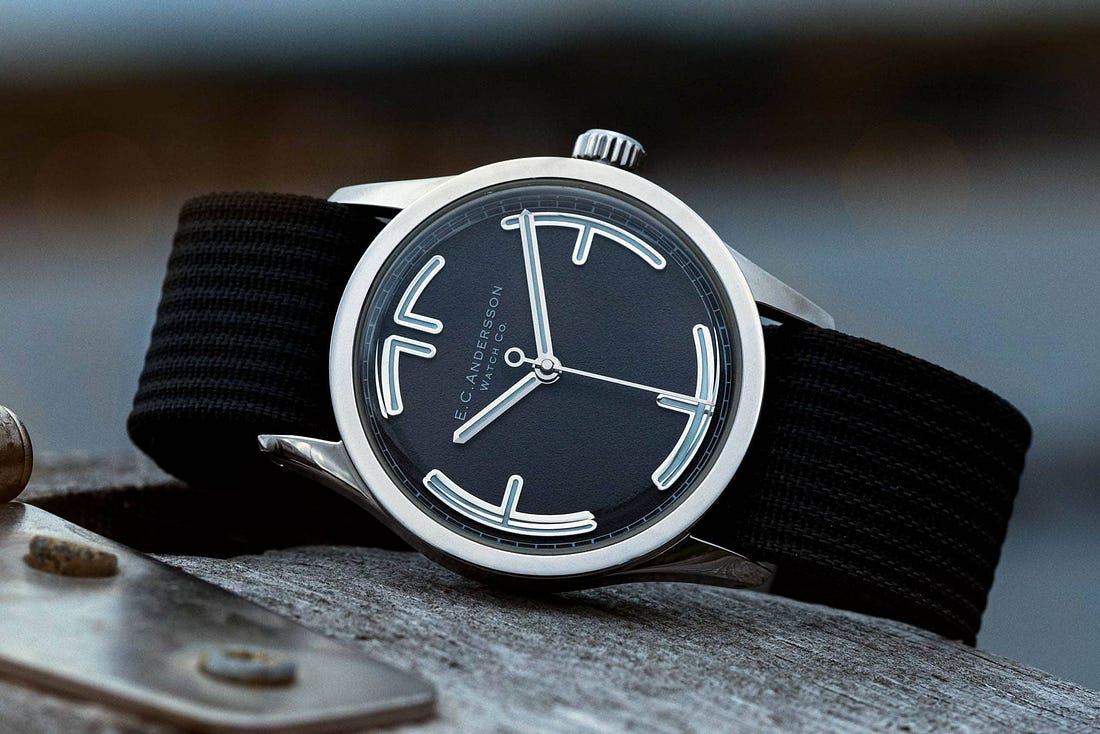
E.C. Andersson’s Cpt Gives the Dress Watch a Nautical Accent
The E.C. Andersson Cpt approaches the dress watch through compact proportions, textured surfaces and maritime inspiration. Its 36.5 mm case measures 8.5 mm thick, while applied markers and a defined minute track give the Midnight Blue and Bright Silver dials a purposeful appearance.
A Miyota 9039 automatic movement, regulated by the brand, supplies approximately 42 hours of power reserve. Water resistance of 100 meters adds everyday flexibility to a watch whose proportions suggest something more formal. Initial production consisted of 45 examples per dial, and the supplied report describes both versions as sold out, with restock notifications available. Price: US$995.
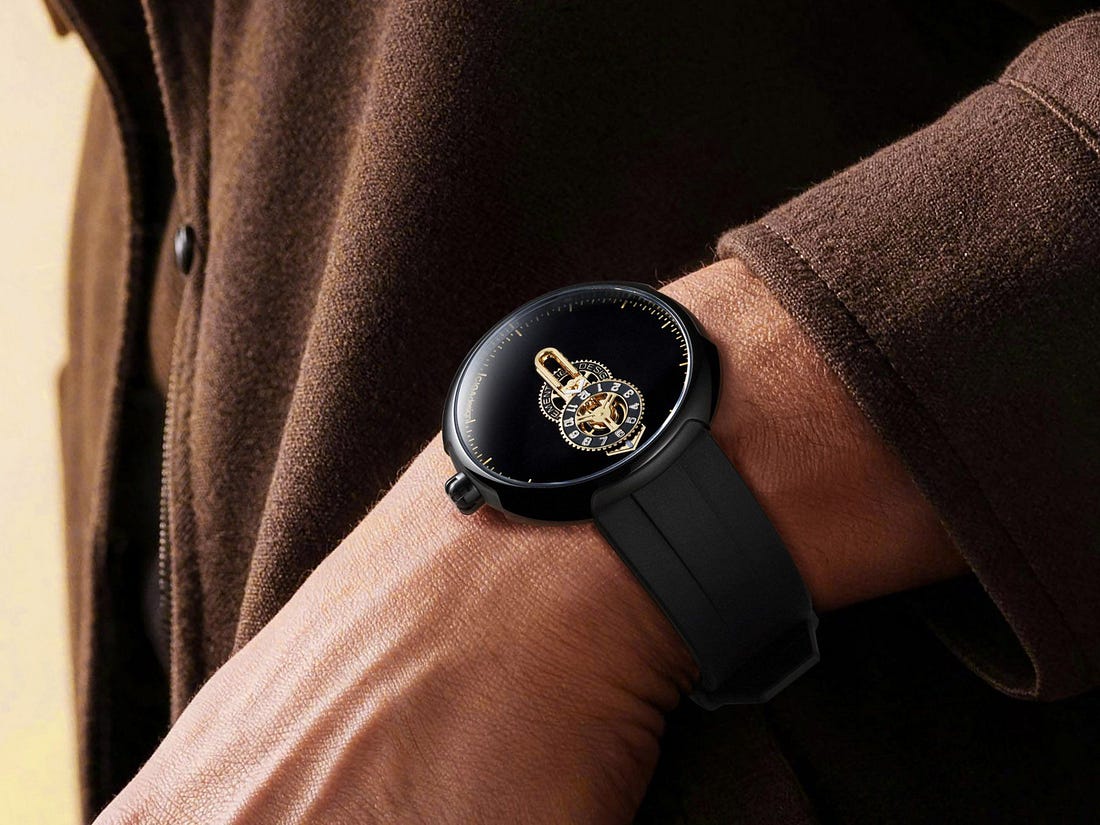
CIGA Design Time Cipher Gold Makes an Unusual Display More Accessible
CIGA Design’s Time Cipher Gold pairs a dark exterior with gold-tone mechanics, drawing attention to its unconventional interpretation of the wandering-hour display. The contrast is intensified by a very dark dial treatment, allowing the moving hour indication and minute scale to dominate the presentation.
The 44 mm steel case houses the CD-08 automatic movement, based on a modified Miyota 9015, with approximately 40 hours of power reserve. A domed sapphire crystal and black fluororubber strap complete a watch that presents mechanical theater without requiring a traditional haute horlogerie budget. Its strongest appeal is the opportunity to own a distinctly different way of reading the time at a comparatively accessible price. Price: US$899 before taxes.
Vacheron Constantin Welcomes the Year of the Goat With Métiers d’Art
Vacheron Constantin’s latest Legend of the Chinese Zodiac watches prepare for the 2027 Lunar New Year with a sculpted goat set within an elaborately decorated dial. Relief engraving, grand feu enamel and miniature painting combine to create a scene whose principal subject would be interrupted by conventional hands.
The automatic caliber 2460 G4 resolves that problem through four apertures displaying hours, minutes, day and date. Offered in 40 mm pink-gold and platinum cases, the limited editions combine decorative craftsmanship with a display designed to preserve the dial as a continuous artistic surface. A sapphire back reveals the movement and gold rotor, while approximately 40 hours of power reserve supports the unusual calendar-and-time arrangement. Price: U.S. dollar price on request; no public numeric price supplied.
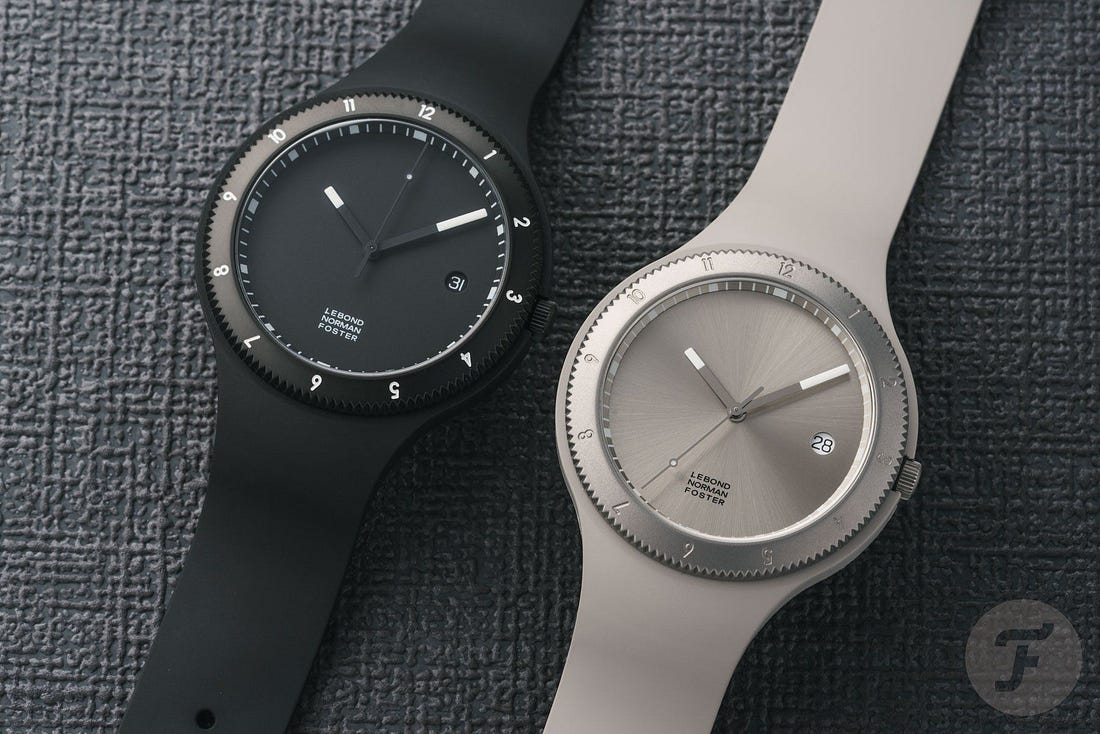
Lebond Norman Foster Treats Case and Strap as One Continuous Design
Architect Norman Foster’s collaboration with Lebond uses the relationship between the case and strap as the organizing idea. The titanium case measures 38.5 mm across, widening where it meets the strap, while its smooth transitions give the watch a unified profile.
Natural Titanium and black DLC versions offer different expressions of the same design, each with a domed sapphire crystal, luminous hands and a bidirectional 12-hour bezel. An ETA 2892-A2 automatic movement is visible through the back, and 50-meter water resistance adds everyday practicality. Interchangeable strap components allow some personalization without disturbing the continuous outline that defines the watch. Price: approximately US$3,900, converted from €3,500.
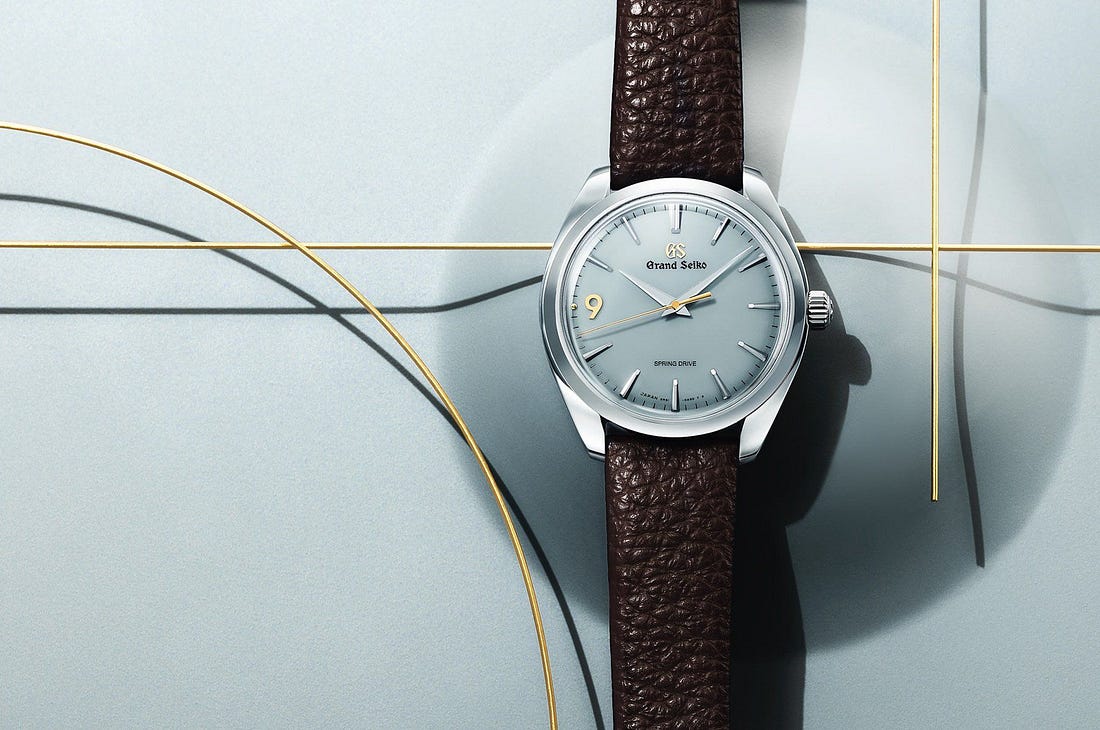
Grand Seiko SBGY045 Adds a GS9 Club Twist to a Familiar Spring Drive Shape
Grand Seiko’s SBGY045 combines the elegant proportions associated with the Omiwatari family with a distinctive blue-green-gray minatonezu dial. Gold-tone applied markers, a numeral nine and a small dot create a restrained but recognizable connection to the GS9 Club.
The manually wound Spring Drive caliber 9R31 provides a 72-hour power reserve and stated accuracy of plus or minus 15 seconds per month. Its steel case measures 38.5 mm across and 10.2 mm thick, with two calfskin straps included. Production is limited to 600 pieces, with purchase access through a GS9 Club lottery and delivery expected in February 2027. Price: approximately US$10,600, converted from €9,500.
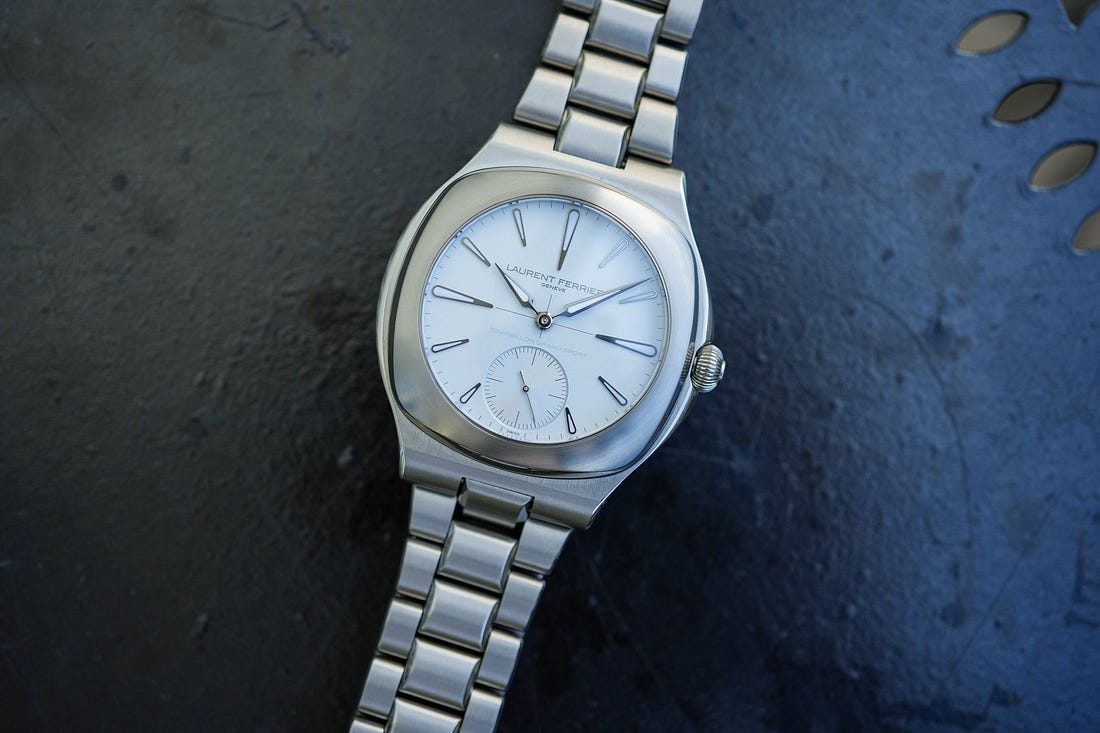
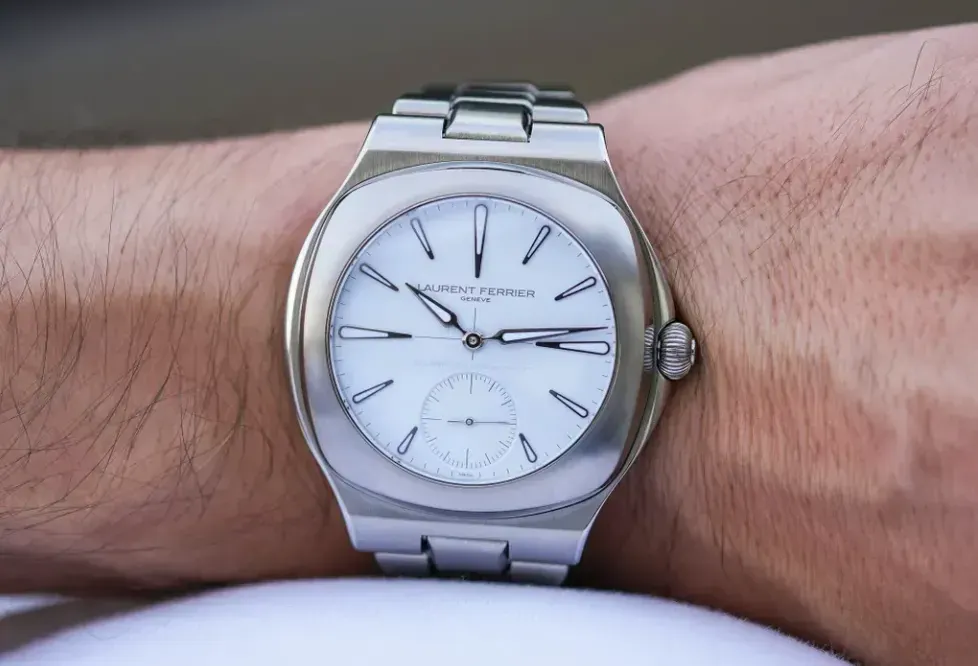
Laurent Ferrier Grand Sport Tourbillon Iceberg Offers a Cooler Expression of Complicated Sport
The Grand Sport Tourbillon Iceberg pairs Laurent Ferrier’s softly shaped sports-watch case with an opaline white dial carrying subtle blue nuances. Grade-5 titanium keeps the 44 mm watch comparatively light, with the supplied review reporting a total weight of approximately 118 grams.
Inside, the manually wound LF619.01 combines a tourbillon with a double balance-spring arrangement and an 80-hour power reserve. The complication is viewed through the back, allowing the dial to retain a calm, legible appearance with luminous hands and markers. An integrated titanium bracelet and 100-meter water resistance support the Grand Sport name, although the finishing and movement place it firmly in the highest reaches of independent watchmaking. Price: approximately US$210,700 before taxes, converted from CHF175,000.
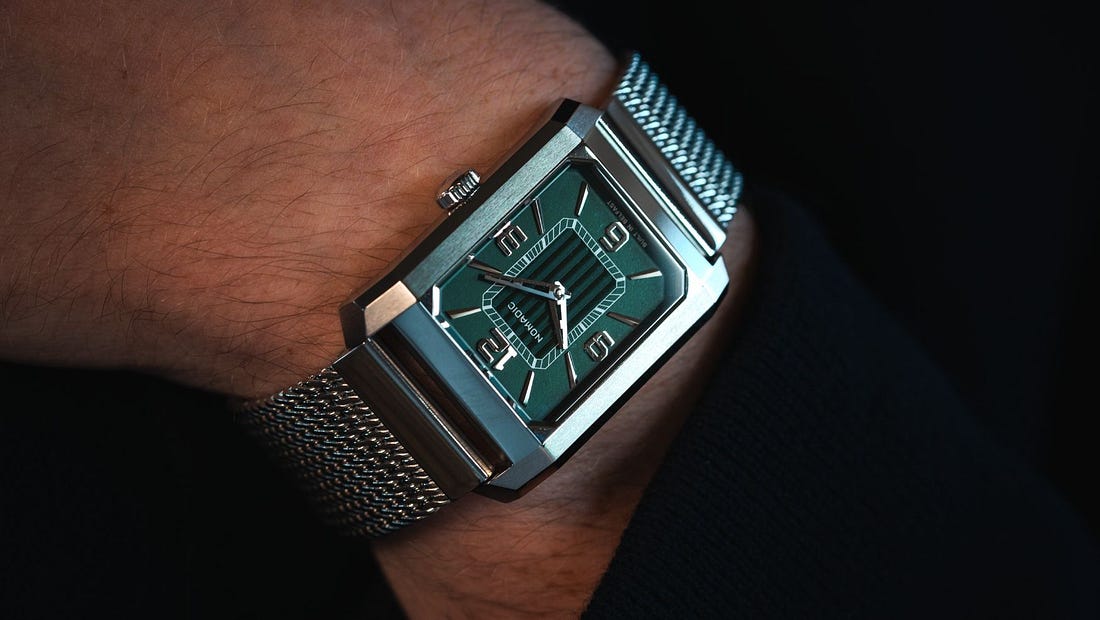
Nomadic Dána 141 Moves From Belfast’s Shipyards to Its Drawing Offices
Nomadic’s first dress watch finds its inspiration in the drawing offices that helped shape Belfast’s industrial history. The Dána 141 uses a rectangular steel case whose proportions refer to the approximately 1:1.41 ratio of A-series paper, creating a clear connection between the design and its architectural starting point.
Measuring 39.6 mm by 28 mm and 8.3 mm thick, the watch houses the manually wound La Joux-Perret D101 with a 50-hour power reserve. Emerald Green, Black Velvet and Moonlight White dials are paired with a selection of leather, suede and mesh options. Sapphire crystal, 30-meter water resistance and an October 30 availability date complete a release that gives Nomadic a more formal direction. Price: US$1,495.
Comparisons
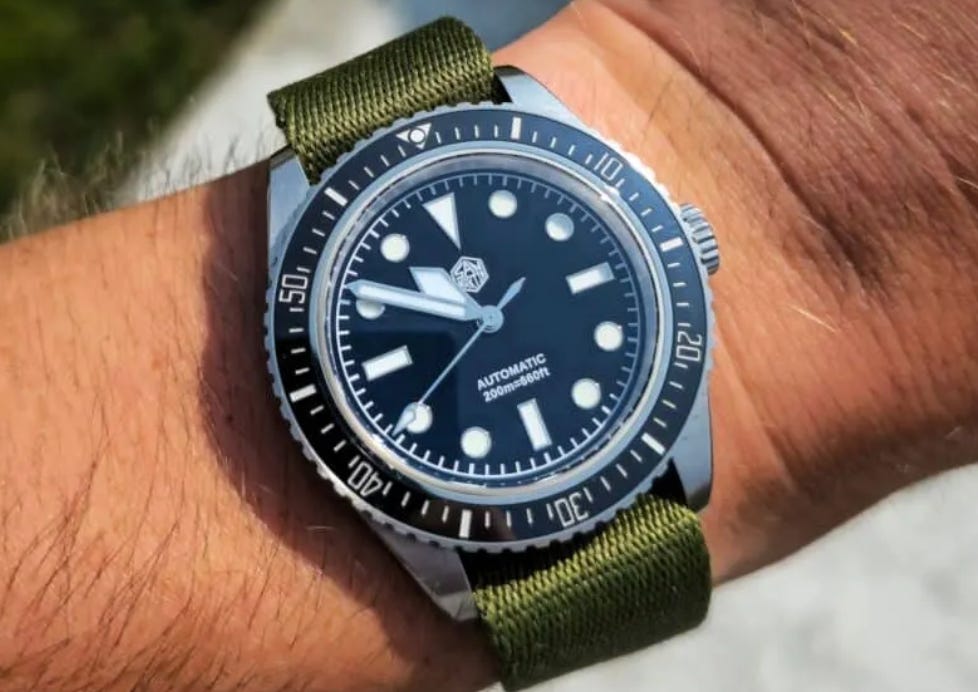
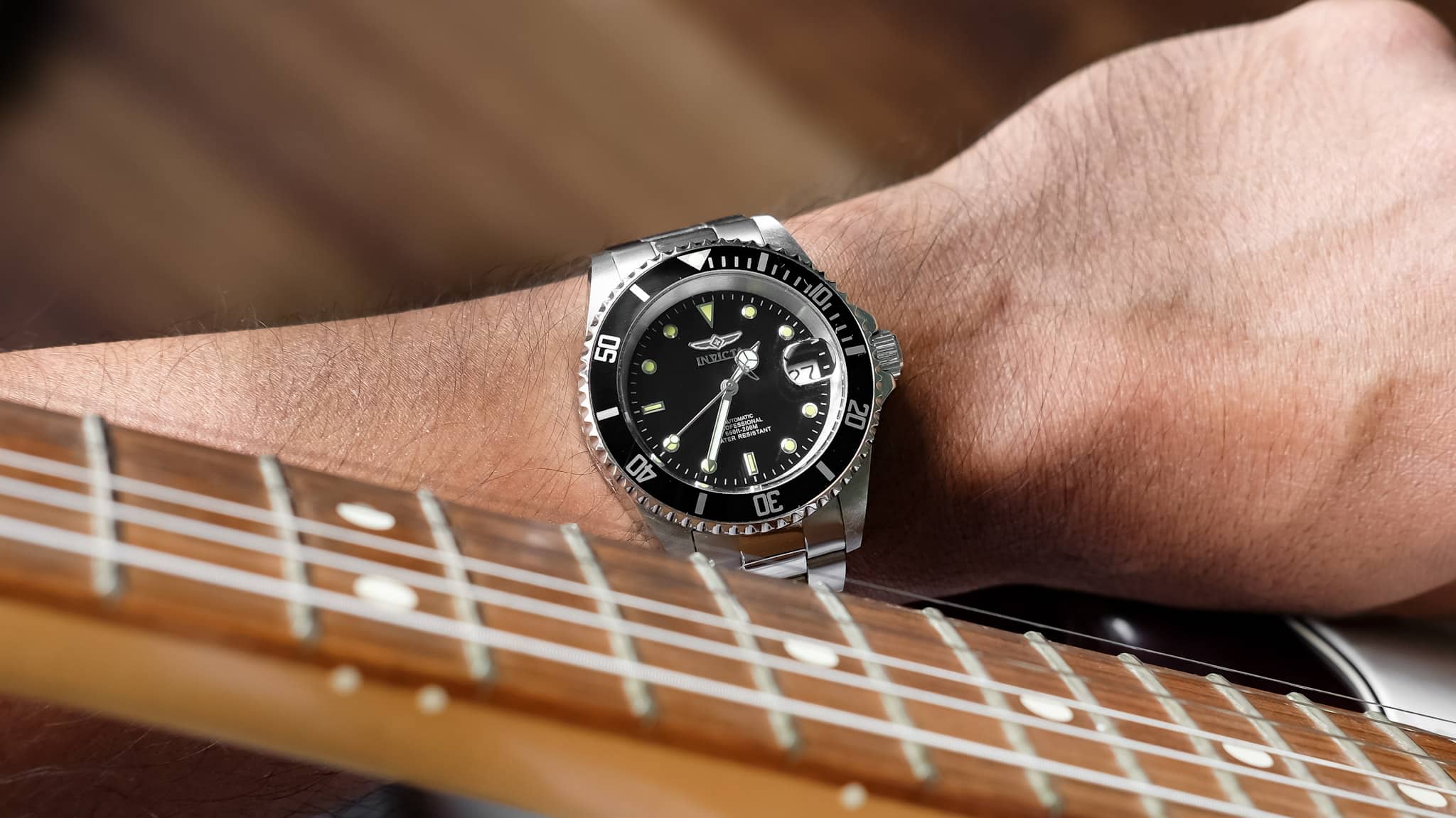
Invicta Pro Diver vs. San Martin SN004 MilSub: Where Does the Extra Money Go?
The Invicta Pro Diver 8926OB and San Martin SN004 MilSub approach familiar dive-watch styling with the same basic mechanical foundation: Seiko’s NH35 automatic movement. Their differences emerge in the components surrounding it, making this a useful comparison of how construction and finishing influence an affordable watch.
The Invicta offers a 40 mm case, mineral crystal and aluminum bezel insert at a lower entry price. The 38 mm San Martin adds sapphire, a ceramic insert and more refined execution of details such as the bracelet and bezel action. The conclusion favors San Martin for enthusiasts who will appreciate those improvements, while recognizing the Invicta’s ability to deliver much of the basic experience for less. The shared movement makes the trade-offs especially easy to identify.
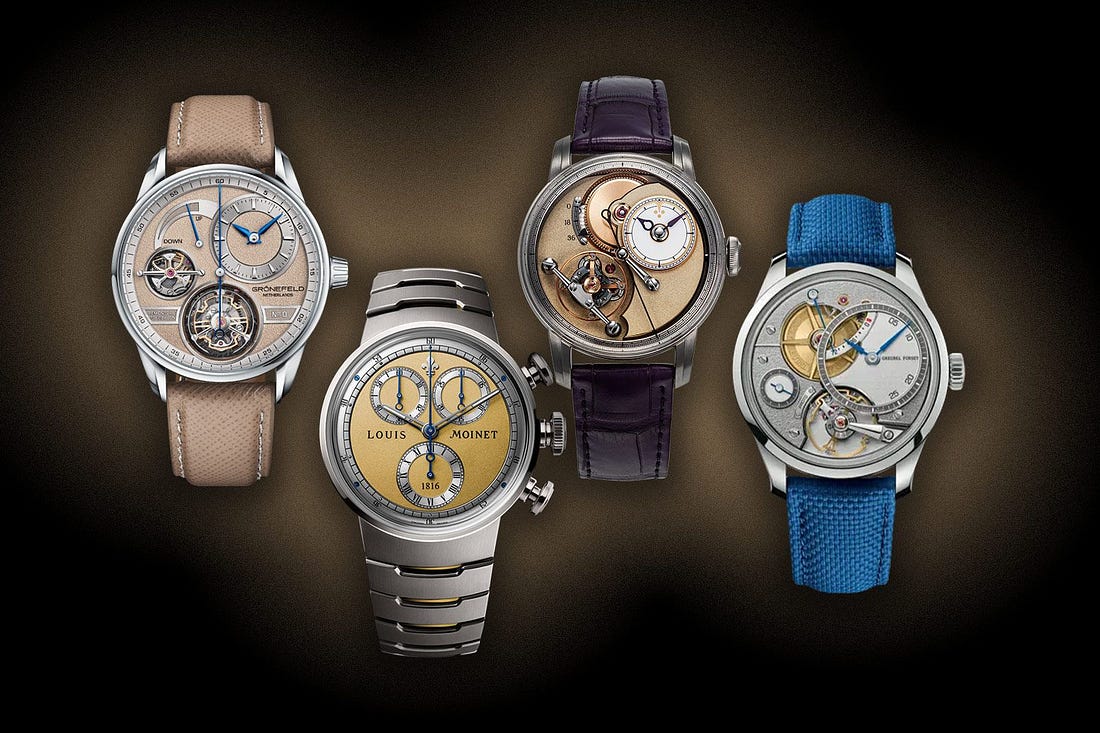
Thirty Independent Watches Show How Broad the Upper End Has Become
A survey of 2026 independent watches priced above £10,000 provides a useful reminder that expensive watchmaking encompasses far more than familiar steel sports models. The selection spans unconventional displays, elaborate calendars, tourbillons, distinctive case shapes and highly specialized decorative work.
Names including Rexhep Rexhepi, Berneron, Armin Strom, Krayon, Laurent Ferrier, Ressence, MB&F and Naoya Hida illustrate the range of approaches. Some watches emphasize mechanical architecture; others concentrate on proportion, hand finishing or a particular philosophy of time display. The guide works best as a map of different creative priorities rather than a simple ranking. For collectors considering a substantial purchase, it offers plenty of reasons to look beyond the most immediately recognizable names.
Reviews
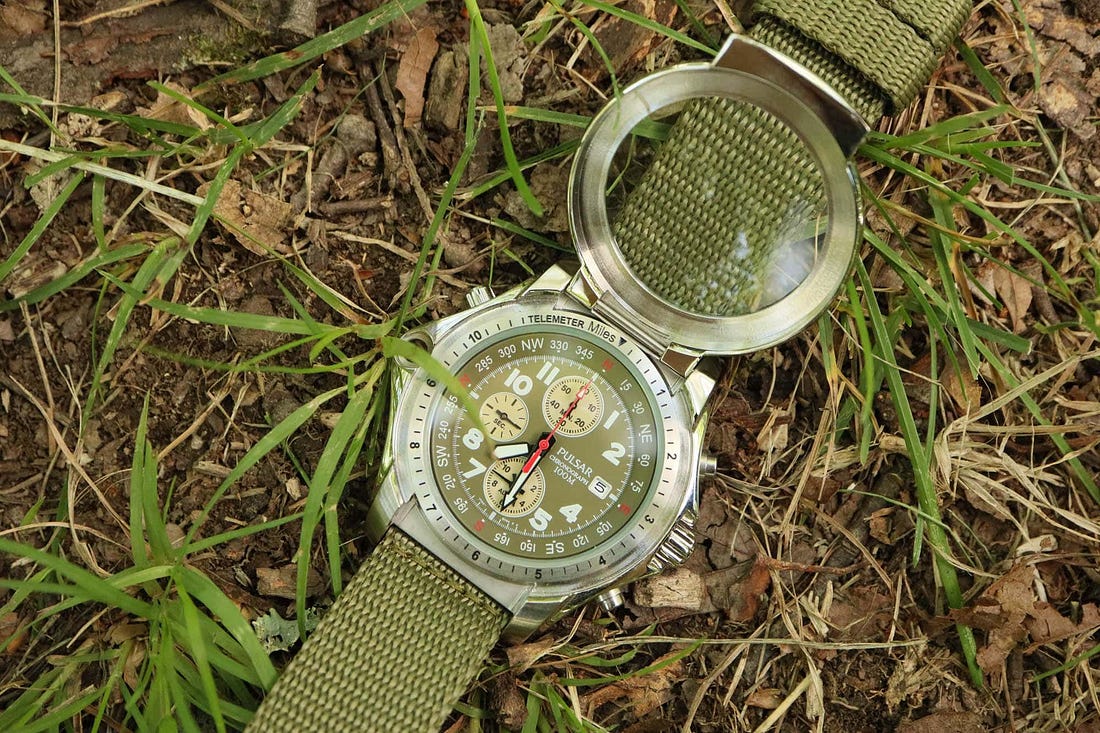
Pulsar Adventurer 7T62-X084: An Unusual Tool Watch With Plenty to Do
The Pulsar Adventurer 7T62-X084 is a reminder that useful watch design can become wonderfully eccentric. Introduced around 2005, it combines a chronograph, alarm and calendar with an inner compass bezel, lanyard attachment point and a distinctive flip-top magnifying lens.
Its approximately 43 mm case becomes considerably larger around the projecting eyelet, so the visual character comes with substantial wrist presence. The quartz 7T62 movement provides a dependable foundation, while different colors and strap configurations add collecting interest. Examples are reported to appear below US$200, although availability and condition vary. For someone attracted to practical features and unusual industrial design, the Adventurer offers considerably more personality than its modest market position might suggest.
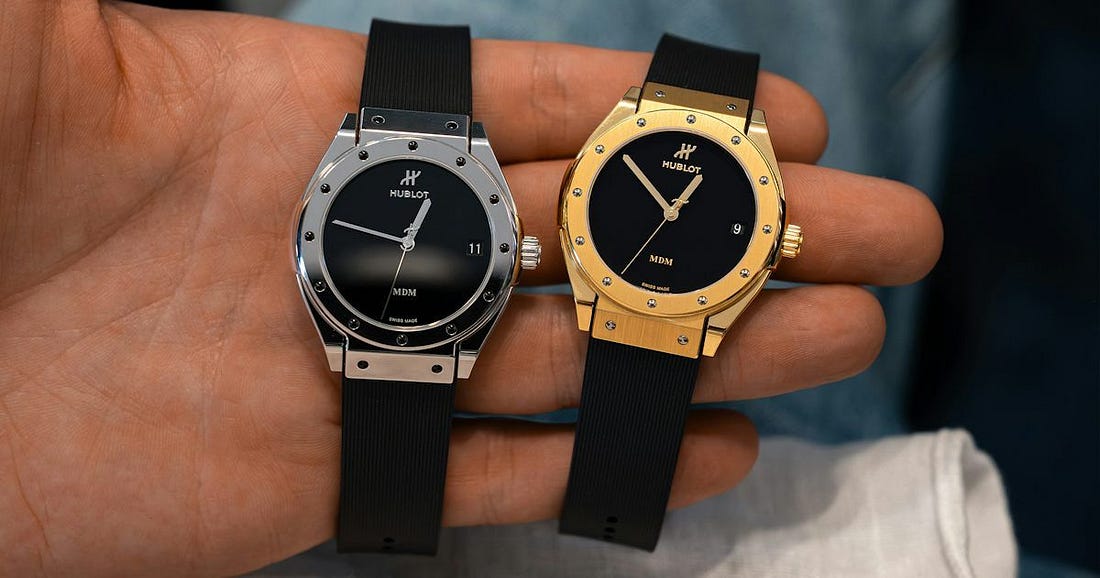
Hublot Classic Fusion Tributo Revisits the Idea That Started the Brand
The Classic Fusion Tributo returns to Hublot’s foundational combination of precious metal and rubber, interpreting the original 1980 design through a contemporary 38 mm case. An onyx dial, visible screws and stepped construction preserve the recognizable character while giving it a more considered modern finish.
The automatic HUB1711 supplies a 60-hour power reserve, and yellow-gold and white-gold versions offer different treatments of the same formula. At a reported US$30,900, the Tributo asks buyers to value the coherence and history of that combination as much as the materials themselves. Its strongest argument is that Hublot’s original idea remains visually distinctive: compact, direct and comfortable with the tension between formal gold and an informal strap.
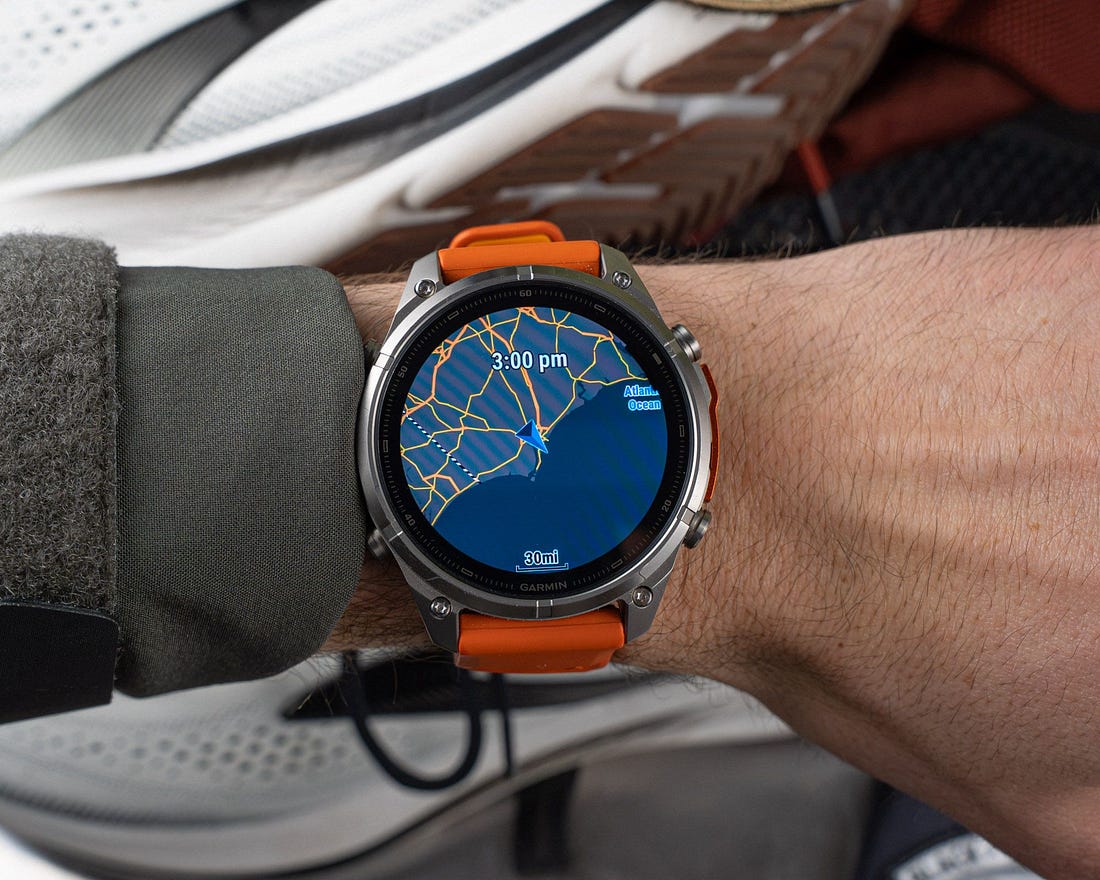
One Hundred Miles With a Garmin Fēnix 9 Pro
A month of training and participation in the Mission Miles challenge gives the Garmin fēnix 9 Pro a practical assignment. The event supports Project Recover’s work locating and repatriating missing-in-action service members, while the watch records the running, walking, rowing and other activity needed to reach the mileage target.
The reviewer reports more than 150 miles of use, emphasizing battery endurance, extensive activity profiles and the usefulness of accumulated training information. Satellite connectivity and outdoor capabilities expand its role beyond a basic fitness tracker, although strap fit and optical-sensor placement still require attention. Starting at a reported US$1,199, the watch makes its case through sustained usefulness—a particularly interesting perspective from a writer whose usual preference is for analog watches.
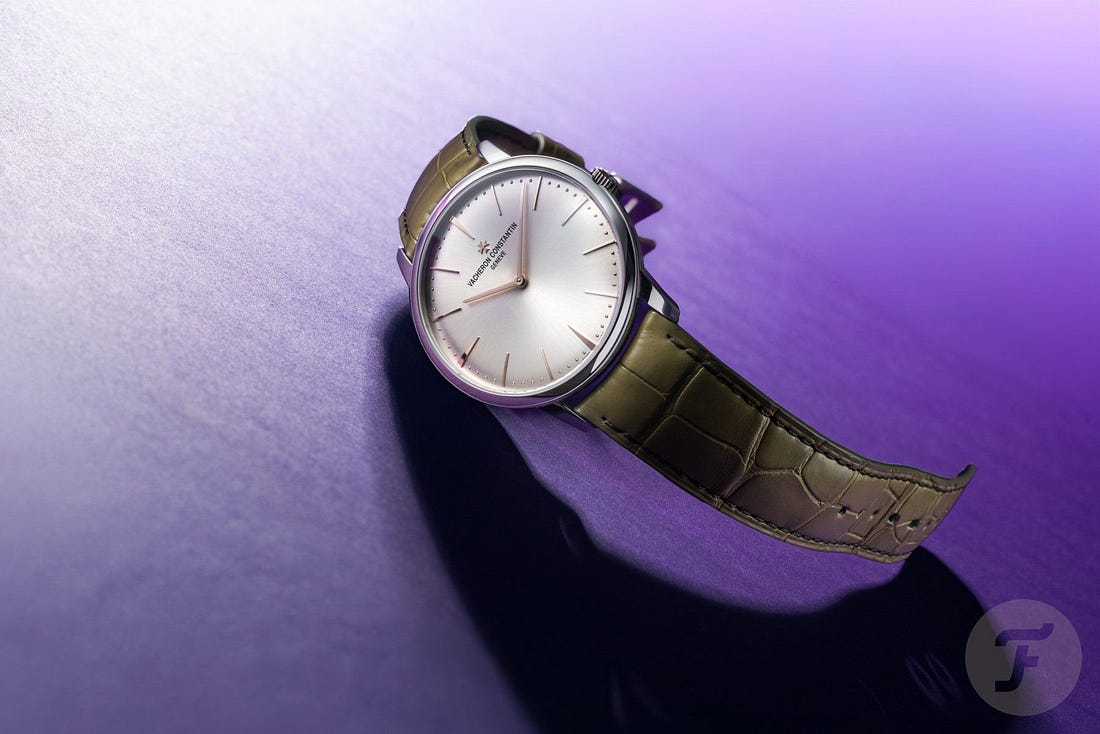
Why a Vacheron Constantin Patrimony Became the Right Personal Choice
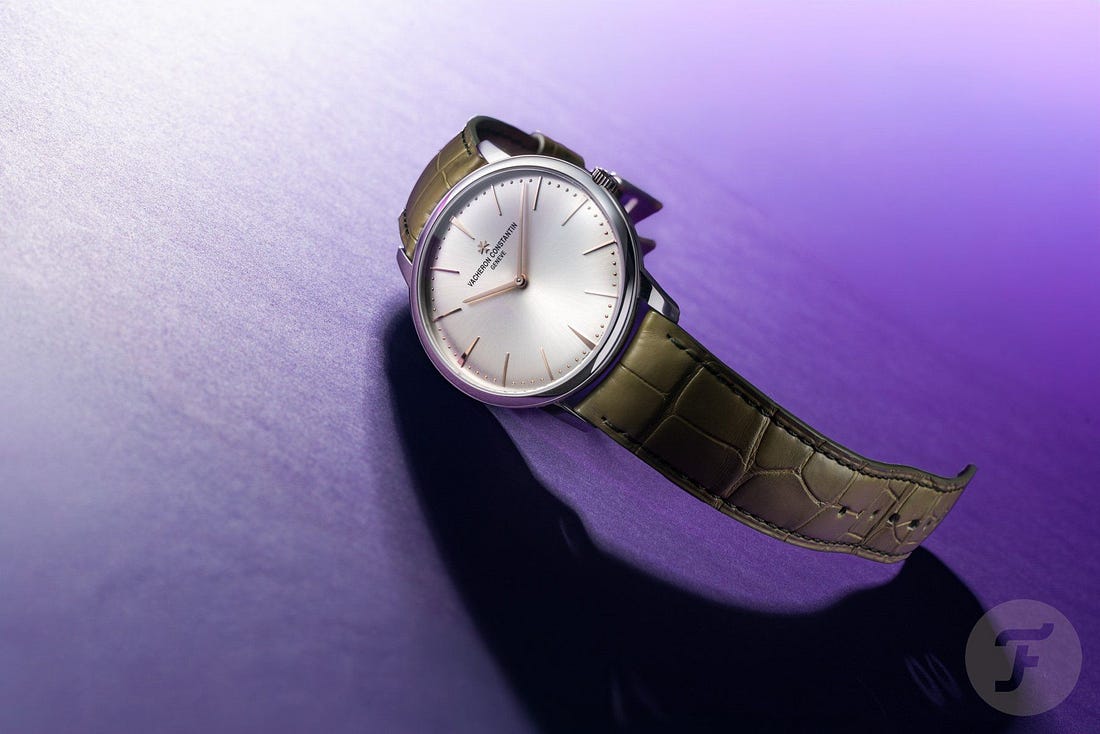
The Patrimony Manual-Winding reference 1410U/000G-H017 demonstrates how much character can be expressed through restraint. Its 39 mm white-gold case, softly shimmering dial, pink-gold markers and olive-green strap create a watch whose distinctions become clearer through wear rather than immediate visual drama.
At 7.7 mm thick, the case preserves the slim profile expected of a traditional dress watch. Inside, the manually wound caliber 1440 offers approximately 42 hours of power reserve and carries the Geneva Seal, while the closed caseback keeps the exterior deliberately simple. The owner’s account focuses on proportion, subtle color and small finishing details, including the polished gold minute markers. It is an argument for choosing a watch because its particular decisions suit you.
Events
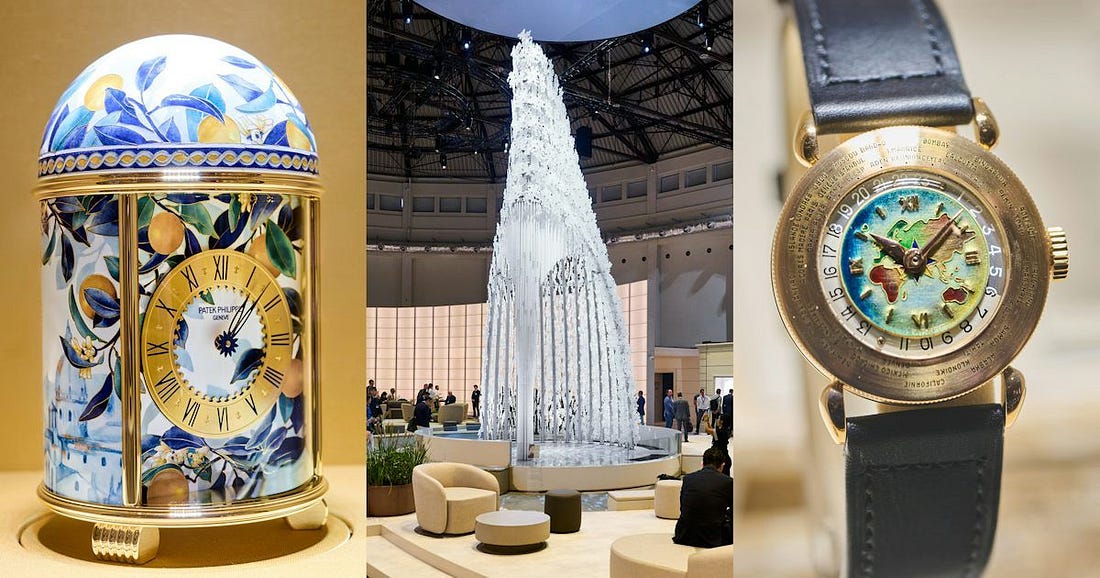
Inside Patek Philippe’s Milan Watch Art Grand Exhibition
Patek Philippe’s Milan Watch Art Grand Exhibition combined new watches, historical material and live demonstrations of the crafts that give many of its most elaborate pieces their character. The report describes approximately 68,000 visitors moving through more than 31,200 square feet of exhibition space, with free admission and digital guides widening access.
Enameling, wood marquetry and clockmaking shared attention with complicated wristwatches and Italian-inspired artistic editions. Dome clocks and miniature dial scenes helped show how differently watchmaking can communicate an idea, even within a single manufacture. The photographs provide the immediate attraction, but the larger value is context: visitors could see finished objects alongside the techniques and historical references that help explain them.
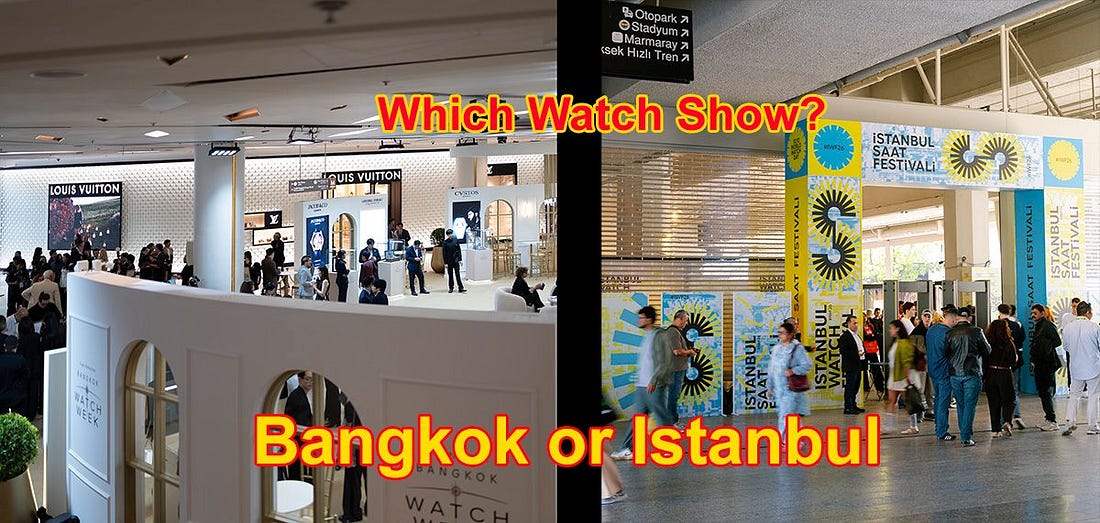
Bangkok and Istanbul Add New Energy to the Watch-Travel Calendar
Bangkok Watch Week and Istanbul Watch Festival demonstrate how regional events can develop their own identities alongside the major international fairs. Bangkok’s second edition reportedly attracted more than 40,000 visitors and 45 international brands, combining retail presentation with discussions and educational programming.
Istanbul’s inaugural festival welcomed more than 7,500 visitors and 20 brands, with workshops, breakout sessions and artistic performances contributing to a broader community atmosphere. The appeal of both gatherings extends beyond the exhibition floor: their host cities offer substantial cultural reasons to make the trip. For enthusiasts, that combination can turn a watch event into a more rounded experience, particularly when a smaller setting allows more direct conversations with the people behind the watches.
Podcasts
SUPERLATIVE: Rethinking Watch Retail With Roldorf & Co. Founder Jason Gallop
Jason Gallop joins Ariel Adams to discuss a retail model that puts the workshop at the center of the customer experience. Drawing on a family background in goldsmithing, watchmaking training and experience with Rolex, Gallop explains how Vancouver’s Roldorf & Co. combines selling watches with visibly maintaining and repairing them.
The conversation addresses changing relationships between brands and retailers, the opportunities available to independent businesses and the importance of service when offering pre-owned watches. Work with brands such as Paulin and anOrdain adds another dimension, connecting the retailer to assembly and production as well as distribution. For listeners interested in what makes a watch shop worth returning to, the episode offers a useful discussion of expertise, transparency and community.
The Business of Watches: What New York Watch Week Says About the Market
TanTan Wang and Griffin Bartsch join the discussion to assess New York Watch Week and the enthusiasm surrounding its overlapping events. INDIES.NYC, the FHH Forum, WatchTime and Windup provide different views of the American audience, from highly specialized independent collectors to enthusiasts exploring more accessible watches.
The episode considers what that visible energy says about demand and how brands are responding to an increasingly important U.S. market. New releases and event experiences provide concrete starting points, but the larger question is whether a busy calendar and crowded rooms translate into durable commercial strength. It is a timely conversation for anyone trying to understand the relationship between collector excitement, brand investment and the business that ultimately supports both.
Videos

Watch Dial Heaven: Calina Shevlin at Atelier Guilloché
Chronoglide Watchmaking Academy returns to Atelier Guilloché in Switzerland for a closer look at Calina Shevlin’s work and the techniques behind decorated watch dials. The subject rewards the video format: patterns that can appear almost printed in a photograph become more understandable when the tools, surfaces and working process are visible.
The attraction is the relationship between precision and artistic judgment. Guilloché depends on controlled geometry, but the resulting dial also has to respond to light and work within the design of a watch. This is a useful companion to today’s enamel feature for readers who want to spend more time with the making of the object.

Rolex AD Games: Are Things About to Get Worse—or Better?
Scott Adam Lancaster examines the changing experience of dealing with Rolex authorized retailers and the possible implications for customers seeking access to desirable watches. The title frames the discussion provocatively, reflecting the uncertainty collectors often feel about availability, relationships and purchasing expectations.
Alongside today’s Bucherer news, the video provides an opportunity to consider how retail changes might affect the person on the other side of the counter. Its arguments should be understood as commentary on an evolving situation, with the practical question remaining straightforward: will the buying experience become clearer and more satisfying for customers?

Zenith Is in Trouble. Who’s Next? Staff Cuts and Price Increases
Britt Pearce discusses reports of staffing reductions and price increases at Zenith, using the situation to examine pressures facing the wider watch industry. The combination raises difficult questions about how a brand balances costs, production, positioning and the expectations of customers being asked to pay more.
The video’s broader interest lies in the relationship between internal business decisions and the external story presented to collectors. A higher price may signal an ambition to move upmarket, but customers will still assess the watches, the alternatives and the strength of the proposition. It is a discussion worth watching alongside today’s stories about retail consolidation and the many competing definitions of value.
Auction Results
Platinum Hermès Slim d’Hermès Stops at US$11,850 and Remains Unsold
The October 28 auction of the Hermès Slim d’Hermès in platinum, reference W054157WW00, ended with a high bid of US$11,850. The seller’s US$20,000 reserve was not met, and the watch did not sell.
Bidding finished US$8,150 below the reserve, a shortfall of approximately 40.8 percent. The final bid reached 59.3 percent of the seller’s required price. That records a substantial gap between the two sides of this particular transaction; it does not establish a completed sale or a definitive market value for the reference.
Auction Report
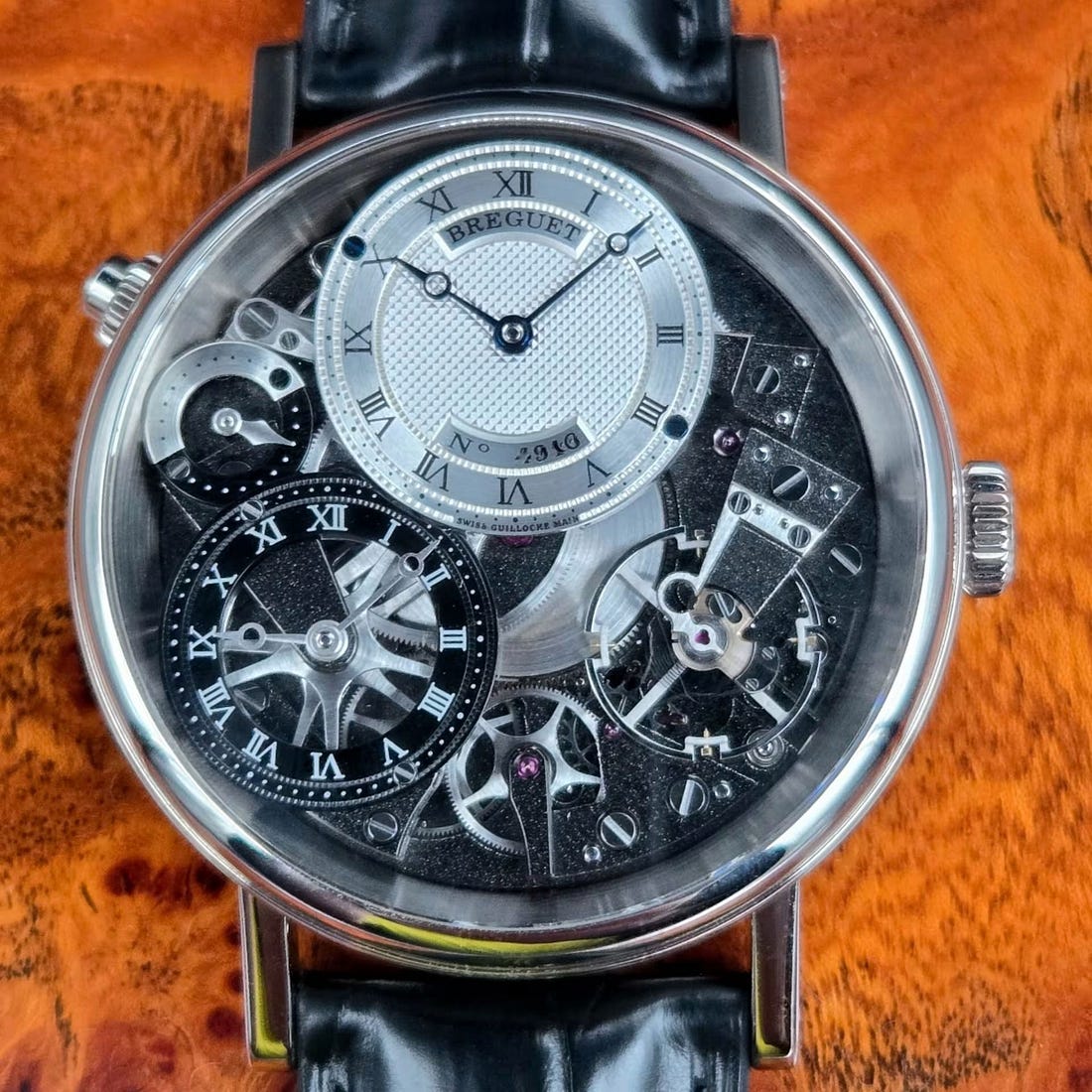
Breguet Tradition GMT: Two Time Zones, Two Centuries of Inspiration and Tonight’s Market Test
Tonight’s auction features a 2024 Breguet Tradition 7067 GMT in 18-karat white gold, reference 7067BB/G1/9W6, offered in the United States with box and papers. The seller describes an excellent dial and minor signs of wear elsewhere, within an overall pre-owned condition assessment. The listing gives the case size as 41 mm, although this reference is generally catalogued at 40 mm, a discrepancy worth resolving before bidding. Its silvered time display and exposed anthracite-toned mechanics make it immediately recognizable as a Tradition, with far more happening on the front than a conventional GMT hand circling an ordinary dial.
Breguet introduced the Tradition collection in 2005, drawing inspiration from Abraham-Louis Breguet’s historical souscription pocket watches, and added the reference 7067 in 2012. The arrangement places much of the mechanical architecture in view around two separate time displays, connecting an eighteenth-century design vocabulary with a practical travel complication. The manually wound caliber 507DRF provides approximately 50 hours of power reserve, a second time zone, day/night indication and a power-reserve display on the reverse. Guilloché decoration, distinctive hands and the visible balance assembly give the watch its appeal as both a usable timekeeper and a compact lesson in mechanical construction.
For current value context, a publicly advertised 2024 complete-set example has been offered at US$24,995, while another comparable 2024 complete-set listing has appeared at US$26,995. Those are asking prices, not verified transaction results, and they suggest a more relevant starting point for evaluating this pre-owned example than much higher new-watch advertisements. A white-gold Tradition GMT reported sold by Phillips for US$37,800 in December 2021 supplies a historical auction comparison, but its different date and selling environment make it unsuitable as a direct prediction. Service history, physical condition, the completeness of the accessories and the final purchase cost remain important distinctions between examples.
The attraction here is substantial watchmaking personality at a price determined by today’s buyers. Box and papers strengthen the presentation, but bidders should still establish how the movement is performing and whether servicing is approaching before deciding what the watch is worth to them. No reserve figure was supplied for this auction. Bidding is scheduled to end at 6:35 p.m. EDT today, Thursday, October 29, 2026, when this Breguet’s unusually visible mechanics will meet the market’s equally visible judgment.
Current bid: $10,200
Losing Time

Today’s Big Losers at Auction on Grailzee
Four watches, four failed sales, and a useful reminder that an asking price is an aspiration until somebody agrees to pay it.
The 2026 Rolex Lady-Datejust 28MM with a rhodium dial and Jubilee bracelet (279384RBR) carried a $25,000 ask but attracted a final bid of just $9,500. That’s a $15,500 shortfall, or 62% below asking. The diamond-set Rolex apparently came with an optimism premium bidders felt no obligation to honor.
The 2026 Rolex Datejust 31MM with a mother-of-pearl dial and Oyster bracelet (278274) came closest to bridging the credibility gap. Its $10,000 high bid fell $6,000 short of the $16,000 ask—37.5% below asking. The strongest showing of the four, although “least unsuccessful” probably isn’t the distinction the seller wanted.
The 2024 Hublot Big Bang Unico “Orange Ceramic” 44MM (441.CU.5910.RX) delivered the evening’s most dramatic disconnect. Against a $24,000 ask, bidding reached $5,100: a whopping $18,900 gap, or 78.75% below asking. The ceramic was orange; the pricing expectations were somewhere in the clouds.
The 2021 Hublot Big Bang Unico “Red Magic” Limited Edition 45MM (411.CF.8513.RX) sought $18,500 and received a $7,300 high bid. That left an $11,200 shortfall, or 60.54% below asking. Apparently, “limited edition” didn’t extend to limiting the distance between seller expectations and bidder enthusiasm.
Together, the four sellers wanted $83,500, while the final bids totaled $31,900—61.8% below the combined asking prices. The Datejust 31MM had the narrowest percentage gap; the Orange Ceramic Hublot had the widest by a considerable margin. Both Hublots struggled to generate bids remotely close to their asks, but the Lady-Datejust proves Rolex branding wasn’t a free pass either. These results don’t establish definitive market values—auction exposure, condition, fees, and buyer participation can all matter—but they do show that these bidders weren’t buying these sellers’ expectations. If a completed sale is the goal, the pricing needs a serious conversation with reality.
Closing Time
The most satisfying watch is often the one that gives you a reason to look down at your wrist when you already know the time. Today’s issue offers plenty of those reasons: an enamel surface, an unusual movement, a historical design or a practical feature that earns its place through use.
Enjoy the discoveries, keep asking what the price actually buys, and leave room in the collection for something that makes sense to you personally.
Thanks for spending part of your day with Buying Time. We’ll see you tomorrow.