Luxury Watch Sales Falter as Iran War Ripples Through Global Economy
Luxury watch demand is slipping fast as war-driven economic pressure hits consumers, with rising gas prices, mortgage rates, and falling confidence forcing buyers out of a purely discretionary market.
Luxury Watch Sales Falter as Iran War Ripples Through Global Economy
The global watch industry—long buoyed by resilient high-end consumers—is beginning to show visible cracks as the economic fallout from the escalating Iran conflict intensifies. What was once a steady stream of discretionary spending on luxury timepieces is now slowing sharply, caught in the crosscurrents of collapsing consumer confidence, rising borrowing costs, and surging energy prices.
At the macro level, the signals are unambiguous. U.S. consumer sentiment has dropped to one of its weakest readings of the year, with the widely watched University of Michigan Consumer Sentiment Index falling to 53.3 as higher gasoline prices and market volatility weigh heavily on households (see: https://data.sca.isr.umich.edu/). At the same time, the average price of gasoline has surged to roughly $3.98 per gallon nationally, driven by a sharp spike in oil prices linked directly to instability in the Middle East. Brent crude has climbed dramatically in recent weeks, briefly pushing into the $110–$119 per barrel range, and analysts warn it could move higher if supply disruptions persist.
This surge in energy costs is cascading across the broader economy. Mortgage rates have climbed for four consecutive weeks, with the 30-year fixed rate now hovering around 6.3%–6.4%, the highest level in months. Rising rates are squeezing housing affordability and, more importantly for the watch industry, reducing disposable income at precisely the moment consumers are becoming more cautious. Financial markets have also weakened, eroding household wealth and further dampening appetite for luxury spending.
That matters because luxury watches are, at their core, a purely discretionary purchase. Unlike housing, transportation, or even most consumer goods, no one actually needs a mechanical watch—certainly not one costing thousands or tens of thousands of dollars. In practical terms, a $20 quartz watch performs the same basic function. In periods of economic stress, that reality becomes impossible to ignore.
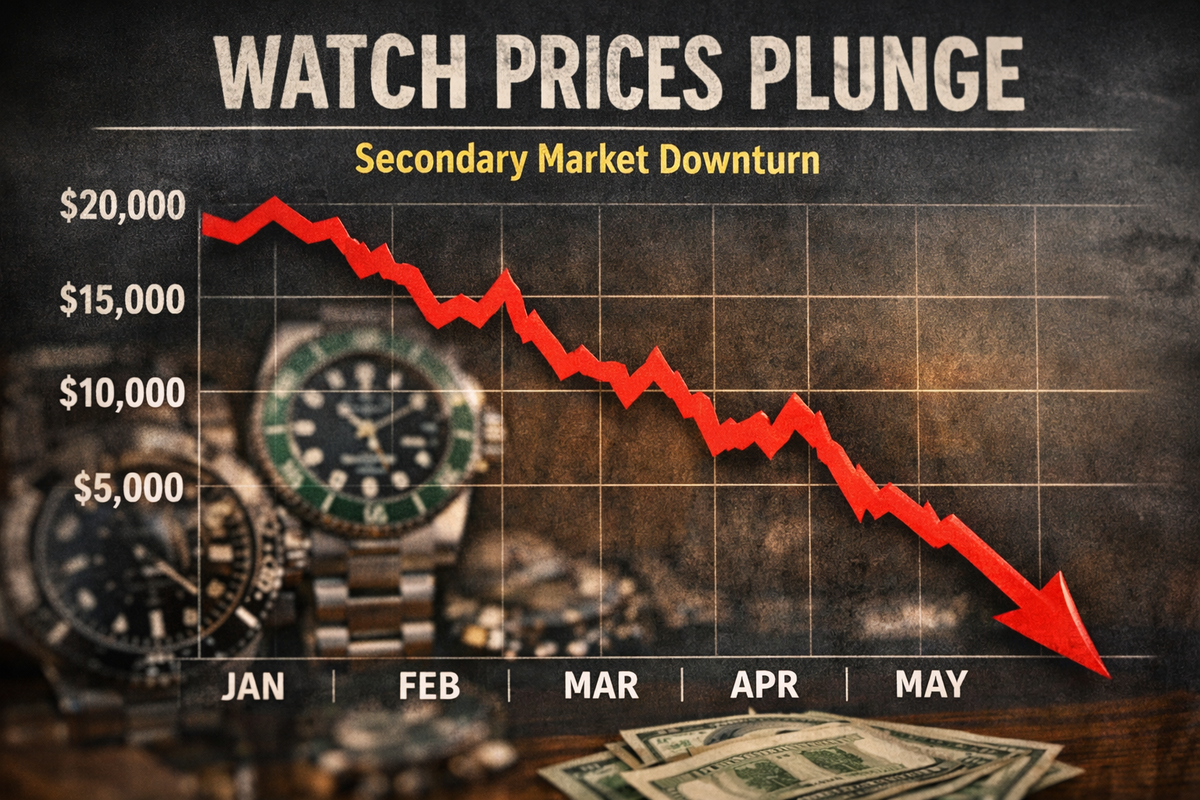
The shift is now showing up clearly in the secondary market. Auction platforms like Bezel (https://www.getbezel.com) and Grailzee (https://www.grailzee.com) are experiencing a noticeable surge in “reserve not met” results, with hundreds of watches failing to sell over the past week. Sellers—many of whom bought at peak prices during the recent boom—are increasingly attempting to liquidate assets in a market where buyers are stepping back. The imbalance is striking: supply is rising just as demand is fading.
Compounding the issue is the extraordinary price inflation seen across the watch market over the past year. Much of that increase has been tied to tariff-related cost pressures and constrained supply, which pushed retail prices higher and drove speculative buying. Many consumers who waited years for allocations from brands like Rolex are now bringing those watches to auction, often facing softer bids than expected.
In effect, the market is undergoing a rapid correction driven by a reversal of the wealth effect. As portfolios shrink, borrowing becomes more expensive, and everyday costs like fuel rise, consumers are shifting from buying luxury goods to preserving cash. The psychology has flipped almost overnight.
The Iran war has not directly targeted the watch industry, but its economic shockwaves are proving deeply consequential. With energy markets unsettled, inflation pressures building, and consumer confidence weakening, the conditions that fueled the recent watch boom are quickly unraveling. And in a category where demand is entirely optional, the downside is now arriving just as swiftly as the upside once did.