Time Graphing Today’s Watch Universe - July 10, 2026
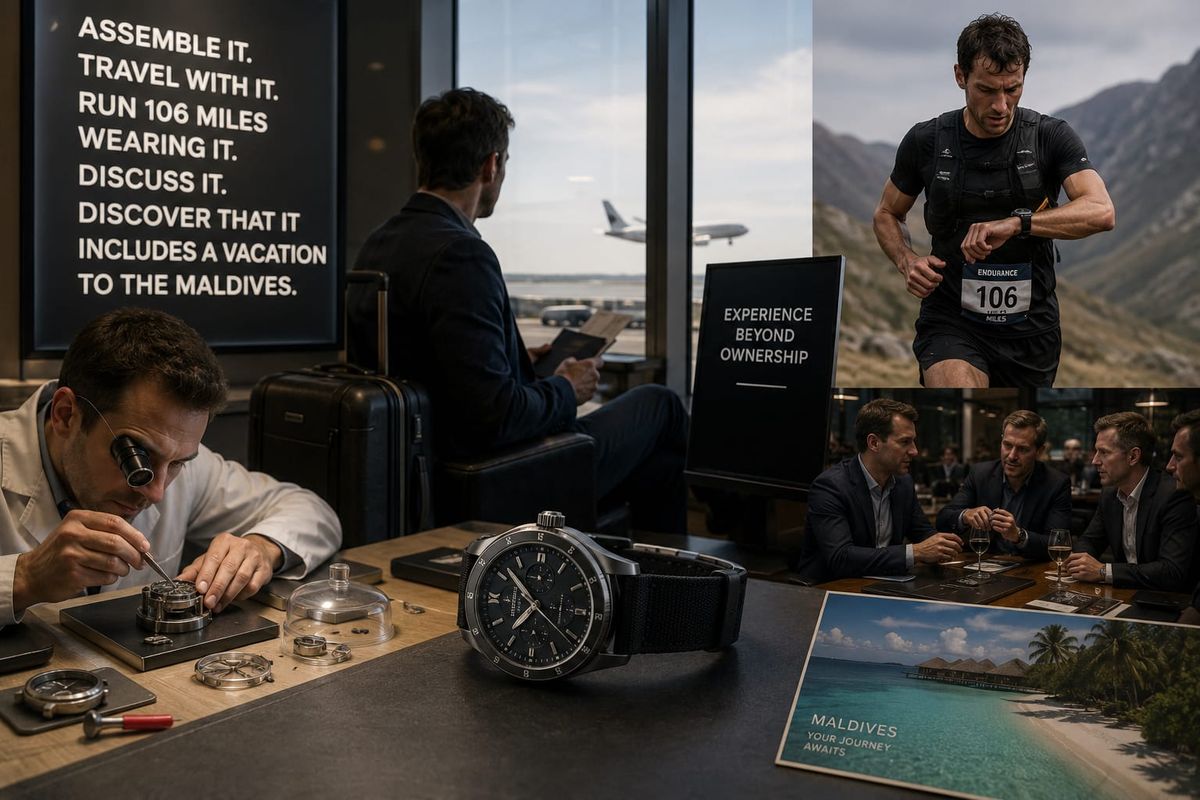
The watch industry has spent years trying to make its products more experiential. Apparently, owning the watch is no longer enough. Now we must assemble it, travel with it, run 106 miles while wearing it, discuss it in a lounge and perhaps discover that it includes a vacation to the Maldives.
That last idea comes courtesy of Norqain’s Freedom GMT Enjoy Life “Holiday” Limited Edition, a 500-piece release containing one hidden “Golden Ticket” that will send its owner and a guest to the Ayada Maldives resort. The watch itself is already doing quite a bit of work. It has a colorful world-map dial, a true GMT movement, holiday icons, destination pins and a travel case designed to resemble something between luxury packaging and a particularly optimistic vision board.
The vacation promotion could easily be dismissed as a gimmick, except gimmicks are becoming increasingly central to how watches are sold. A watch carrying a capable Kenissi-built movement and a 70-hour power reserve should theoretically be able to stand on its own. But specifications are now merely the admission price. Brands are competing to provide the story that surrounds the object, whether that means adventure, community, artistic participation or the possibility of waking up in an overwater villa.
The same logic is visible in Tudor’s new partnership with the UTMB World Series. Tudor has steadily built a sporting identity that reaches beyond the familiar territory of motorsports and sailing. Ultra-trail running gives the brand access to a younger and rapidly expanding audience while reinforcing its “Born to Dare” slogan in an environment where daring is not an advertising abstraction. The headline Mont-Blanc race covers 106 miles and roughly 10,000 meters of elevation gain. Nobody participating needs to be reminded that endurance is difficult.
It is a strong partnership because the activity provides an authentic test of the values Tudor wants associated with its watches: resilience, reliability and the willingness to keep moving when stopping would be considerably more pleasant. The watches may not be timing the entire race in any practically essential way, but that has never been the sole point of sports sponsorship. The goal is to place the brand inside a culture and allow some of that culture’s credibility to migrate onto the product.
Studio Underd0g is building culture from the opposite direction. Instead of sending collectors into the mountains, the company is inviting them into the D0ghouse to assemble a limited-edition watch themselves. For £700, participants can build an 01Series Guava under professional supervision and leave with both the watch and the unusually persuasive belief that they helped create it.
That experience matters because it converts manufacturing from an invisible process into a relationship. Most collectors know, intellectually, that a watch consists of parts assembled by people using specialized tools. Very few have seated a movement, installed hands or discovered how quickly a tiny component can expose the limitations of human patience. Once someone has attempted the work, even under controlled conditions, the value of competent assembly becomes easier to understand.
It also supports Studio Underd0g’s larger effort to position itself as more than a clever dial company. The acquisition of Horologium and the expansion toward nearly 15,000 watches assembled annually suggest a business developing genuine production capability. The workshop turns that industrial ambition into something collectors can see, touch and participate in. It is brand education disguised as an enjoyable afternoon.
Then there is Peter Speake and PS Horology, representing the more romantic end of the same conversation. Speake’s watches draw from English pocket-watch movements, Japanese sword guards, Vietnamese drums and Arabian astronomy. Those references are not added merely to decorate a dial. They provide the reason the watch exists.
Speake understands that independent watchmaking increasingly depends on narrative distinction. Large brands can rely on distribution, ambassadors, recognizable silhouettes and decades of accumulated marketing. An independent maker working in small quantities needs a more intimate proposition. The collector is not simply buying a movement inside a case. The collector is buying the maker’s curiosity, judgment and interpretation of history.
That does not mean romanticism can replace execution. Speake’s emphasis on respectful collaboration is important because modern independent watchmaking is rarely the work of a completely isolated genius. Specialists, movement manufacturers, dial makers, case suppliers and finishing workshops all contribute. The difficult part is creating something coherent enough that the resulting watch still feels like the expression of one mind.
Concepto’s 20th anniversary provides the industrial counterweight to that mythology. The company employs 183 people, produces around 30,000 movements annually and supplies more than 100 brands. It builds everything from chronographs to tourbillons and has contributed to some of the most ambitious mechanical spectacles sold by Bulgari, Louis Vuitton and Jacob & Co.
Concepto is a reminder that the watch industry’s most visible names depend on an extensive, highly skilled infrastructure that consumers rarely encounter. A brand may present a movement as an expression of its own creative universe, but behind that universe can be a specialist manufacturer producing complicated mechanisms at a scale that makes experimentation commercially possible.
Leica occupies another interesting position. CEO Henrik Ekdahl’s description of the company’s next watchmaking chapter centers on community, selective distribution and a gradual move toward more accessible pricing without abandoning mechanical credibility. That is a difficult balance. “Accessible” in luxury often means less inaccessible, while “community” can mean anything from genuine dialogue to an email list with very attractive photography.
Still, Leica has an advantage most new watch brands would gladly borrow: an existing global audience that understands precision instruments, appreciates restrained industrial design and is already comfortable paying premium prices for beautifully made objects. Its challenge is persuading that audience that a Leica watch is a natural extension of the camera company rather than merchandise carrying a famous red dot.
What connects all of these stories is the search for participation. Norqain asks buyers to imagine future travel. Tudor places the watch inside a demanding athletic community. Studio Underd0g hands the collector the tools. Peter Speake invites buyers into a web of historical and cultural references. Leica builds from an existing community of photographers. Concepto participates quietly by giving other brands the mechanical capabilities needed to tell their stories.
The product still matters. The movement must work, the case must wear well and the price must survive at least a moderately skeptical inspection. But the commercial center of watchmaking is moving outward from the object. Brands are increasingly selling access to a place, a person, a process, a culture or an experience.
The watch tells the time. Everything around it explains why someone should care.
-Michael Wolf