Time Graphing Today’s Watch Universe - July 15, 2026
Today’s Time Graphing explores why trust—not scarcity—may be the luxury watch industry’s most valuable asset.
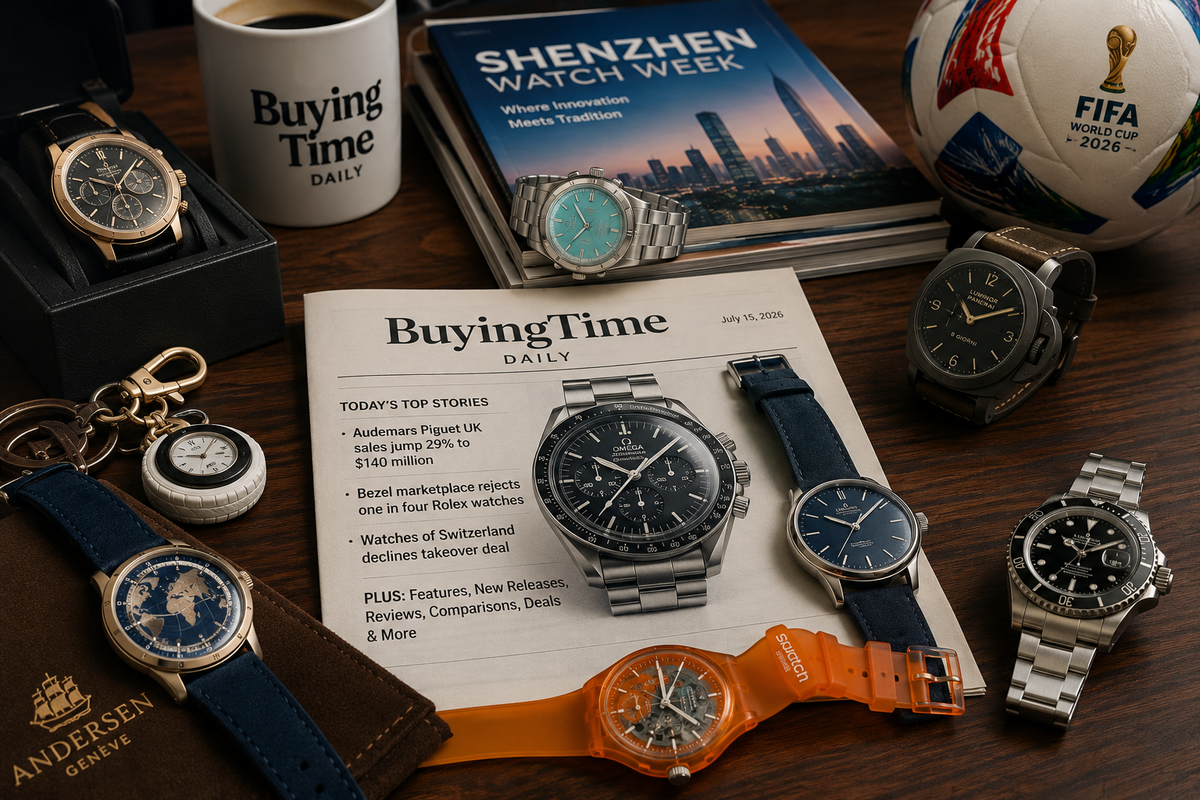
The luxury watch business has always depended on confidence. We like to imagine that it depends on craftsmanship, history, finishing techniques or beautifully decorated movements, and certainly those things matter. But underneath every transaction sits something much more fragile: trust. The buyer has to trust the brand, trust the retailer, trust the watchmaker, trust the service network and, increasingly, trust that the watch itself is exactly what everyone claims it to be.
Today’s headlines all point toward that single reality.
Consider Audemars Piguet’s remarkable expansion in the United Kingdom. The headline is the impressive 29 percent increase in sales, but the more interesting number may be the dramatic increase in investment. Property, plant and equipment assets rose from £2.8 million to £17.6 million as the company opened AP House Manchester, expanded in Mayfair and assumed greater control over its own retail destiny. Luxury brands no longer want to rent relationships with customers. They want to own them from beginning to end.
That strategy is not simply about selling more Royal Oaks. It is about controlling every touchpoint where confidence is created. The lighting, the furniture, the welcome, the sales conversation, the after-sales service and even the emotional atmosphere surrounding the purchase are increasingly viewed as parts of the product. The watch may leave the boutique on the customer’s wrist, but the experience is what the brand hopes will bring that customer back.
At the same time, Watches of Switzerland demonstrated another kind of confidence by rejecting a takeover proposal. A company does not walk away from acquisition interest unless management believes its own future is worth more than someone else’s offer. Revenue climbed 11 percent to £1.8 billion, profit before tax rose 76 percent and the company’s share price has advanced substantially this year. Those numbers gave Watches of Switzerland the freedom to say no.
Instead of selling, the retailer is doubling down on showroom expansion, e-commerce, strategic acquisitions, pre-owned watches and the continued development of its American business. Physical retail, once pronounced endangered by e-commerce evangelists, continues proving that luxury remains a remarkably human business. People may research watches online, compare prices on their phones and watch dozens of reviews before leaving home, but when the purchase becomes serious, many still want a real conversation across a real counter.
That human element is especially important when the watch is not coming directly from the manufacturer. Which brings us to perhaps today’s most revealing story: Bezel’s authentication statistics for Rolex watches. Rolex represents 28 percent of the platform’s sales, yet approximately 38 percent of the Rolex watches it inspects are rejected. Some are counterfeit. Others contain incorrect or mismatched components. Some are misdescribed, improperly documented or identified as stolen.
That is an extraordinary rejection rate for the most recognized luxury watch brand in the world. It also explains why authentication has quietly become one of the industry’s most valuable products, even though nobody actually buys it as a separate object. Buyers purchase the confidence that comes with it.
Ironically, this makes the modern secondary market resemble banking more than conventional retail. Buyers are not merely purchasing watches anymore; they are purchasing verification. Every inspection, movement check, serial-number search, database comparison and accessories review adds another layer of reassurance. Authentication has become an invisible luxury complication all by itself.
The attraction of Rolex also amplifies the danger. Because demand is enormous and the designs evolve gradually, counterfeiters and unscrupulous sellers have a large market and a familiar visual template to exploit. A watch may appear correct in photographs while concealing replacement components, altered movements or provenance problems that only emerge during a thorough physical examination. The more liquid the watch, the greater the incentive to manipulate it.
This is why the secondary market’s next competitive battle may not be fought primarily over price. It may be fought over credibility. The platforms that win will be those able to convince buyers that every watch has passed through a process more rigorous than the customer could reasonably perform alone. Speed matters. Selection matters. Pricing matters. But none of those things matter very much after a buyer discovers that a supposedly authentic watch is not what it appeared to be.
Today’s stories also expose an important distinction between scarcity and certainty. The watch industry has spent years manufacturing scarcity through waiting lists, limited editions, boutique exclusives and constrained allocations. Scarcity creates desire, but certainty completes the transaction. A buyer may desperately want a watch, but desire evaporates quickly when questions arise about authenticity, condition, ownership history or future service.
That may ultimately reshape the industry’s competitive landscape. The brands will continue making beautiful watches. Independent retailers will continue building elegant boutiques. Marketplaces will continue racing to list more inventory. But the companies that create the greatest value over the next decade may simply be the ones customers believe the most.
Luxury has always been about aspiration. Increasingly, it is becoming about certainty.
And certainty, unlike steel or gold, has become one of the rarest materials in the business.
-Michael Wolf