Time Graphing Today’s Watch Universe - July 14, 2026
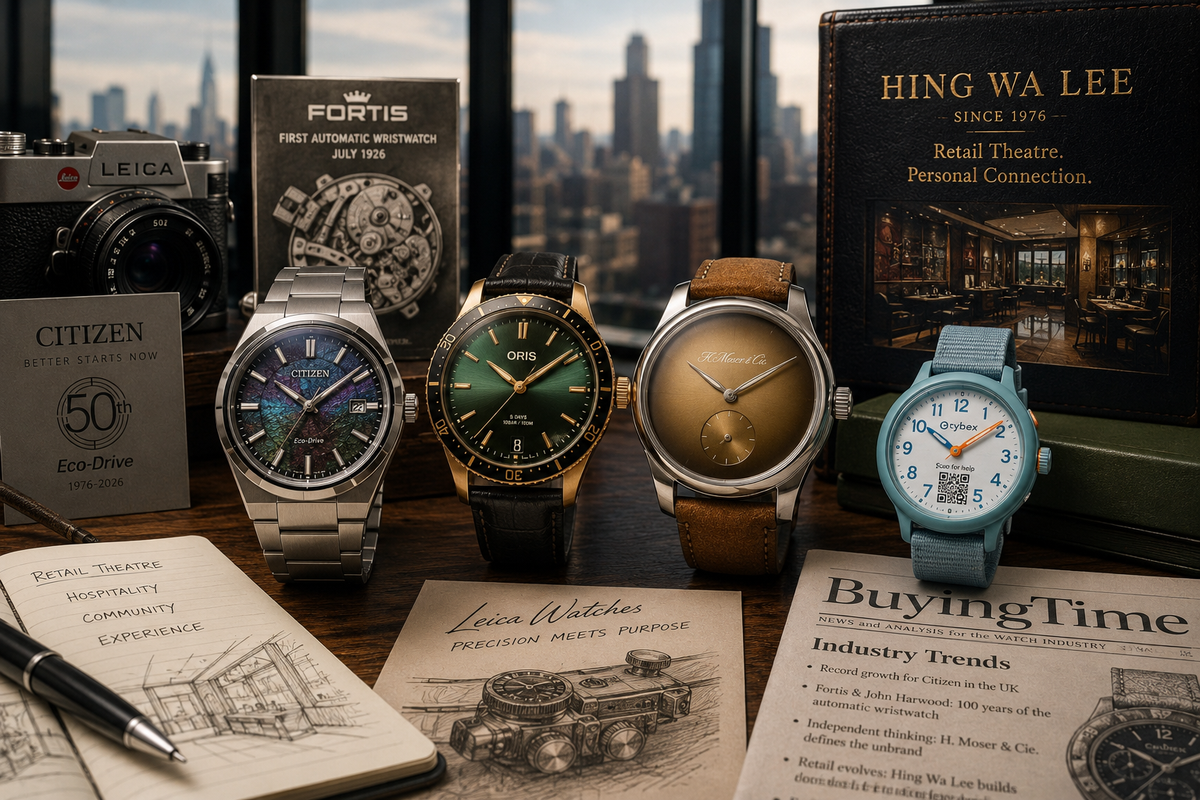
There are days when the watch industry appears to be moving in several directions at once. Today is one of those days. Citizen is celebrating record sales in the United Kingdom, Fortis is looking back to the invention that made mechanical watches easier to live with, H. Moser & Cie. is explaining why it prefers to behave like an anti-brand, and retailers are investing heavily in stores that increasingly resemble hospitality businesses. At the same time, watchmakers continue to argue over what complications are worth, whether a tourbillon still means anything, and how much history can reasonably be added to the price of a watch before the customer notices.
The most commercially important story may be Citizen’s record year in the United Kingdom. An 8% increase in turnover and an 11% rise in operating profit would be respectable in any market, but they are especially notable at a moment when much of the Swiss watch industry is discussing declining exports, excess inventory and nervous consumers. Citizen’s success is not being driven by one isolated product. The company has built a portfolio that stretches from accessible Citizen models to Bulova, Frederique Constant, Alpina and Accutron, giving it the ability to participate across multiple price levels without pretending that every customer is searching for a six-figure complication.
That broader portfolio strategy also helps explain why Citizen can celebrate the 50th anniversary of Eco-Drive without treating the technology like a museum exhibit. Eco-Drive remains commercially relevant because it solved a real problem: batteries run out, mechanical watches stop, and most consumers do not want ownership to become a maintenance hobby. The new Photon anniversary watch is more visually ambitious than the average solar-powered Citizen, but the underlying proposition remains simple. Light enters the watch, the watch continues running, and the owner can get on with something else.
That practical approach has deep historical roots. The story of Fortis, John Harwood and the first commercially viable automatic wristwatch is a reminder that some of the industry’s greatest innovations began as attempts to remove inconvenience. Harwood’s bumper winding system was not created because collectors needed another complication to discuss over dinner. It was created because wristwatches needed to become more reliable and easier to use. Fortis turned the idea into a manufacturable product in 1926, and the rest of the industry spent the following decades refining the concept until automatic winding became nearly invisible to the customer.
That may be the most important measure of successful watchmaking: the best technology often disappears into everyday use. Few owners think about the rotor moving while they walk, just as few Citizen owners think about photons charging a capacitor. The mechanism becomes valuable precisely because it no longer demands attention.
Of course, not every modern watch company is trying to disappear. H. Moser & Cie. has built its identity around being an “unbrand”, which is a wonderfully watch-industry way of saying it has constructed a highly recognizable brand around rejecting conventional branding. The joke works because Moser has the watchmaking credibility to support it. The company can release a concept dial without a logo, make fun of the Swiss industry, build a watch inspired by a sneaker, and still return to serious movements, dual hairsprings and complicated in-house engineering.
Moser’s strategy also reflects a broader shift among independent brands. Collectors no longer respond only to technical specifications. They want personality, access and a sense that the company is being run by people rather than a committee. That freedom can produce brilliance, nonsense or both, sometimes in the same watch. Moser understands that being polarizing is not necessarily a problem when production is limited and the intended customer is already tired of conventional luxury.
Retailers are reaching a similar conclusion. The interview with Hing Wa Lee’s chief executive about retail theater and future stores shows how far the luxury showroom has moved from the glass-counter model. Lounges, bars, personal collections, hospitality spaces and carefully staged environments are no longer secondary details. They are the product around the product.
That makes sense when nearly every watch can be researched online before a customer enters the store. The retailer is no longer simply providing information or inventory. It is providing reassurance, belonging and an experience sufficiently pleasant to make spending a large amount of money feel less like a transaction. Hing Wa Lee’s advantage is that it owns its real estate and remains independent, allowing it to design spaces around customers rather than around the operational standards of a global retail group.
The same search for credibility is shaping Leica’s expansion into watchmaking. Leica has the heritage, engineering reputation and design language to make the move plausible, but the company also understands that camera fame does not automatically create watchmaking legitimacy. Its watches borrow ideas from photography without becoming novelty products, using push crowns, power-reserve displays and mechanical details that feel related to camera operation rather than decorated with camera logos.
Leica’s challenge will be patience. Watch collectors can be surprisingly forgiving of a new independent brand and surprisingly suspicious of an established company entering from another luxury category. The watches have to prove that they are more than branded accessories. Leica appears willing to make that investment slowly, increasing its own contribution to production while resisting the temptation to claim that every component must eventually be manufactured in-house.
The industry’s continuing obsession with in-house production becomes especially relevant when tourbillons enter the conversation. The complete history of the multi-axis tourbillon is a reminder that the complication can still represent extraordinary engineering. From Anthony Randall and Richard Good to Thomas Prescher, Greubel Forsey and the many watchmakers who followed, the multi-axis tourbillon has become a field of experimentation in geometry, energy management and kinetic architecture.
But that history also sharpens the criticism in the argument against paying $25,000 for an unmodified third-party tourbillon. A tourbillon is no longer automatically evidence of technical achievement by the brand whose name appears on the dial. The complication has been industrialized, outsourced and democratized. That is not inherently bad. Affordable tourbillons can be fascinating watches. The problem begins when a company buys an available movement, places it in a case and prices the result as though it has reinvented gravity.
The customer now has to distinguish between complication and contribution. What did the brand actually design, engineer, finish or improve? A third-party movement can be entirely respectable, just as an in-house movement can be unreliable and expensive to service. The meaningful question is whether the asking price reflects what the company added.
That question hangs over much of today’s watch market. Rolex prices have doubled in real terms over the past 50 years. Gem-set independents now cost as much as houses. Retailers are building destination stores because the watches alone may no longer be enough to close the sale. Brands are selling history, hospitality, technical storytelling, cultural relevance and increasingly elaborate explanations of value.
Meanwhile, the most enduring innovations remain the ones that made watches simpler to own. Harwood found a way to eliminate daily winding. Citizen found a way to eliminate routine battery changes. Children’s watches from Cybex now add a scannable emergency contact system to the wrist. These ideas may be less theatrical than a rotating multi-axis tourbillon, but they solve recognizable problems.
The watch industry will always need fantasy. No one requires a gem-set astronomical watch that calculates sunrise and sunset for a specific location, and that is part of its appeal. But fantasy works best when it is supported by clarity. Customers can accept that a watch is irrational. They become less comfortable when the pricing is irrational and the explanation pretends otherwise.
Today’s stories show an industry trying to balance both sides. Citizen is winning through scale, technology and a broad portfolio. Fortis is preserving the memory of a practical invention. Moser is turning irreverence into identity. Hing Wa Lee is making the store part of the luxury. Leica is attempting to earn legitimacy one watch at a time. And tourbillon makers are discovering that once a complication becomes widely available, the real scarcity is no longer the mechanism. It is originality.
-Michael Wolf